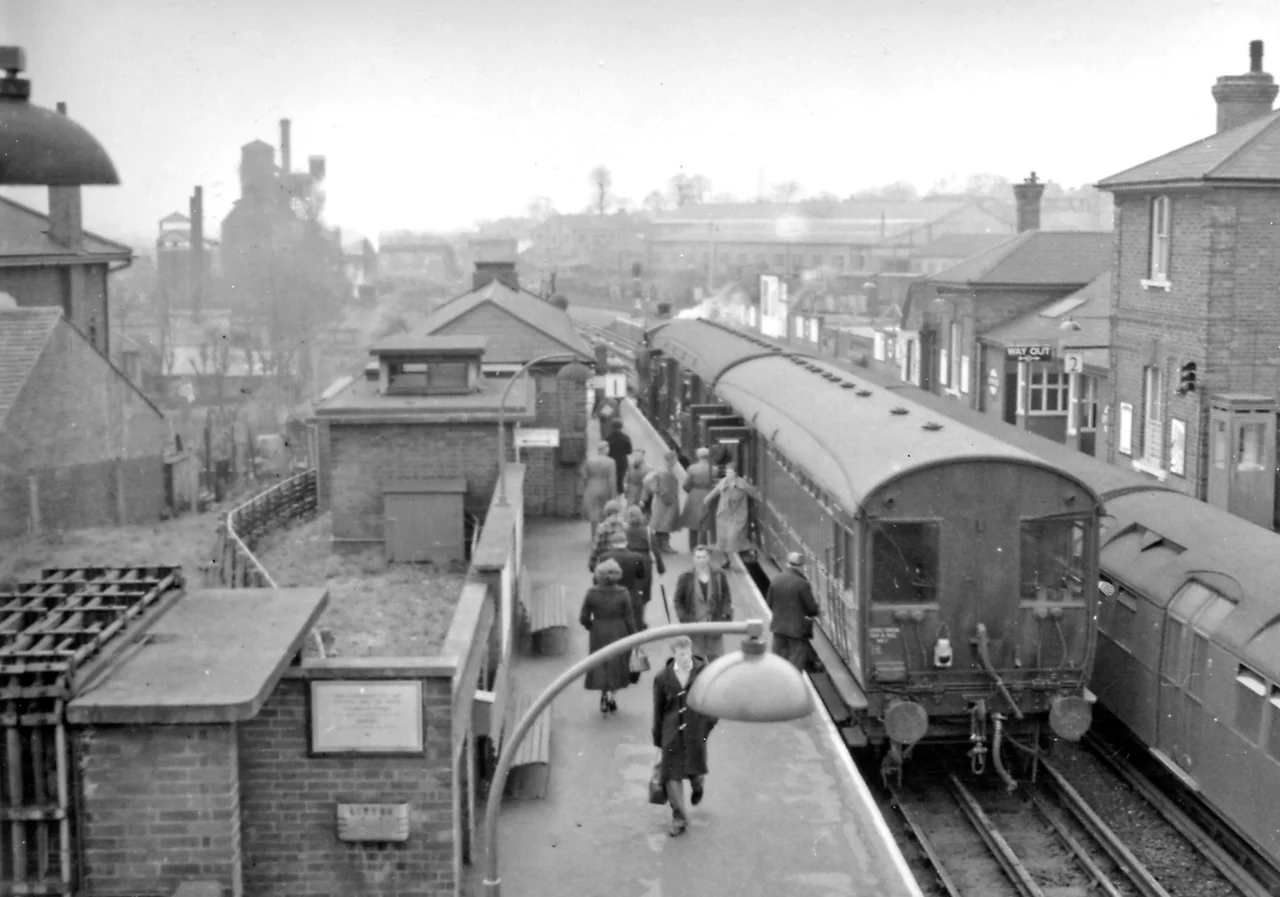

Central line (London Underground)
In 1943, the United States Army Transportation Corps assembled rolling stock in a Tube depot in east London. The trains weren't for the Underground. They were Sherman tank carriers, locomotives, and freight wagons bound for D-Day. The depot was at Hainault, on the Central line's far eastern branch - one of two Underground depots completed in 1939 just in time for the war. The other, at Ruislip, was making anti-aircraft guns. The Tube line that today crawls between Ealing Broadway and Epping, packed with commuters, has more secret history under its tracks than the brochures suggest. It opened in 1900 as the Central London Railway, gained the nickname "twopenny tube" because of its flat fare, and grew over a century into a 46-mile artery threading east-west through the city. By 2013 it was running 35 trains an hour in the morning peak - the most intensive train service in the United Kingdom. The Central line still does the hardest work in London, every weekday, on rolling stock that turned 33 in 2025.
Locomotives That Shook the Buildings
When the Central London Railway opened in 1900, it used electric locomotives hauling carriages with gated lattice ends - passengers boarded through them as if into Victorian railway compartments. The locomotives had heavy unsprung masses, and the vibrations they sent into the tube tunnels could be felt in the buildings above the route. The Board of Trade investigated. By 1903 the carriages had been adapted to run as trailers, formed with new motor cars into electric multiple units - the configuration that defined every Tube train for the next century. The trains were rebuilt again in 1925-28 to replace the gated ends with air-operated doors, which let the railway reduce the number of guards on each train from one per car to two per train. The last of those original 1903 carriages didn't leave service until 1939, the year the war started, by which time they had been running for thirty-six years on tracks that had been continuously upgraded around them.
Underground at War
The 1939 depots at Ruislip and Hainault both went into war work almost immediately. Ruislip's deep cover and existing rail connections made it ideal for assembly of complex weapons; anti-aircraft guns were built there throughout the war. Hainault was handed to the U.S. Army Transportation Corps in 1943, who used it to assemble American-built railway equipment for the Allied invasion of Europe. Civilian passenger service continued during this period, but on cut-back timetables and with some of the older trains stored uncovered in sidings and yards - exposed to the British weather for years. By the end of the war those trains were worn out. A scheme to refurbish them never quite caught up. When new 1959 Stock began arriving on the Piccadilly line, the order was diverted to the Central, and the Piccadilly got new 1962 Stock instead. The Central line's last pre-war Standard Stock train ran in 1963. The 1962 Stock then ran for thirty years.
Epping, Ongar, and the End of the Line
For most of the twentieth century, the Central line's eastern extremity wasn't really part of the Tube at all. The single-track section from Epping to Ongar - five miles of rural Essex through North Weald and Blake Hall - was taken over from the Great Eastern Railway in 1949 but not electrified until 1957. Until then, it operated with an autotrain: a steam locomotive coupled to passenger carriages with cab controls at both ends, hired from British Railways. For a brief experimental period in 1952, an AEC three-car diesel multiple unit ran weekday shuttles. When electrification finally came, four-car sets of 1962 Stock specially modified for the limited current took over the shuttle. Blake Hall station closed in 1981 with one of the lowest passenger counts on the entire Underground. The full Epping-Ongar branch closed in 1994, but the tracks survive: today they carry the Epping Ongar Railway, a heritage operation running restored steam and diesel trains on Sundays. The Tube map ends at Epping. Beyond it, the line dissolves into something older.
The Trains That Won't Retire
The 1992 Stock entered service in 1993 and was supposed to be retired around 2023. It is still running. The Central Line Improvement Programme, an attempt to refurbish all the 1992 Stock and upgrade signalling for higher frequencies, has consumed over £160 million of an original £500 million budget. By early 2025, only one refurbished train was actually in service, with three more expected by the end of that year. An expert quoted by London commentators suggested that in retrospect it would have been cheaper to buy new trains. Transport for London admitted the 1992 Stock was significantly less reliable than newer rolling stock; the same trains run on the Waterloo & City line, with the same problems. New trains are coming - eventually. The Piccadilly line will get them first, in the 2030s, and only then will the Central queue start moving. The line that once ran the most intensive train service in the UK now waits its turn for the trains that should already have arrived.
From the Air
From above, the Central line is almost entirely invisible. The deep-level tunnels through central London leave no surface trace. The eastern surface section between Stratford and Epping cuts across the green belt as a clear corridor of double track, with stations marked by their distinctive 1930s art deco architecture - North Acton, Hanger Lane, Perivale at the western end, Newbury Park and Hainault at the eastern. The western branches surface near White City and run aboveground through Ealing Broadway, West Ruislip, and the long northwest reach into Hillingdon. The depot at Hainault, where the Americans once assembled D-Day equipment, sits at 51.6017 N, 0.0978 E and is visible as a fan of sidings off the main line. Flying west to east at moderate altitude across London, the Central line's path through the inner city can only be read by surface clues - a station entrance here, a ventilation shaft there - but its endpoints stand out clearly at either edge of the urban sprawl.
From the Air
The Central line runs east-west across London, totaling about 46 miles. Geographic centroid near 51.5697 N, 0.4372 W in Greenford. Best viewed at 2,000-3,000 feet AGL flying east-west over inner London. Nearest airports: London Heathrow (EGLL) 5 nm south of West Ruislip; RAF Northolt (EGWU) directly north of the line near South Ruislip. London City Airport (EGLC) lies south of Stratford on the eastern side. The deep-level central section is invisible from the air; the surface branches at either end are clearly visible as double-track corridors.
Nearby Stories
- Woking Palace 2.7 km away
- Wanstead Roman Villa 3.9 km away
- River Lea 7.6 km away
- Waytemore Castle 11 km away
- Sevenoaks 14 km away
- Abingdon-on-Thames 18 km away
- Death of Harry Dunn 19 km away
- Highclere Castle 21 km away