
Wanstead Roman Villa
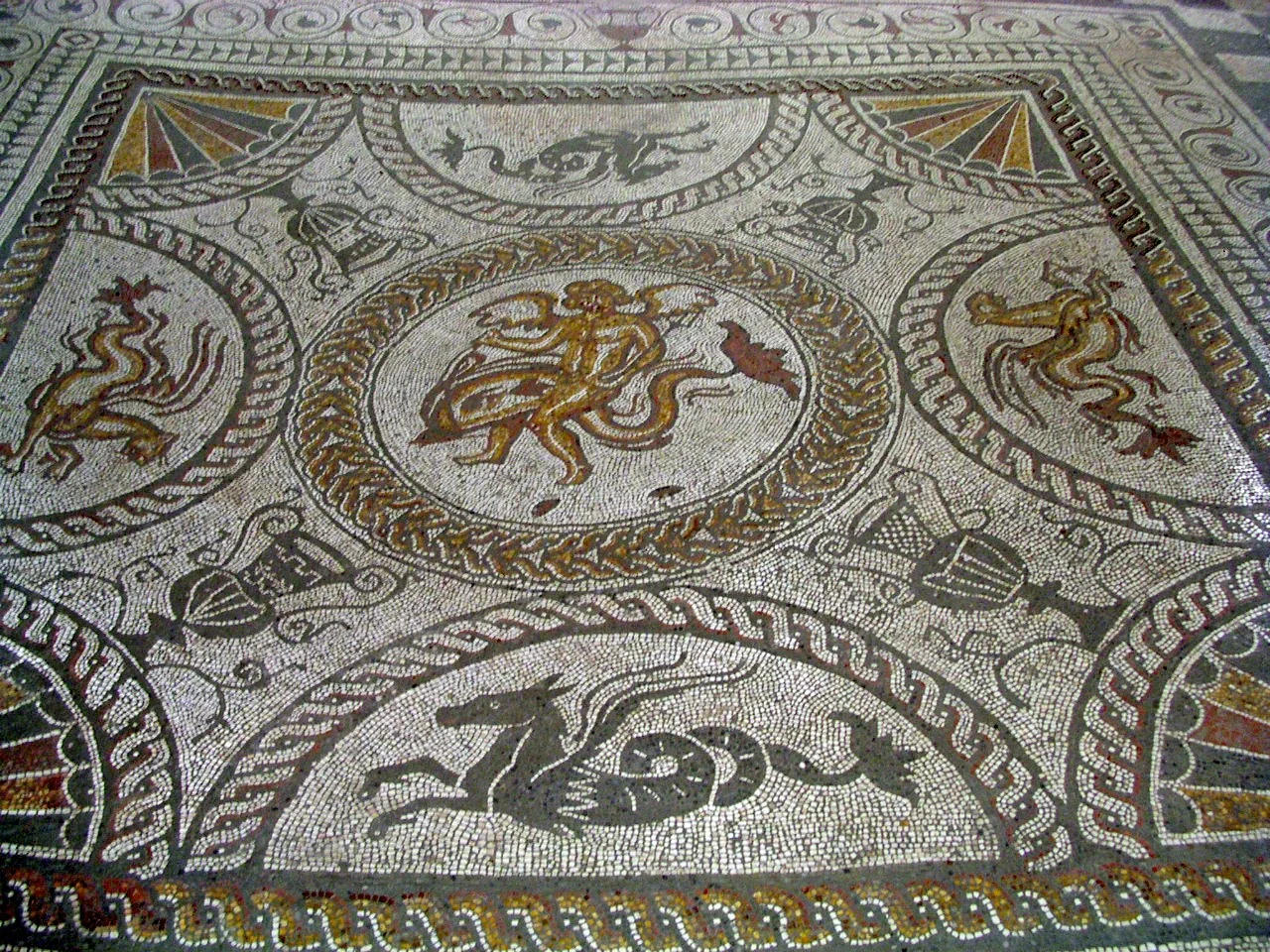
In 1715 a man named Adam Holt was digging holes for an avenue of trees in the grounds of Wanstead House, a great Palladian pile a few miles east of London. He had reached this particular gentle gravelly rise, sloping south, when his spade turned up something that did not belong - small squared brick pieces in black and white and red. Tesserae. Roman mosaic tiles. He stopped, stared, and tried to convince his employer Sir Richard Child to let him excavate properly. Permission was refused. The avenue had to be planted on schedule. Holt examined what he could in haste - the pavement was about twenty feet north to south and sixteen east to west, with a foot-wide border, and in the centre the figure of a man riding upon some beast and holding something in his hand. Then the tree-planting holes went straight through it. Within days the mosaic was gone.
Empire on the Marshes
When the Romans landed in Britain in June 43 CE - a force of 45,000 men under generals including the future Emperor Vespasian - they fought a two-day battle against an army of 150,000 Britons at the River Medway, then crossed the Thames and pushed inland. The local tribes around what is now Wanstead were the Trinobantes and the Catuvellauni, the latter the largest in Britain, with their capital at Camulodunum (Colchester). After the conquest, the Romans built the great road from Londinium to Camulodunum - Roman Road 3 in Ivan Margary's later classification - and a network of secondary roads radiating across the eastern flatlands. One of those roads, RR30, ran from Old Ford at Bow-Stratford through Wanstead and Chigwell on to Great Dunmow. An ancient agger - the raised embankment that marks a Roman road - can still be traced today in the woods at the junction of Blake Hall Road and Bush Road, exactly where it should be. Romans lived here. Romans died here. Romans buried their dead in urns of coarse clay and stamped coins with the heads of emperors. The evidence has been turning up in Wanstead Park for three hundred years.
Adam Holt, More Than a Gardener
Adam Holt was christened in 1689 at St Botolph's Aldgate and buried at Wanstead in 1750. He is described in the records as a gardener, which understates him. He was a surveyor, a nurseryman, a canal engineer, a drainage contractor and a leading specialist in the cultivation of auricula primulas. He had worked at Fulham Palace under the great George London, the Bishop of London's gardener, who had himself been influenced by the work of André Le Nôtre at Versailles. Holt's commissions stretched across Essex - garden landscaping at Coopersale House at Epping, canalisation and drainage at multiple country estates. His tree-planting at Wanstead House was part of the early Georgian extension of the grand Stuart tradition of long avenues, ornamental ponds and statuary. It was this very work - digging through ground that had never been turned since the Romans left - that produced the discoveries. Holt seems also to have been involved in the slightly later excavations at Leyton in 1718, where Roman remains turned up under similar circumstances. Both sites were later revisited by the antiquarian Smart Lethieullier.
The Antiquarian and His Letters
Smart Lethieullier (1701-1760), owner of the adjacent Aldersbrook Manor, wrote two letters to the Society of Antiquaries in London that constitute almost everything we know about what Holt found. The first letter, dated 12 July 1735 and addressed to Roger Gale, described the pavement from twenty-year-old memory: situated on the gentle gravelly slope, close by a fine well of bright water that had since been absorbed into a great pond. About 300 yards south of the pavement, Lethieullier remembered, there had been the visible foundations of a Roman building, since destroyed by the same kind of tree-planting that destroyed the mosaic. He found Roman bricks scattered there, some hollowed for what may have been drainage gutters. Lethieullier speculated that this might have been a banqueting house - a luxury room for entertainments - belonging to a Roman villa whose owners had chosen the site for its beauty, its southerly aspect overlooking what is now Shooter's Hill in Kent, and its proximity to both Londinium and the Roman road. "That luxuries of this nature were introduced into Britain will not, I believe, be denied," he wrote. He apologised for going too far with his conjectures.
Coins, Urns, and a Mausoleum
In the summer of 1746, Lord Tilney was making further alterations to the park and his workmen brought Lethieullier word: more discoveries, near the site of the lost pavement. Lethieullier walked over and found fragments of several urns of the coarsest earth, some still holding teeth and calcified bones - the burnt remains of cremation burials - mixed with brick and tile. Among the urns lay a Roman coin bearing the head of Urbs Roma on one side and Romulus and Remus suckling at the wolf on the other. Lethieullier shifted his thinking. Perhaps this had not been a banqueting house but a mausoleum, the burial place of a private Roman family whose villa stood on the higher ground where Wanstead House itself now sat. Later still, a coin of Allectus - the third-century usurper who was killed in 297 CE - turned up at the same site. This was the kind of evidence that mattered: a coin so late in the Roman occupation suggested continuous use, century after century, of a place that had become invisible to the Georgian gardeners now planting avenues through it.
What Lies Beneath the Park
The exact locations of Holt's pavement and Lethieullier's burial site have been lost. Jack Elsden Tuffs did further archaeological work in the 1960s without confirming the precise findspots. In February 2007 a limited ground-penetrating radar survey ran a north-south line through Wanstead Park to a point just north of the refreshment hut, and detected anomalies consistent with the buried foundations of a large masonry building running diagonally across the survey area - at least two rooms visible in the data, of probable Roman date. The Wanstead Roman Villa - if that is what it is - has not been excavated. Excavations carried out in 1985 confirmed Roman presence here from the first century to the fifth, but did not pin down the villa itself. Today the park is grass and woodland and a great pond that is probably the same well Lethieullier remembered from his boyhood. People walk dogs over it. Joggers pass. Below the surface, what remains of Roman Wanstead - a banqueting house, a mausoleum, a working farmstead, all of those - still waits for the archaeology to catch up with the letters.
From the Air
Wanstead Roman Villa lies somewhere within Wanstead Park at approximately 51.57°N, 0.04°E, in what is now the London Borough of Redbridge. The park itself - a large green expanse with multiple ponds and woodland - is highly visible from the air, surrounded by suburban housing and crossed by Blake Hall Road. The North Circular Road passes immediately south. London City Airport (EGLC) is 4 miles south; London Stansted (EGSS) is 22 miles north. Best viewed from 2,000-3,000 feet over the wooded grounds.
Nearby Stories
- Waytemore Castle 2 km away
- Prittlewell Royal Anglo-Saxon Burial 4.2 km away
- Sevenoaks 5.6 km away
- Central line (London Underground) 6.4 km away
- River Lea 9.7 km away
- Surrey 11 km away
- Mercury Theatre, Colchester 14 km away
- Faversham Munitions Explosion Memorial 14 km away