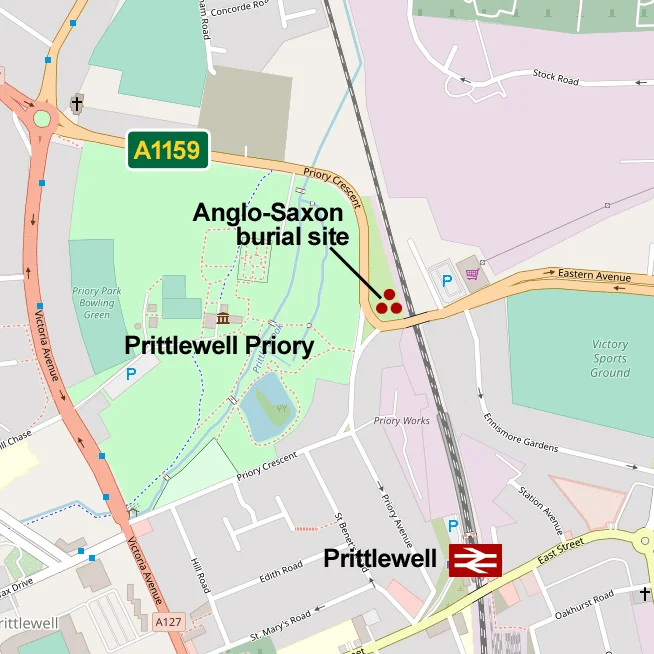

Prittlewell Royal Anglo-Saxon Burial
The acidic Essex sand had dissolved the body completely. Only fragments of tooth enamel survived, too far decayed to yield DNA, and the wooden coffin had collapsed centuries ago into dark stains on the soil. But the grave goods lay exactly as the mourners had arranged them around 580 AD: a sword, a lyre, copper-alloy hanging bowls inlaid with Christian crosses, gold-foil crosses laid where eyes had once been, Merovingian coins from the continent, a folding stool of a kind seen only in royal portraits in early medieval manuscripts. For about fourteen hundred years he lay undisturbed beneath a low mound on the outskirts of what is now Southend-on-Sea, between an A1159 road-widening scheme and an Aldi supermarket, beside a pub the locals had named, without yet knowing why they were right, The Saxon King.
The Most Spectacular Find in Sixty Years
The excavation, conducted by archaeologists from the Museum of London Archaeology Service in 2003, ended on 20 December with the final lift of the chamber's contents - about 110 objects raised over two phases across ten days, some block-lifted in their bed of soil to preserve their relationships. MOLA called it 'the most spectacular discovery of its kind made during the past 60 years.' The press reached for the obvious comparisons: this was Britain's answer to Tutankhamun, found in 1922, and to Sutton Hoo, discovered in 1939. The chamber itself measures four metres square, making it the largest chambered tomb ever found in England. The walls had been timber-lined, the ceiling timber-roofed, the whole structure built like a small underground room for the dead man to inhabit. As the wood rotted, soil gradually filled the space, sealing each object in place. When the archaeologists finally entered, they walked into the precise arrangement his family had left.
The Prince of Prittlewell
Who was he? The question matters because he was a real person, not a curiosity. The current best guess is Sæxa, brother of Sæberht of Essex - one of the kings who governed this corner of England in the generation before St Augustine arrived from Rome with Christianity. The richness of his grave suggests royalty. The two gold-foil crosses placed where his eyes would have rested suggest faith, or perhaps something more complicated. Early interpretations imagined a Christian who was buried by pagans, the crosses placed by believers and the chamber filled with grave goods by mourners who still followed the old ways. More recent thinking, noting how closely the crosses resemble examples from Lombardy, suggests they may have been less about personal conversion and more about connection to the continent - symbols of Romanitas, of belonging to the wider Latin Christian world. He may have been buried with them to claim that prestige, not to confess that faith. Either way, he died around 580. He was probably young. He was certainly loved enough that his community emptied considerable wealth into the earth for him.
Lyre and Sword and Folding Stool
The objects themselves are extraordinary. The lyre, reconstructed from soil impressions and surviving metal fittings, is one of the most complete found anywhere in Britain - and it had been repaired at least once during his lifetime, suggesting it was a treasured instrument rather than a funeral prop. A modern copy was made from yew wood and used to accompany an Old English funeral song sung for King Sæberht at St Mary's Church in Southend. There was a sword. There was a hollow gold belt buckle, plainer than the one from Sutton Hoo's Mound 1 but cut from the same cultural tradition. There were three stave-built tubs bound with iron, an Anglo-Saxon hanging bowl decorated with cruciform applied strips, an object identified as a 'standard.' Most remarkably, there was a folding stool - the only such object ever found in England, of a kind shown in royal portraits in early medieval manuscripts, almost certainly imported. The richness is less sumptuous than Sutton Hoo, but the individual objects are of equal quality.
Camp Bling
After the excavation, Southend Borough Council intended to widen the A1159 road right across the burial site. Local protesters refused. From September 2005 to July 2009, a road protest camp called Camp Bling occupied the area - the name a half-joking reference to the press nickname the occupant had acquired, the 'King of Bling.' (The joke is uncomfortable now; the term reduces a real seventh-century man to a meme, and the popular nickname has never sat entirely well with the archaeology.) In 2009 the council backed down and chose an alternative scheme at nearby Cuckoo Corner. The site was preserved. Channel 4's Time Team made a special episode in 2005. The work won the Developer Funded Archaeology Award in 2006. After years of restoration and carbon dating, the Prittlewell finds went on permanent display in May 2019 at Southend Central Museum, where you can stand a few inches from the gold-foil crosses, the lyre, the folding stool - and from the absence at the centre of all of them, the man whose bones the soil refused to keep.
From the Air
Located at 51.554°N, 0.709°E, just east of Prittlewell Priory in Southend-on-Sea. The burial site itself is now beneath landscaped public ground between the A1159 and the Shenfield-Southend railway line; the artefacts are displayed at Southend Central Museum on Victoria Avenue, about 1 km south. London Southend Airport (EGMC) is approximately 1.3 nm to the east. From altitude, look for the green rectangle of Priory Park - the burial lies just outside its eastern edge.
Nearby Stories
- Port of Ramsgate 0.7 km away
- Faversham Munitions Explosion Memorial 2.6 km away
- St John's Abbey, Colchester 3.7 km away
- Brentwood Cathedral 4.4 km away
- Maunsell Forts 6.7 km away
- Tilty Abbey 6.9 km away
- Shipbourne 9.9 km away
- Broadstairs 26 km away