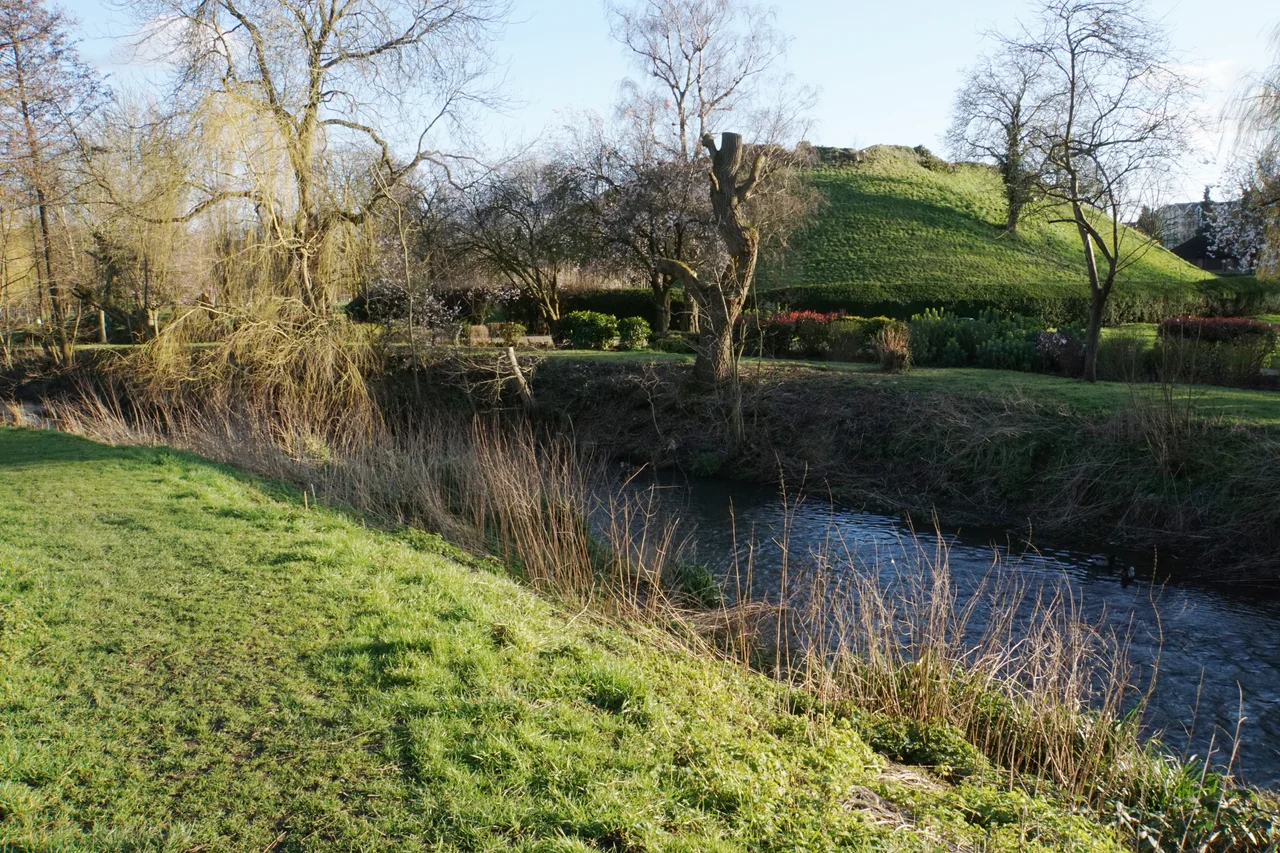

Waytemore Castle
King John fell out with the Pope in 1208 over who should be Archbishop of Canterbury. The Pope responded by placing England under an interdict - no Masses, no marriages, no Christian burials anywhere in the realm. John responded by confiscating the property of the bishops. Most bishops' castles were simply taken. The castle at Bishop's Stortford, owned by the Bishop of London, was different. John ordered it pulled down. Slighted, in the medieval term. The forty-two-foot motte that the Normans had raised beside the River Stort more than a century before sat exposed and ruined while the king fought his churches. The mound is still there. So are the foundations of the keep that King John rebuilt six years later, after he had made peace with Rome.
A Mound Older Than the Castle
The earth mound at Waytemore is older than its Norman castle. Some historians have argued it began as a Celtic burial mound. Others think it was a Saxon burh - a moated, stockaded fortress adapted in the early tenth century by King Edward the Elder as part of his defences against the Danes. The name itself reaches further back. 'Wayte' was long thought to be Saxon for 'a place of ambush.' The historian Jacqueline Cooper has argued more recently that it is a corruption of the Old Norse thwaite - 'forest clearing' - and that 'more' is the Old Norse marr, 'boggy place.' If she is right, the name records a Scandinavian moment in this corner of Hertfordshire, possibly during the Danelaw of the ninth or tenth century. Either way, when the Normans came in 1066, they found a serviceable mound beside a river crossing - exactly the kind of strategic site they collected like postage stamps.
Built in White
The transition from timber to stone happened, by best guess, between 1086 and 1135. The Normans surrounded the mound with a moat. They built a curtain wall of flint and rubble nine feet thick around its summit. Inside the wall they raised a rectangular stone keep, possibly sixty feet high, with three straight sides and a curiously convex north end bonded with reused Roman bricks and medieval tiles. And then they did something interesting: they painted the keep white. Or at least, the surviving evidence suggests they did - a mixture of lime and chalk slapped across the exterior to make the building visible for miles. It was a statement. The point of a Norman keep in 1100 was not just to defend a river crossing but to remind the conquered population, every time they looked up, who was now in charge. A white castle on a mound on the skyline. The Normans were very good at this.
Demolished and Rebuilt
When John quarrelled with Innocent III in 1208 over Stephen Langton's appointment to Canterbury, the Pope placed England and Wales under interdict. John retaliated by seizing church property. Most bishops' castles passed quietly into royal hands. But the Bishop of London's castle at Stortford got the harder treatment. John ordered it slighted - demolished as a fortification - on the principle that a destroyed castle could not be returned to the bishop. By 1212 John was excommunicated personally. By 1213 he had submitted to Rome, made England a papal fief, and started giving things back. In 1214 he rebuilt the keep at Waytemore, presumably as part of that reconciliation. The remnants of wall at the mound's summit today date from that rebuild. The original well still sits in the southwest corner under a large modern steel plate.
The Prison Years
A licence to crenellate - permission to fortify - was granted by Edward III in the mid-fourteenth century, but the castle was already past its military prime. By the seventeenth century it had been slighted a second time, after the English Civil War, when Parliament dismantled many royalist strongholds to prevent their reuse. What remained was put to a quieter purpose: a prison. For more than a hundred years the ruined keep at Waytemore was where the town of Bishop's Stortford kept its debtors and minor offenders. Local historian J. L. Glasscock made a small excavation in 1900 and found only a few Roman coins of the Lower Empire. An 1850 dig had turned up parts of the wall and 'a few human bones,' a detail that took on weight in the late 1990s when a much larger collection of human bones was accidentally uncovered in the grounds. Experts suggested this strongly indicates a medieval hospital once attached to the castle.
The Mound Among the Houses
Today the motte sits in the middle of Bishop's Stortford, a wooded knoll behind Castle Gardens with a footpath spiralling up to a small viewing area on top. The town has grown around it on every side. The River Stort still curves past the western edge, narrower than it was when the Normans positioned the castle to command its crossing. From the summit you can see the parish church of St Michael on the next ridge over, the suburban roofs of Twentieth Century Stortford, and the green strip of the river. The remains are a Grade I listed structure and a scheduled monument. The keep is gone but its footprint is marked. The well is still there under its steel plate. The Roman bricks are still bonded into whatever foundation survives. A thousand years of human life on a small Hertfordshire mound, and most of the people walking past it have no idea.
From the Air
Waytemore Castle sits at 51.872 degrees North, 0.1629 East, in the centre of Bishop's Stortford in eastern Hertfordshire, about 30 miles north of central London. Best viewed at 1,500 to 2,500 feet. The motte is a small wooded mound visible as a darker green spot within Castle Gardens just west of the town centre, with the parish church of St Michael on higher ground to the east. London Stansted (EGSS) lies just 2 nautical miles east-southeast - the airport is the dominant feature of the area. The M11 motorway runs along the western edge of the town.
Nearby Stories
- Cambridge Museum of Technology 2.3 km away
- Hunt family murders 3.5 km away
- St Edmundsbury Cathedral 4.2 km away
- Kelvedon Hatch Secret Nuclear Bunker 5.6 km away
- River Lea 8.4 km away
- Gainsborough's House 11 km away
- Prittlewell Royal Anglo-Saxon Burial 14 km away
- Wellingborough 25 km away