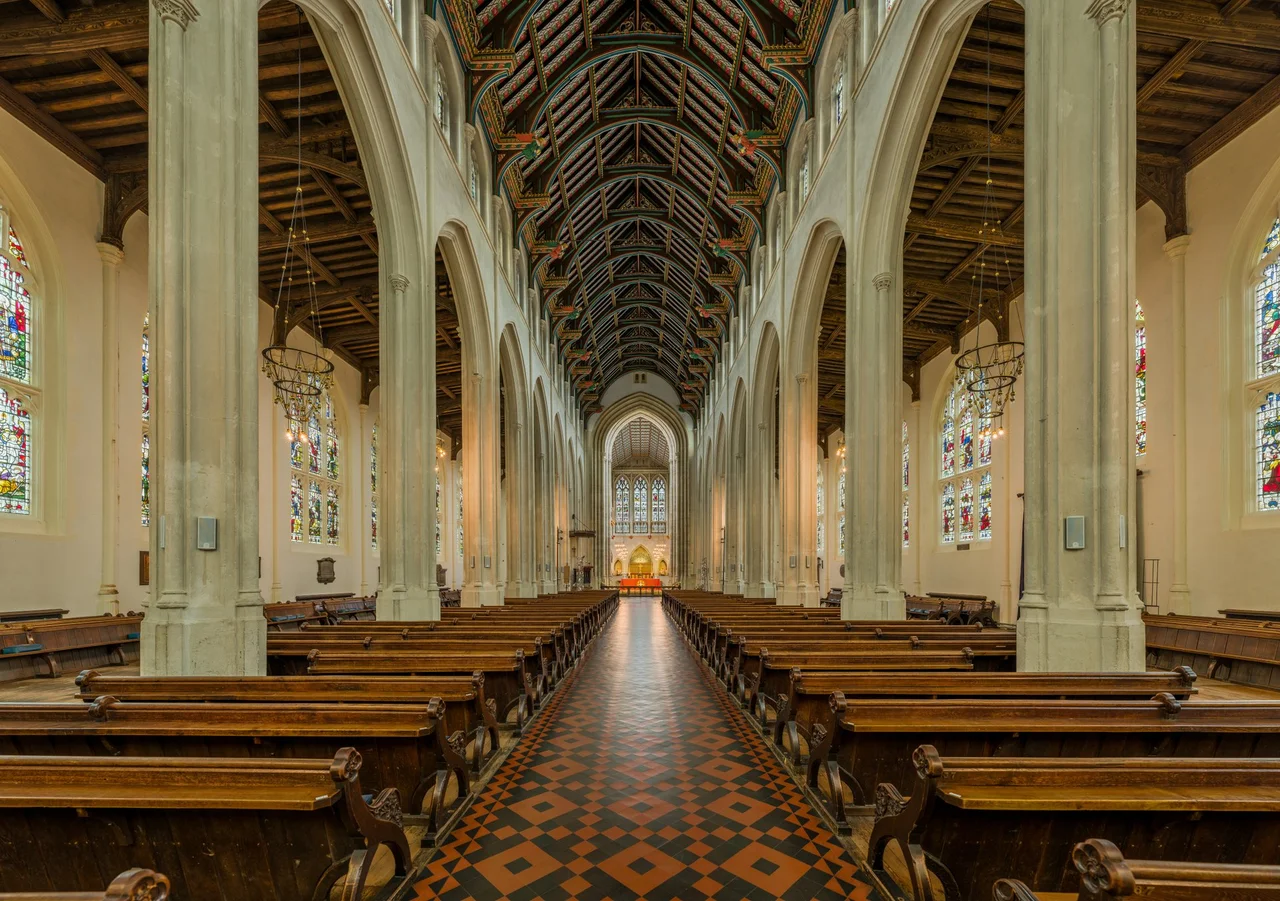

St Edmundsbury Cathedral
The story of St Edmundsbury Cathedral begins with a thwarted pilgrimage. In the early 12th century, the Abbot of Bury St Edmunds, a man named Anselm, wished to walk the Way of St James to Santiago de Compostela in Spain. He was unable to go. Instead he rebuilt the church of St Denis within the abbey precincts and dedicated it to Saint James — a small act of devotion in lieu of the journey he could not make. That church, rebuilt and extended many times since, is now the cathedral of the Diocese of St Edmundsbury and Ipswich.
A Church Inside an Abbey
A church has stood on this site since at least 1065, when St Denis's Church was built within the precincts of Bury St Edmunds Abbey. Anselm's 12th-century rebuilding gave it a dedication to Saint James. Alongside the new church he also built what is now known as the Norman Tower — still standing, still functioning as the cathedral's belfry, unchanged in its four-storey structure since it was built between 1120 and 1148. The church was substantially rebuilt again beginning in 1503, in the Perpendicular style, by John Wastell — a master mason who also worked on the fan vaulting of King's College Chapel in Cambridge. The hammerbeam roof was added later by George Gilbert Scott. For centuries it was simply the parish church for the north side of Bury St Edmunds.
Cathedral Status and the Century of Building
When the Diocese of St Edmundsbury and Ipswich was created in 1914, St James's Church became its cathedral almost by default — there was no purpose-built cathedral, and the medieval church was what existed. The upgrade required physical expansion. From 1959 to 1970, the Victorian chancel was demolished and replaced with a new quire; transepts, a Lady Chapel, and a side chapel dedicated to St Edmund were added; a cloister appeared on the west side. Stephen Dykes Bower served as cathedral architect from 1943 to 1988 and left £2 million for the completion of the project. Benjamin Britten composed his Fanfare for St Edmundsbury in 1959 for a Pageant of Magna Carta held in the cathedral grounds — the only piece of music he wrote for three antiphonal brass groups stationed in different parts of a building.
The Millennium Tower
The most visible addition to the cathedral skyline is the Millennium Tower, completed in 2005. Its profile, rising above the ancient Norman Tower and the medieval town, changed the way Bury St Edmunds looks from across the fields. Inside, the cathedral's collections include the Cathedral Treasures display of historic and religious regalia, a changing programme in the Edmund Gallery, and a painting by Brian Whelan — The Martyrdom of St Edmund — hanging in the Lady Chapel. The font was designed by George Gilbert Scott in 1870 on a medieval shaft, the decoration added in 1960. The Ancient Library, in a room above the northwest porch, was founded by Miles Mosse, who preached here in the late 16th century.
Bells in the Norman Tower
The 12 bells of St Edmundsbury Cathedral hang not in the cathedral's own tower but in the adjacent Norman Tower — the 12th-century gatehouse that has served as the church's belfry since Anselm built it. The original ten bells were cast in 1785 by Thomas Osborn of Downham Market. Two more were added following a public appeal at Easter 2012, and a thirteenth was added in 2013 to allow beginners to practice with a full octave without needing the three heaviest bells. The bells ring on Sundays before morning and evening services, and for weddings and special occasions. They have been ringing from this tower, in one form or another, for close to nine centuries.
From the Air
Located at 52.24°N, 0.72°E in Bury St Edmunds, Suffolk. The cathedral and its Millennium Tower are prominent landmarks visible from significant distance. The adjacent Norman Tower provides a distinctive medieval companion structure. Nearest airports: Norwich Airport (EGSH), approximately 38 miles northeast. Recommended viewing altitude 1,500–2,500 feet. The town's medieval street grid and the abbey ruins to the south provide context.
Nearby Stories
- Wicken Fen 4.5 km away
- Walden Abbey 7.6 km away
- Saxmundham 10 km away
- East Bergholt 11 km away
- RAF North Pickenham 13 km away
- Acle 13 km away
- Maunsell Forts 16 km away
- Wisbech & Fenland Museum 17 km away