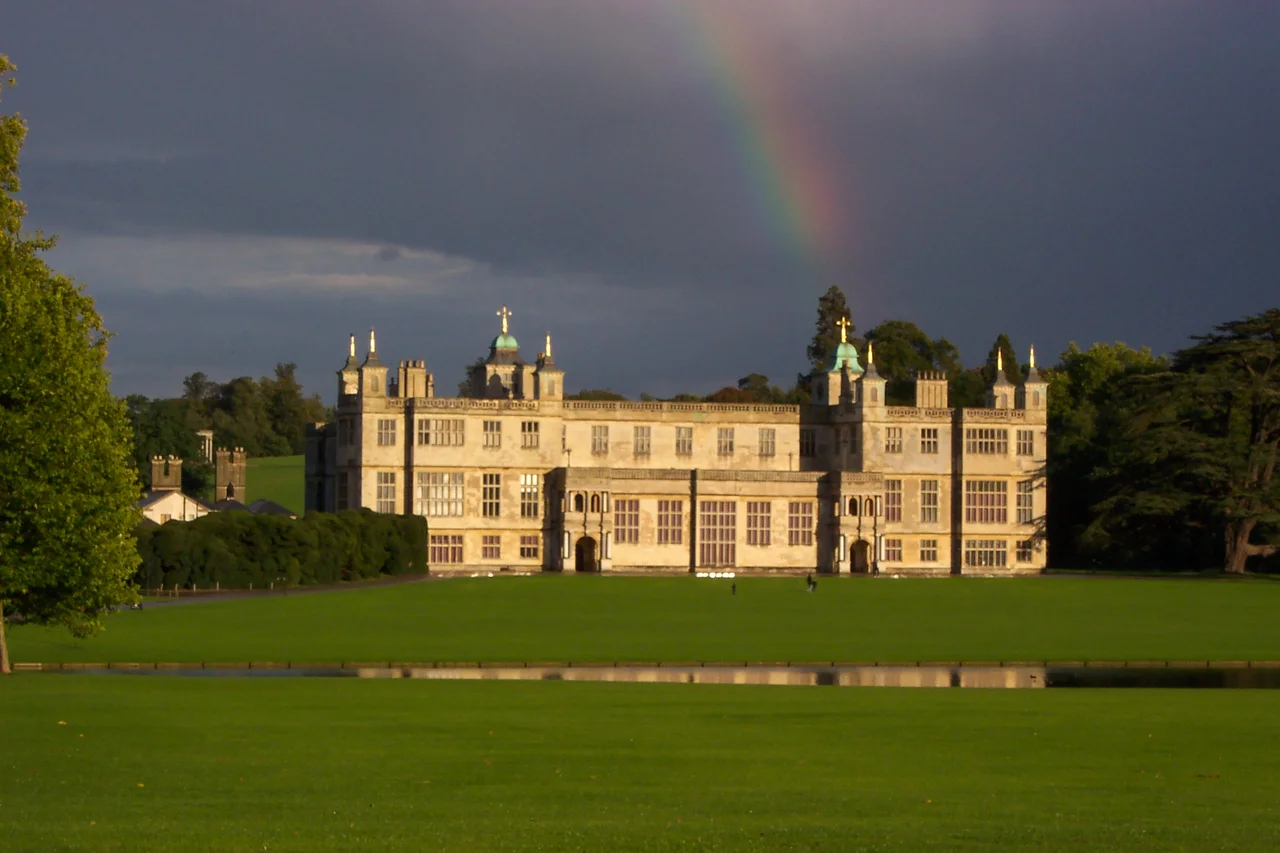

Walden Abbey
Geoffrey de Mandeville, the first Earl of Essex, founded a Benedictine priory at Walden somewhere between 1136 and 1143, then promptly ruined his own foundation by getting himself arrested by King Stephen and excommunicated for rebellion. When he died, his body could not be buried in the priory he had built. The monks struggled on without a patron, eventually became an abbey in 1190, weathered four centuries of medieval politics, and were finally dissolved by Henry VIII in 1538. On their site rose Audley End House - one of the largest Jacobean mansions ever built in England, big enough to be mistaken for a royal palace. Charles II eventually bought it for that purpose.
A Founder in Disgrace
Geoffrey de Mandeville was one of the most powerful magnates of King Stephen's reign - and one of the most slippery. He held lands on both sides of the civil war between Stephen and the Empress Matilda, and he played them with cold competence. Around 1140 he founded a Benedictine priory at Walden, on the edge of his Essex estates, as a fitting act of piety for a man of his rank. Three years later Stephen finally lost patience and arrested him at St Albans, forcing him to surrender his castles. De Mandeville came out of captivity and led a vicious rebellion across the Fens in 1143-1144, attacking monasteries and looting villages, until he was struck by an arrow at Burwell. He died excommunicate. The monks of his own priory could not bury him. The Knights Templar eventually accepted his body and laid it under their preceptory in London.
A Monastery Without a Patron
Without an active founder, Walden Priory struggled. De Mandeville's son, the second Earl of Essex, got the family's lands back under Henry II but did almost nothing for the priory. When he died in 1166 his body was still brought to Walden for burial - over the protests of his mother Rohese de Vere, who wanted him buried at the monastery she had founded at Chicksands. The third Earl was, according to the priory's own chronicle, turned against the house by Countess Rohese's influence. The earldom of Essex passed by marriage in 1189 to Geoffrey fitz Peter, who became patron by inheritance and quarrelled with the monks within a few years. Despite all this, Walden was raised to abbey status in 1190. The Book of the Foundation of Walden, written by an aggrieved member of the community, gives a remarkably candid picture of an institution kept alive by the determination of its own monks rather than the generosity of its patrons.
The Bohun Tombs
By the later Middle Ages the abbey came under the patronage of the Duchy of Lancaster, which gave it stability for the first time. A succession of great noblemen and noblewomen were buried in the abbey church - Humphrey de Bohun, third Earl of Hereford. His wife Joan. Elizabeth of Rhuddlan, daughter of Edward I and Countess of Hereford in her own right. The seventh Earl of Hereford. William de Bohun, first Earl of Northampton. The Bohun connection to Walden ran for generations - this was a family abbey in everything but the early founding. When the duchy passed to the Crown on the accession of Henry IV in 1399, Walden became royal property. It would have been hard to predict, watching the monks chant the office over Elizabeth of Rhuddlan in 1316, that within two and a half centuries the whole institution would simply cease to exist.
The Audley Mansion
Walden Abbey was dissolved in 1538. Sir Thomas Audley - Henry VIII's Lord Chancellor, the man who had presided over the trial of Thomas More - bought the property in 1538 and was given the title Baron Audley of Walden. He died at the new mansion in 1544 and was buried in what had been the abbey church (and was now a chapel of his own house). His daughter Margaret married Thomas Howard, fourth Duke of Norfolk - the man Elizabeth I executed in 1572 for plotting to marry Mary, Queen of Scots. Their grandson, also called Thomas Howard, became the first Earl of Suffolk in 1603. It was this Suffolk - a wealthy courtier under James I - who pulled down Audley's house and built the enormous prodigy mansion that visitors see today. Audley End was finished in 1614 and was, by some measures, the largest house in England, designed deliberately to entertain the King.
Charles II's White Elephant
Audley End was so huge that Charles II actually bought it from the Suffolks in 1666 for use as a royal palace - convenient for the Newmarket races. The Crown later sold it back, no monarch having quite wanted to live in something quite so big or so expensive to maintain. Successive demolitions in the eighteenth century - some by the architect Sir John Vanbrugh, more by Robert Adam under the third Earl of Suffolk - took the house down to roughly two-thirds of its original footprint. The abbey itself is long gone; only earthworks remain in the parkland between the house and the River Cam, marking the cloister and the great church where the Bohuns lie. The Howard Vault under the chapel still holds successive Earls of Suffolk. Audley End House is now in English Heritage's care. The abbey under the lawn waits, undisturbed.
From the Air
Walden Abbey lies at 52.0224 degrees North, 0.2412 East, on the grounds of Audley End House just west of the town of Saffron Walden in northwest Essex. Best viewed at 1,500 to 3,000 feet. From the air, Audley End is unmistakable - a large E-shaped Jacobean mansion in white Ketton stone, set in green parkland with formal gardens and the River Cam winding through. The abbey site itself is now lawn between house and river. London Stansted (EGSS) lies about 11 nautical miles south; Cambridge (EGSC) sits 12 nm north-northwest. The M11 runs about 2 miles east of the property.
Nearby Stories
- Cambridge Museum of Technology 2.3 km away
- Hunt family murders 3.5 km away
- St Edmundsbury Cathedral 4.2 km away
- Kelvedon Hatch Secret Nuclear Bunker 5.6 km away
- River Lea 8.4 km away
- Gainsborough's House 11 km away
- Prittlewell Royal Anglo-Saxon Burial 14 km away
- Wellingborough 25 km away