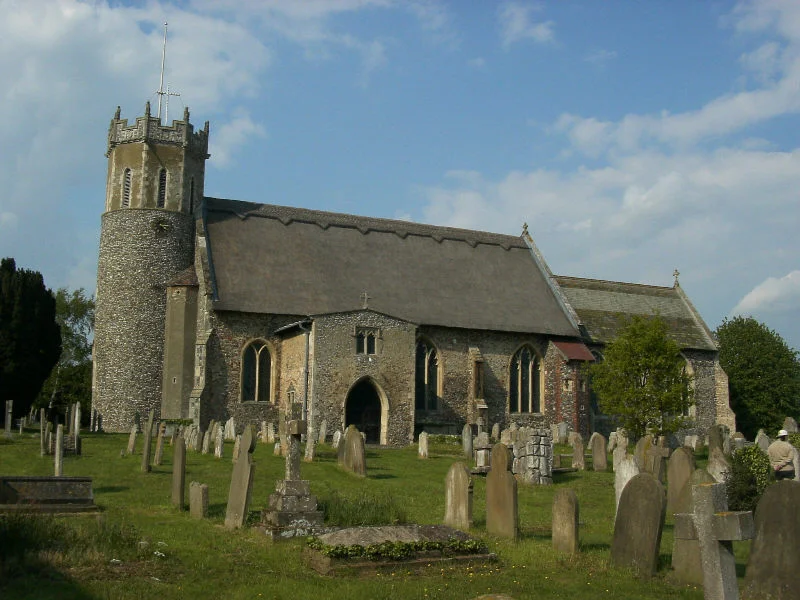

Acle
The name is a confession. Acle means 'oaks lea' in Old English - a clearing in an oak forest - and in Tudor times that forest was felled to build Elizabeth I's warships. Hundreds of oaks went south to the shipwrights and never returned. The town that remains sits in the clearing they left behind, halfway between Norwich and Great Yarmouth, holding the only bridge across the River Bure for miles in either direction.
Port at the Head of an Estuary
In Roman times Acle was a port. The whole landscape around it was different then - a wide tidal estuary called Gariensis reached deep inland, and Acle stood at its head, where the high ground met the water. The estuary silted up over centuries, the coastline shifted east, and Acle slowly became what it is now: a market town several miles from any sea, with a boatyard on the Bure and walks along old riverbanks. The Domesday Book recorded the village in 1086. In 1253 it received its market charter. The cattle and produce markets ran for more than seven centuries before fading away in the 1970s.
The Turbary Right
In 1382 Acle won a right that defined Broads life for the next five hundred years: turbary, the right to dig peat. The peat workings in this part of Norfolk were so extensive that when they flooded centuries later they became the Broads themselves - the network of shallow lakes and waterways that now define the landscape. Acle still has a boatyard and Boat Dyke, gateways into a watery world that medieval villagers helped create one shovelful at a time. A foundry built in 1892 specialised in windpumps for draining the marshes; it built the last windpump ever raised for the Broads, at Ash Tree Farm.
St Edmund's Round Tower
The Church of St Edmund stands on the village edge with one of Norfolk's 124 surviving round-tower churches rising from its corner. The round stage at the base is Saxon, dated somewhere between 850 and 950 AD - a thousand years and more of weather and prayer have not toppled it. An octagonal stage was added in the 13th century. The battlements are from 1472. Six bells hang in the tower; five of them were cast in Norwich in 1623 and still ring, supported now by a metal frame to take the strain. Step inside and the nave reveals its Norman bones: walls of the right thickness, a 1410 stone font, traces of a serpent painted on the rood staircase. A 15th-century wooden screen separates nave from chancel - probably not made for Acle at all, but brought here from St Benet's Abbey or the priory at Weybridge after their dissolution.
The Damgate Kingfisher
Since the turn of the century, volunteers have built a walkway running from the railway station to Boat Dyke, threading through the kind of indigenous flora most villages have lost. They call it Damgate. Walkers report a kingfisher there - locally known as Henry - who is said to fly under the abandoned railway bridge in the middle of the afternoon. Whether Henry is one bird or several, whether the legend persists by sightings or by hope, the kingfisher has become a small Acle institution. The Acle Straight, the notoriously narrow turnpike from Acle to Great Yarmouth, opened in 1831 and remains undualed - a campaign for change continues. The Bure flows past, the Broads spread out around, and Acle stays in its clearing, somewhere between the Tudor warships and the kingfisher.
From the Air
Acle sits at 52.638 N, 1.555 E in the heart of the Norfolk Broads, roughly halfway between Norwich and Great Yarmouth on the River Bure. From altitude the village appears as a clearing in the flat fenland landscape, with the A47 bypass curving around it and Boat Dyke visible heading north to the river. Norwich Airport (EGSH) is about 10 nm west, London Stansted (EGSS) approximately 75 nm southwest. Best viewed at 1,500-2,500 feet on routes between Norwich and the coast.
Nearby Stories
- Redgrave and Lopham Fens 2.7 km away
- Cley next the Sea 4.8 km away
- East Dereham Windmill 7.1 km away
- Dunwich 12 km away
- Cromer Lighthouse 18 km away
- Battle of Lowestoft 58 km away
- Southern Bight 62 km away
- SM U-97 90 km away