
RAF Wittering
On 15 May 1957, a Vickers Valiant XD818 took off from RAF Wittering and flew six and a half thousand miles to Malden Island in the Pacific, where it dropped Britain's first thermonuclear device over the Pacific on Operation Grapple. Both the aircraft and the bomb had been refined and prepared on this Cambridgeshire airfield, a place that had begun its life forty-one years earlier as a wooden hangar belonging to a Royal Flying Corps squadron hunting German Zeppelins. By the late 1960s the same runways were the base of the world's first operational vertical-take-off jet fighter. RAF Wittering's history runs in a single line through three quarters of British air power.
The Zeppelin Years
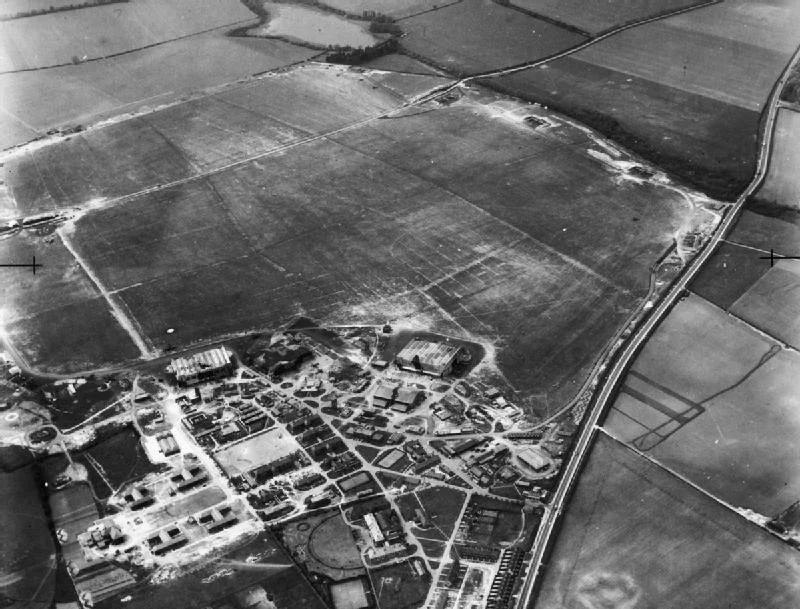
Wittering opened on 5 May 1916 as RFC Stamford, home to A Flight of No. 38 (Home Defence) Squadron. The job was anti-Zeppelin patrol: night-flying frail biplanes (BE2cs, RE7s, FE2bs) over the East Midlands to engage the German airships then conducting Britain's first strategic bombing campaign against civilian cities. The pilots trained by day and flew at night. The aerodrome's role expanded in 1917 when it became No. 1 Training Depot Station, paired with its neighbour at Easton on the Hill which became No. 5. Between the wars the Central Flying School moved here from 1926 to 1935, training the flying instructors who would later train the men who flew the Battle of Britain. The infrastructure laid down then (three Type C hangars, an officers' mess, a sector control room) still shapes the station today.
Pathfinders and the Long Runway
Wittering was a Fighter Command station throughout the Battle of Britain and the Blitz, part of No. 12 Group operating from RAF Watnall. Squadrons rotated through, taking turns in the south of England under 11 Group's punishing schedule and then coming north for rest. The station was at the leading edge of British night-fighter techniques, including the strange and largely unsuccessful Turbinlite experiment which mounted a powerful searchlight in the nose of a Havoc or Boston intended to illuminate enemy bombers for accompanying Hurricanes. In 1941 the runway was extended to nearly three miles long by joining Wittering to Collyweston Relief Landing Ground, partly to reduce landing accidents in the dark. By the end of the war, aircraft operating from Wittering had been credited with shooting down a hundred and fifty-one Luftwaffe aircraft and eighty-nine V-1 flying bombs. Seventeen people were killed when the airfield itself was bombed on 14 March 1941. Andrew Humphrey, who would become Chief of the Defence Staff in 1976, flew Spitfires from here with 266 Squadron.
The Nuclear Decades
Bomber Command took over the station in 1953 as the Cold War turned RAF Wittering into a vital piece of the British nuclear deterrent. Avro Lincolns gave way to English Electric Canberras the same year. In November 1953 the first operational British atomic bomb (Blue Danube) was delivered to Wittering. The V-bombers arrived in July 1955: the Vickers Valiant first, then the Handley Page Victor, then the Avro Vulcan. In 1957 the Valiants of 49 Squadron flew the Operation Grapple hydrogen-bomb tests at Christmas Island. From the mid-1960s until January 1969 two Victor B.2 squadrons (100 and 139) carrying Blue Steel stand-off missiles maintained Quick Reaction Alert from Wittering. Two nuclear-armed aircraft sat permanently within a hundred metres of the runway threshold on fifteen-minute readiness. In times of higher tension four bombers stood on the Operational Readiness Platform; if manned they could all be airborne within thirty seconds, the kind of detail the public never saw but which defined the daily working lives of the men based here. The BMEWS radar at Fylingdales would give them four minutes' warning of an incoming Soviet missile strike. Thirty seconds was enough.
Home of the Harrier
From August 1969 the first operational Harriers arrived for No. 1 (Fighter) Squadron, and Wittering became known as the Home of the Harrier. The aircraft was unprecedented: a single-seat jet fighter capable of vertical take-off, hover, and landing on unimproved surfaces, the world's first such machine to enter operational service. In May 1971 four 1(F) Squadron Harriers flew off HMS Ark Royal in the type's first carrier operation, under Wing Commander Kenneth Hayr (later killed at the Biggin Hill airshow in 2001). In 1982 the Falklands War tested the aircraft in combat. Six Harrier GR3s were shipped south on SS Atlantic Conveyor; they transferred to HMS Hermes before the Conveyor was sunk by Exocets. In June a further twelve GR3s flew from Wittering to the Falklands via Ascension Island with multiple in-flight refuellings, an eight-thousand-mile transit in seventeen hours that set an RAF record. On 27 May, Squadron Leader Bob Iveson was hit over Goose Green by Argentine anti-aircraft fire, ejected seconds before his Harrier exploded, and evaded capture for two and a half days before being rescued by helicopter. The Joint Force Harrier era ended in December 2010 when the entire Harrier fleet was retired under the Strategic Defence and Security Review. Wittering today is the home of the RAF Support Force engineering and logistics organisation, and university air squadrons returned to flying training here in 2015. Her Royal Highness the Duchess of Edinburgh is the station's honorary air commodore.
From the Air
RAF Wittering sits at 52.6125 degrees north, 0.4764 degrees west, on the boundary between Cambridgeshire and North Northamptonshire, with Stamford the nearest town. ICAO code EGXT. From 3,000 feet AGL the long single runway aligned roughly east-west, the dispersal pans on the south side, the Gaydon-era V-bomber hangar and the Type C hangars from the Fighter Command rebuild are all clearly visible. Class D zone and MATZ extending to 4,000 feet; transit clearance required during operating hours. Nearest civil airport: East Midlands (EGNX) 30 nm west.
Nearby Stories
- 2022 Leicester Unrest 3.7 km away
- Trent Bridge 6 km away
- Ancaster, Lincolnshire 6.7 km away
- Murder of Una Crown 9.9 km away
- Wellingborough 15 km away
- RAF Witchford 16 km away
- Batemans Brewery 26 km away
- Canons Ashby House 27 km away