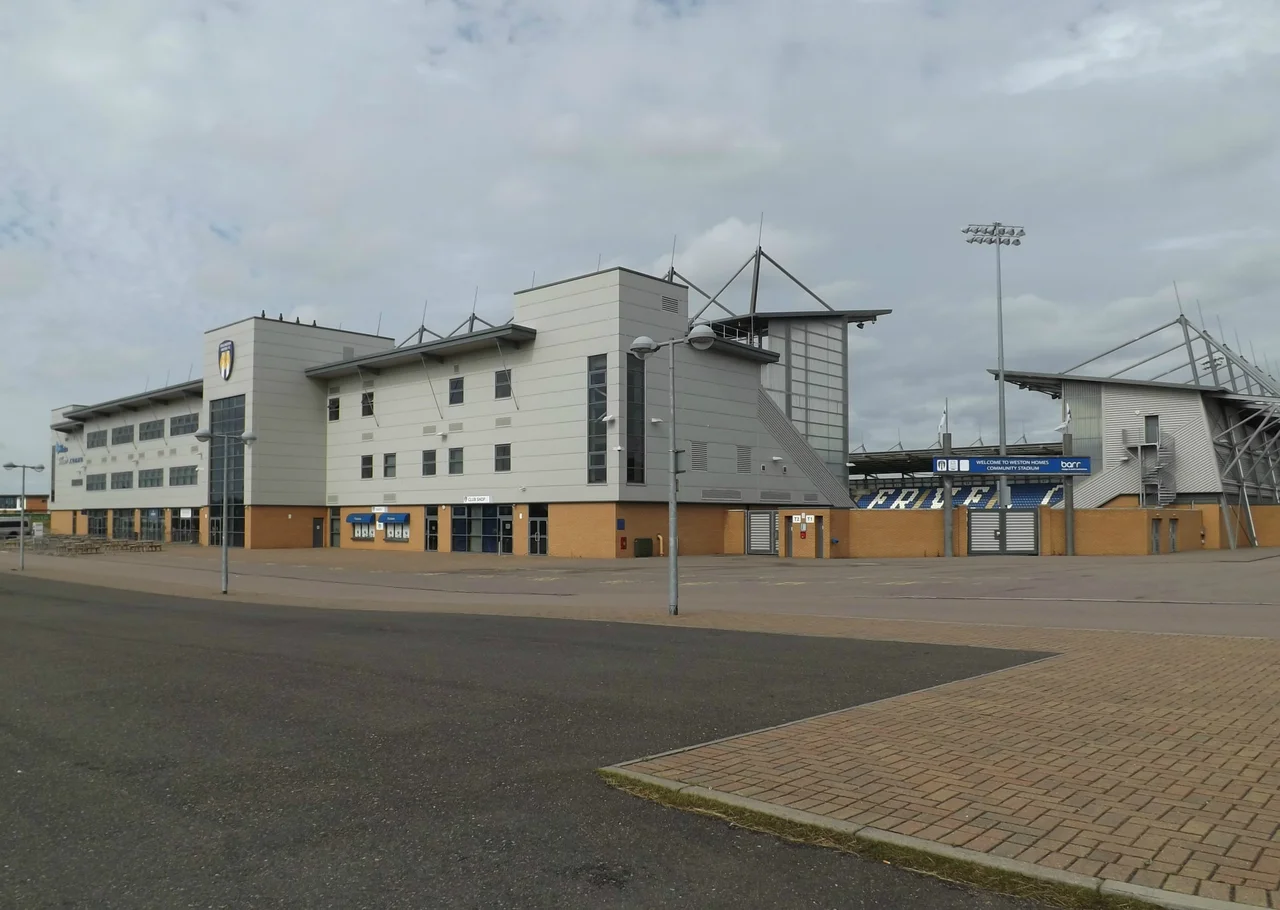

Colchester Community Stadium
For the better part of a century, Colchester United played their home matches inside a creaking wooden stand on Layer Road, a residential street where supporters parked across people's drives and dressing rooms doubled as broom cupboards. The town's leaders knew the ground was not fit for purpose. They had known since 1976, when the council set up its first stadium working party. It would take them another thirty-two years to actually build a replacement. When the new Colchester Community Stadium finally opened in August 2008 - on the edge of town, at a place called Cuckoo Farm - the first team through its gates was Athletic Bilbao.
The Long Wait for Cuckoo Farm
The trouble with Layer Road was the trouble with all old English grounds: a Victorian pitch with a Victorian timber stand, an ageing infrastructure that legislation kept asking more of than the club could pay. In the early 1970s the chairman Maurice Cadman announced that £280,000 of basic safety work was needed - serious money for a Fourth Division club drawing average crowds of under four thousand. A covenant on the land barred selling for housing, which removed the obvious lever. Plans were floated, sites suggested, decades passed. The working party kept meeting. Eventually the Borough Council settled on its own land in Myland, north of the town, at a site whose old name spoke of older pastures: Cuckoo Farm. Detailed planning permission came through in June 2007. The cost was set at £14 million. Construction started a month later.
Opening Night Against Bilbao
The new stadium's first fixture was a curiosity. On 4 August 2008, with the paint barely dry and the seats - 10,105 of them - waiting to be tested, Colchester United faced Athletic Bilbao in a pre-season friendly. The Spanish side from the Basque Country was a strange and glamorous choice for the maiden match of a League One club. Bilbao's striker Aritz Aduriz scored the first goal ever registered on the new pitch, fifteen minutes in. Colchester's Scott Vernon equalised from the penalty spot at thirty-two minutes - the first U's goal at the new ground. Bilbao eventually won 2-1. The first competitive fixture followed twelve days later, a 1-0 home loss to Huddersfield in front of 5,340, and the club had to wait until 25 October before they registered their first league win at Cuckoo Farm: 5-0 over Carlisle United, with Mark Yeates scoring twice.
Concerts, Conferences, Weddings
A modern community stadium is rarely just a football ground. The naming rights have moved from Weston Homes to JobServe; in conversation the locals still tend to call it simply 'the Community Stadium.' The building's hospitality suites - Layer and Centennial, both named for the old ground's streets - host conferences, banquets, weddings, boxing nights, darts opens, comedy bills and school proms. The pitch itself becomes a 20,000-capacity open-air arena once or twice a summer. Elton John played the first concert here in June 2014, his Colchester debut at the age of sixty-seven, drawing 16,500. Lionel Richie followed in 2016. Olly Murs, the local Witham-born singer turned chart act, drew 17,000 in 2017. Little Mix played the Summer Hits tour in 2018. In 2025 it was announced that Ipswich Town Women would call the ground their home for two seasons - a Suffolk-Essex border crossing that traditionalists found mildly surreal.
Internationals and Youth Football
Six full international fixtures have been played at Cuckoo Farm, all in the youth ranks. The first was 18 November 2008, three months after the stadium opened, when England Under-19s beat Germany 1-0 thanks to a goal from Henri Lansbury, watched by a crowd of 9,692. England Under-21s have played three matches here, including a qualifier on the road to the 2011 UEFA European Under-21 Championship. The stadium's modest size - by Premier League standards it is small - turns out to be the right scale for youth internationals, where atmosphere matters more than attendance ceiling. Walk past on a match day and the lighting glows from the floodlight pylons; the surrounding fields, once farmland, now hold supermarket carparks and warehouses. The U's, founded in 1937, finally have somewhere to belong that does not need £280,000 in immediate repairs.
Two Grounds, One Town
Layer Road was demolished in stages after the move. The old wooden stands came down; the site is now housing. Some former players still find their way back to the street - it remains residential, the gardens of new homes laid out where the centre circle used to be. At Cuckoo Farm the U's continue in League One and Two football, the kind of club whose fortunes oscillate around the lower professional tiers, whose supporters know each other by name. The stadium is plain, low-built, and undemonstrative; it does not pretend to be more than a working ground for a working-class town. That, in its own way, is the point. Thirty-two years of council debate produced exactly what was promised: a stadium suited to Colchester, no larger and no smaller.
From the Air
Colchester Community Stadium sits at approximately 51.92 N, 0.90 E, in the Myland suburb on the northern edge of Colchester, Essex, just east of the A12. Recommended viewing altitude is 1,500-2,500 ft AGL; identify it by the rectangular green pitch surrounded by four floodlight masts and a 600-space car park, immediately south of Cuckoo Farm Road. London Stansted (EGSS) lies 30 nm west; Southend (EGMC) is 27 nm south-west; Wattisham (EGUW, military) is 23 nm north. Class G airspace below the Stansted TMA.
Nearby Stories
- Woolpit 2 km away
- Tilty Abbey 3.6 km away
- Saxmundham 5.6 km away
- RAF Bottisham 6.5 km away
- Kelvedon Hatch Secret Nuclear Bunker 6.6 km away
- Maunsell Forts 7.4 km away
- Battle of Assandun 15 km away
- Broadstairs 36 km away