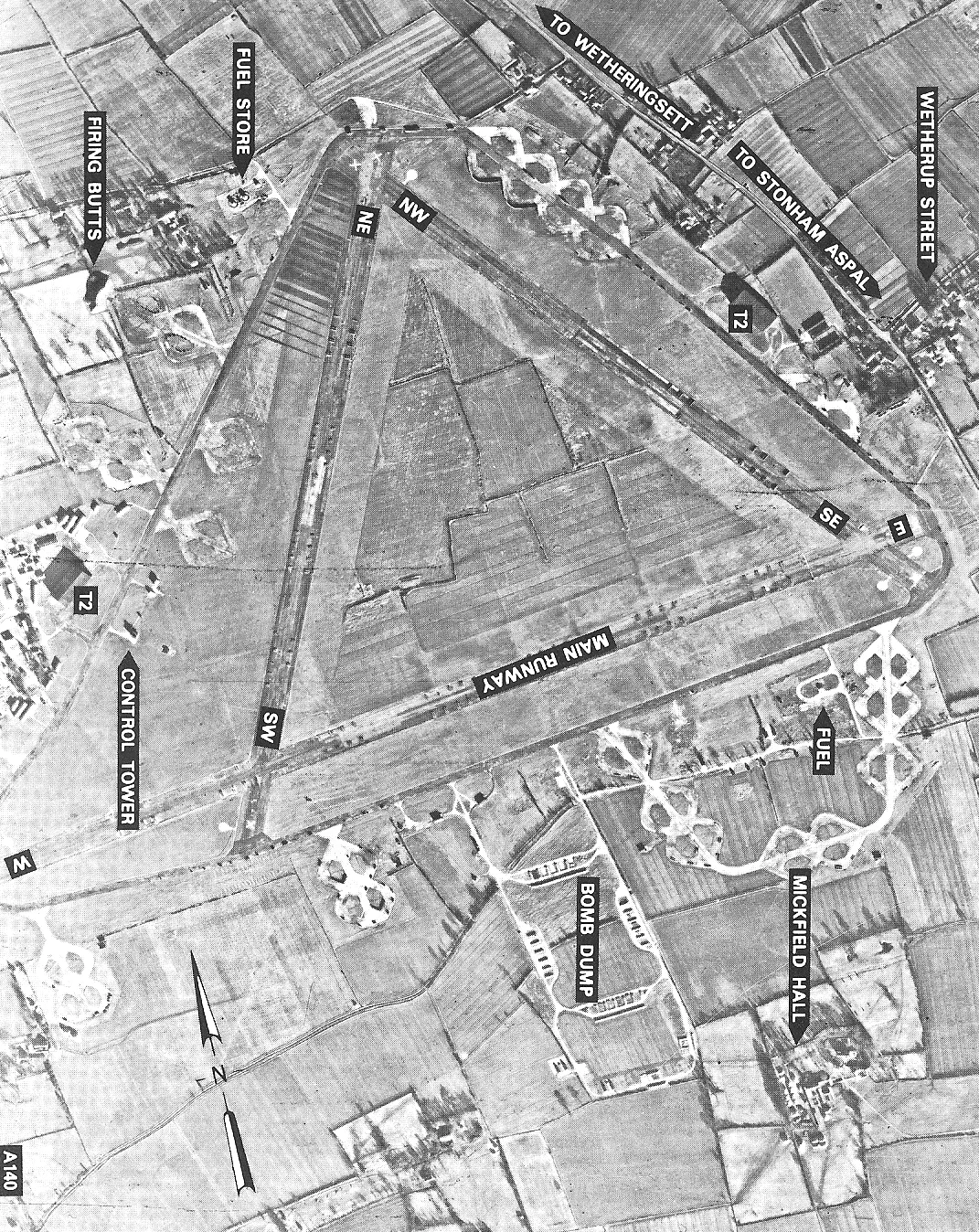

RAF Mendlesham
The bronze plaque the airmen left behind told the whole story in a few square feet: names, missions, a request that the local community remember. Then, in April 2010, someone pried the memorial off its mounting next to the A140 and presumably melted it down for scrap. Sixty-one years of standing watch ended in a single night. RAF Mendlesham, 5.5 miles east of Stowmarket in Suffolk, was already largely vanished by then. The runways had been broken up for aggregate. The control tower was gone. Only the T2 hangar at the old technical site still stood, surrounded by an industrial estate built on what had once been the headquarters of the 93rd Combat Bombardment Wing.
Czech Spitfires First
Before the Americans arrived, three RAF squadrons of Czechoslovakian pilots flew out of Mendlesham in Supermarine Spitfire LFIXs. Numbers 310, 312, and 313 Squadrons, all part of No. 134 (Czech) Airfield RAF, used the new field through the late winter and early spring of 1944. These were exiled airmen who had been fighting Hitler since 1939, when their country was dismembered, men whose homes lay behind enemy lines and whose families lived under occupation. They flew from Mendlesham for barely six weeks before moving on, leaving the airfield to a different air force entirely.
Square-S and the Long Conversion
In March 1944, the field was reassigned to the United States Army Air Forces Eighth Air Force and designated Station 156. The 34th Bombardment Group (Heavy) arrived from Blythe, California, painting a large Square-S on the tails of their bombers. The group started the war flying Consolidated B-24 Liberators, the slab-sided heavy bomber that Eighth Air Force crews often regarded with affection and exasperation in equal measure. Then, in September 1944, the 34th followed the rest of the 3rd Division and converted to the Boeing B-17G Flying Fortress. Of 170 operations flown from Mendlesham, the first sixty-two were Liberator missions; the remainder belonged to the Fortress.
Marshalling Yards and Oil
From October 1944 through February 1945, the 34th hammered the strategic targets that defined the late air war: marshalling yards at Ludwigshafen, Hamm, Osnabruck, and Darmstadt; oil refineries at Bielefeld, Merseburg, Hamburg, and Misburg; factories in Berlin and Hanover; airfields at Munster, Neumunster, and Frankfurt. When the Wehrmacht broke through the Ardennes that December, the group flew tactical support during the Battle of the Bulge. By March 1945, with Allied armies pouring across Germany, there were few industrial targets left to hit. The 34th turned to interdicting communications and supporting ground forces directly.
Chowhound and Coming Home
In the war's final weeks, the bombers that had flown to Berlin flew instead to feed the Netherlands. The Dutch population had been starving through what they called the Hunger Winter of 1944-45. Under Operation Chowhound, the 34th dropped food into flooded Dutch fields. After V-E Day, the same crews ferried liberated prisoners of war from German camps back to Allied centers. On 28 August 1945, the group returned to Sioux Falls Army Airfield in South Dakota and was inactivated. The next year, the field at Mendlesham passed to RAF Maintenance Command as an ammunition storage depot. It went inactive in June 1954.
What Remains
Today most of Mendlesham is farmland. Sections of the perimeter track and runway 02/20 survive as single-track farm roads. Local microlight pilots and the Suffolk Coastal Floaters hang-gliding club still use a grass-covered portion of runway 08/25, taking off from the same surface that launched Liberators against Hitler. After the plaque was stolen in 2010, the village launched a 35,000-pound appeal to replace it in a more secure location inside St Mary's Church in Mendlesham. The new memorial stands inside the church now, indoors, where it cannot be carried away.
From the Air
RAF Mendlesham sits at 52.233 degrees north, 1.118 degrees east, in flat Suffolk farmland 5.5 miles east of Stowmarket alongside the A140. Nearest active aviation: Norwich Airport (EGSH) is roughly 25 nautical miles north; RAF Honington (EGXH) lies 18 nautical miles west; RAF Wattisham (EGUW) is 10 nautical miles southwest. Recommended viewing altitude is 2,500 to 4,500 feet AGL to make out the surviving T2 hangar near the industrial estate and the agricultural lines that hint at the old triangular runway pattern.
Nearby Stories
- RAF Hethel 4.1 km away
- West Stow Anglo-Saxon Village 4.9 km away
- Castle Hedingham 8.1 km away
- Shotley Gate 8.5 km away
- RAF Marham 14 km away
- Four Days' Battle 52 km away
- Southern Bight 79 km away
- SS Elbe 113 km away