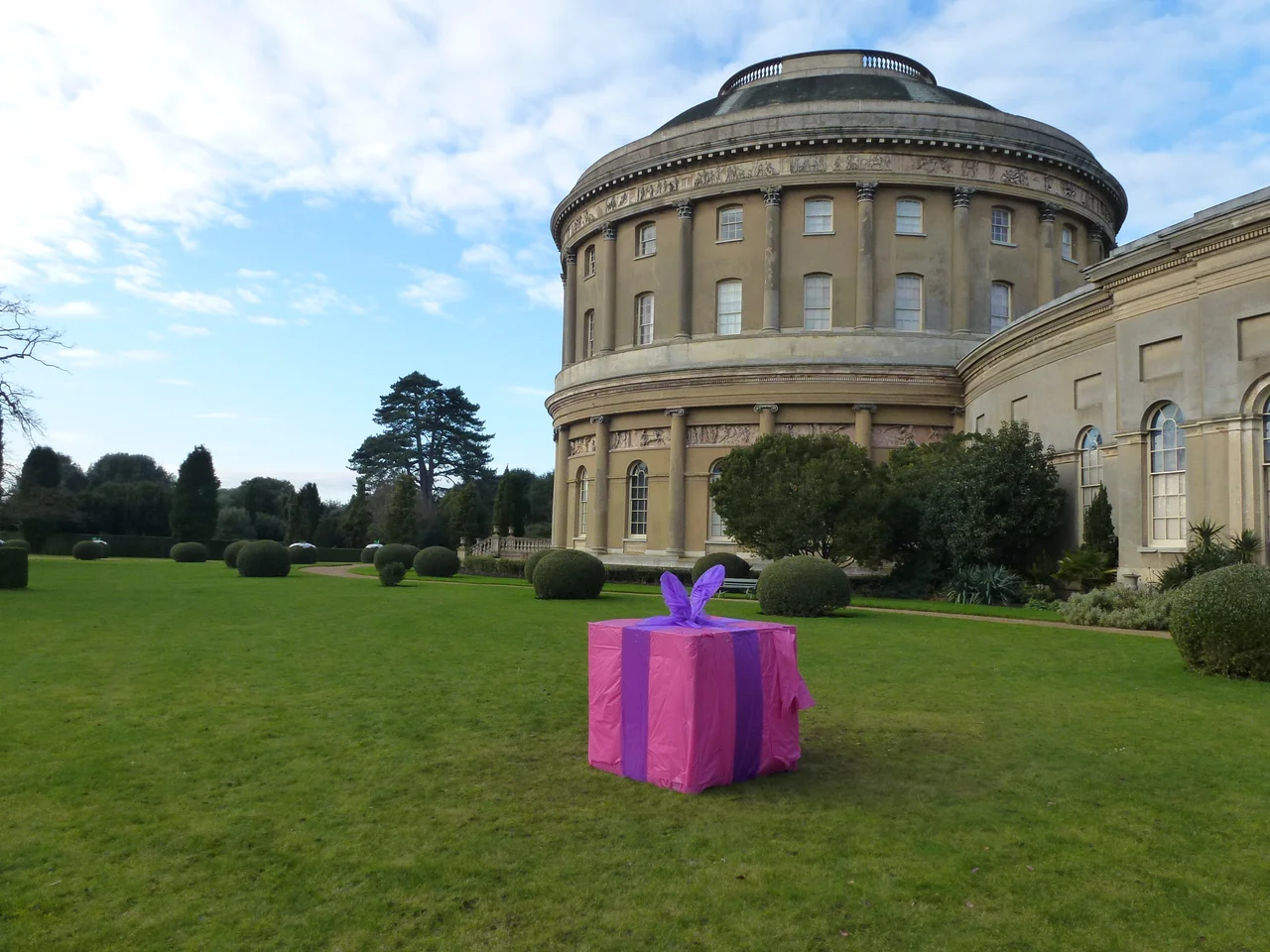

Ickworth House
It looks like a building that has wandered in from somewhere else. The Rotunda at Ickworth - a vast oval drum 100 feet high, flanked by long curving wings - sits in 1,800 acres of Suffolk parkland and resembles nothing else in England. Critics have called it 'a huge bulk, newly arrived from another planet' and 'an overgrown folly'. Architectural historians have lately reassessed it as the only English building comparable to the visionary neoclassical schemes of the French architects Etienne-Louis Boullee and Claude-Nicolas Ledoux - colossal geometries that mostly stayed on paper. The man who commissioned it was Frederick Hervey, 4th Earl of Bristol and Bishop of Derry, known as the Earl-Bishop. He intended the Rotunda as a private art gallery. Napoleon seized his collection before the building was finished. The Earl-Bishop died in 1803 without seeing the work completed.
The Earl-Bishop's Vision
The Hervey family had held the Ickworth estate since 1467, and by the late 18th century they were among the great Whig landowners of England. Frederick Hervey was the eccentric of the dynasty - a peer who was also Bishop of Derry in Ireland, a serial traveller across Europe (his name still attaches to Hotels Bristol in many European cities, named in honour of his patronage), and an obsessive collector of paintings and antiquities. Around 1795 he commissioned the Italian architect Antonio Asprucci to design a classical villa fit to house his collection. Construction proceeded slowly. In 1798 Napoleon's army marched through the Papal States and seized the Earl-Bishop's accumulated art. He died in 1803. The Rotunda was finished by his successor, mostly between 1803 and 1829, to a modified design - empty of the masterpieces it had been built to display.
Architecture of the Rotunda
The plan is unusual to the point of audacity. A great elliptical Rotunda, ringed with terracotta friezes copied from John Flaxman's designs for the Iliad and the Odyssey, anchors the centre. Two curving corridors sweep outward to flanking wings - one east, one west - giving the whole composition a span of nearly 700 feet. The east wing was the family's domestic quarters; the west wing went unfinished for two centuries. The interiors range from the formal Pompeian Room and the long Library to the smaller domestic rooms upstairs. The proportions, the geometric purity, and the sheer ambition of the silhouette are why historians put Ickworth in the same conversation as Boullee's never-built cenotaph for Newton and Ledoux's revolutionary visionary cities.
What Hangs on the Walls
Even after Napoleon, the collection that survives at Ickworth is remarkable. Paintings by Velazquez and Titian hang in the Rotunda alongside 18th-century family portraits by Gainsborough, Reynolds, Vigee-Lebrun, Pompeo Batoni, Angelica Kauffman, Allan Ramsay, Jacob van Loo, and William Hogarth - a small museum of Georgian portraiture in one English country house. There is a notable collection of Georgian silver, Regency furniture, porcelain, and 16th-century maiolica. Geraldine Hervey, Marchioness of Bristol, collected elaborately decorated fans and silver fish, and her acquisitions remain in the house. The combined effect is of a family that across five generations could not stop buying beautiful things and would not stop displaying them.
From Death Duties to National Trust
In 1956 the house, park, and a large endowment were transferred to the National Trust in lieu of death duties, on terms that included a 99-year lease on the sixty-room East Wing for the Marquess of Bristol. The arrangement held until 1998, when the 7th Marquess sold the remaining lease back to the National Trust. His half-brother Frederick Hervey, the 8th Marquess - born in 1979 - was unable to recover the lease despite a 'Letter of Wishes' that the head of the family should always be offered accommodation at Ickworth. The East Wing now operates as the Ickworth Hotel. The West Wing, unfinished since 1829, was finally completed in 2006 as a conference and events centre, and the first wedding in the house's history was held that year - 211 years after construction began.
Church and Park
A short walk from the house, in the park, stands Ickworth Church - a Norman building with later additions where most members of the Hervey family from Thomas (died 1467) to the 7th Marquess (died 1999) are buried. Inside is a fifteenth-century wall painting of the Angel of the Annunciation, a fifteenth-century font, roundels of Flemish glass from as early as the fourteenth century, and marble memorials to generations of Herveys. The Park itself runs to 1,800 acres of designed and natural landscape. The Tea Party Oak, south of Ickworth Lodge, is at least 800 years old and has a trunk diameter of more than nine metres - a tree that was already mature before any Hervey lived here.
From the Air
Coordinates 52.22 N, 0.66 E, in the parkland of Ickworth, near Bury St Edmunds in Suffolk. From the air, the Rotunda's distinctive oval form and the long sweeping wings make Ickworth one of the most recognisable country houses in East Anglia - a great geometric set-piece in 1,800 acres of designed park. Nearest airport is RAF Honington (EGXH) about 7 nautical miles north-east; Cambridge (EGSC) lies 22 nm west. London Stansted (EGSS) is 30 nm south. Best viewed at lower altitudes when the Rotunda's silhouette, the wings, and the surrounding parkland with the Tea Party Oak and Ickworth Church are visible.
Nearby Stories
- Wymondham Abbey 3.8 km away
- St Ives Bridge 6 km away
- RAF Eye 6.6 km away
- Castle Hedingham 6.9 km away
- Royal Hospital School 9.2 km away
- RAF Downham Market 9.9 km away
- Flag Fen 13 km away
- Letchworth 17 km away