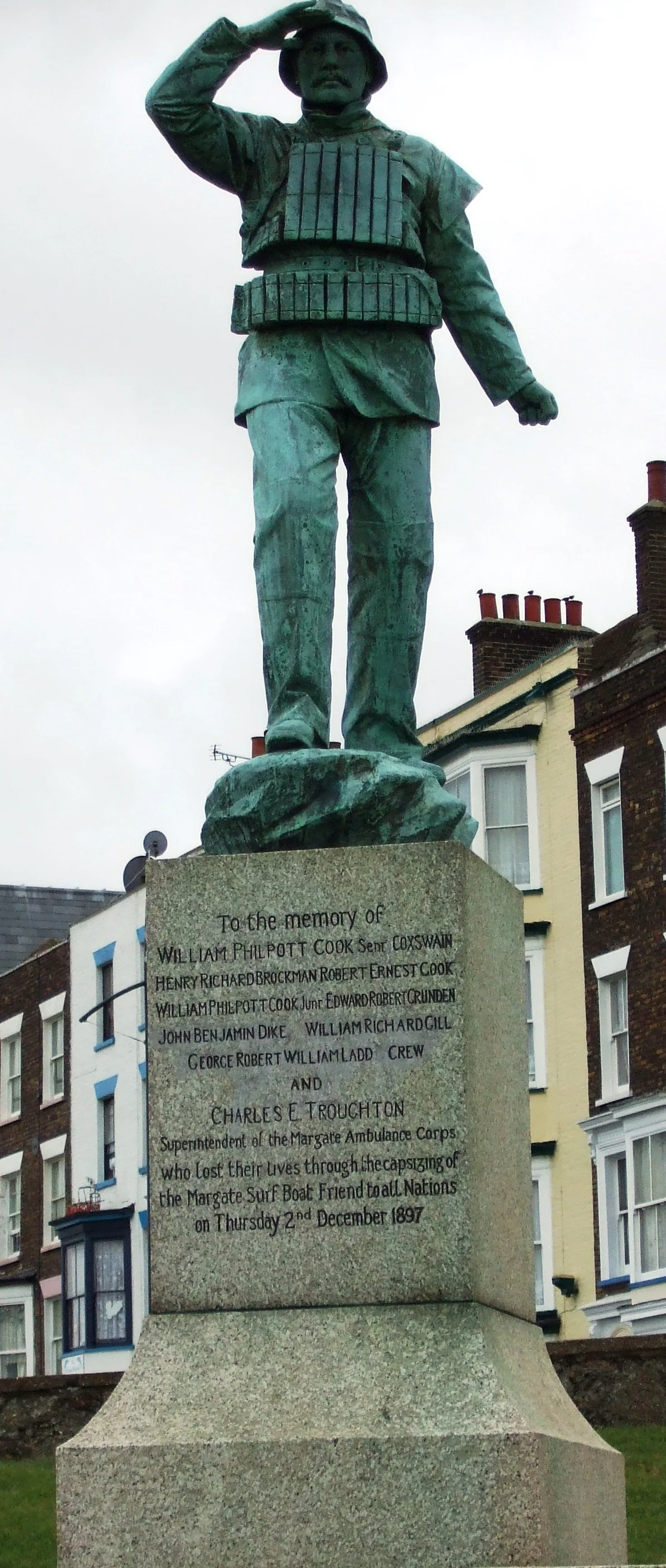

Margate Surfboat
On the morning of 2 December 1897, the steamship Persian Empire was in trouble off the Margate coast. Thirteen men of the Margate surfboat - local boatmen who had clubbed together to buy the boat and shared whatever salvage money came in - launched the Friend to All Nations to reach her. Two waves hit in quick succession just off the Nayland Rock. The boat capsized. Four men made it to shore. Three more, plus the medic Charles Edward Troughton, who died on reaching land - the rest were beaten on the rocks. Joseph Epps was found barely alive beneath the upturned hull. Nine men did not survive. Their names, carved into the seafront memorial above Nayland Rock and onto another stone in Margate Cemetery, are Charles Edward Troughton, Henry Richard Brockman, John Benjamin Dike, George William Ladd, Edward Robert Crunder, Robert Ernest Cook, William Philpott Cook, William Richard Gill, and William Philpott Cook Jr. They were neighbours, and many of them were related; the Cook family lost a father and a son in the same boat.
Boatmen of Margate
The Margate surfboats existed because of a different disaster. In January 1857, when the American ship Northern Belle ran aground in a blizzard, the Margate lugger Victory had been lost with all nine of her crew while attempting the rescue. Fifty Margate boatmen decided afterwards that the town needed a dedicated surfboat service - something lighter than a full lifeboat, that could be launched by four men without horses. The first boat, named Friend of All Nations, entered service in November 1857. She was built by J. Samuel White of Cowes, a yard that would build all three Margate surfboats over the next forty-two years. The cooperative model was unusual: local working men pooled their wages to buy the boat, and they shared the salvage payments she earned when she helped recover cargo and vessels from the Margate Sands. It was rescue work done by neighbours for neighbours, and it was paid for in instalments by the same neighbours.
The First Boat
The first Friend of All Nations had a difficult history before her 1860 wreck. On 13 February 1860 she tried to rescue the crew of the Spanish brig Samaritano, which had grounded on Margate Sands in a 5:30 a.m. squall. A second Margate boat, launched in haste, was overpowered by the gale; the Friend of All Nations followed her and was driven onshore a mile west of Margate. The Samaritano's crew were eventually rescued by the Ramsgate lifeboat. The Friend was repaired and returned to service. She capsized again during a January 1866 rescue, leaving her crew 85 minutes in winter seas before they were picked up. She was eventually replaced after a second boat was built in 1878 - confusingly also named Friend to All Nations - and continued in cooperative ownership until being lost again in 1877.
The 1897 Disaster
The second boat's destiny came on 2 December 1897. The Friend to All Nations was a non-self-righting whaleboat, which meant that once she went over there was no automatic mechanism to bring her back upright - she relied on her crew to right her, and her crew could not do so if the rocks reached them first. The waves at Nayland Rock that morning did. Joseph Epps survived by being trapped underneath the hull where, somehow, an air pocket sustained him until rescuers reached him. The boat itself, apart from her mast and rigging, was not badly damaged. She returned to service. She was lost again, alone, while under tow on the night of 30 November 1898 in the Kentish Knock - found as far away as Great Yarmouth, repaired, but never used again. After 1897, Margate built memorials. A statue of a sailor in oilskins and an early-style life belt, shading his eyes as he looks out to sea, stands on the parade above Nayland Rock. The names of the nine men are carved at its base. A second memorial sits in Margate Cemetery, where most of them are buried.
The Third Boat and a Luftwaffe Prisoner's Last Voyage
A new and larger Friend to All Nations was commissioned from J. Samuel White and delivered in September 1899. She required a crew of 15 and cost £800. By then, improvements in dedicated RNLI lifeboats had largely displaced the surfboats from primary rescue work; she was used mostly for local salvage and occasional emergencies. One notable rescue saved 26 people from the sailing ship Marechal Suchet. In 1922 she was fitted with a motor following public donations. The Royal Navy requisitioned her during the Second World War for use as a tender in Chatham docks. After the war she moved to Falmouth in Cornwall. Her final voyage came in 1957, under unusual circumstances: Willi Froelich, a former Luftwaffe pilot who had been a British prisoner of war, was trying to sail his family home to Germany when they ran into difficulty near Ostend. The surfboat was taken under tow, but the hawser snapped. After drifting, she broke her bow in rough seas and sank. Three boats, exactly a century of service, and a memorial on the seafront with nine names on it that Margate is still careful, every December, to read aloud.
From the Air
Located at 51.400°N, 1.367°E on the Margate seafront in Kent. The surfboat memorial - a statue of a sailor in oilskins - stands on the seafront parade above Nayland Rock, west of the harbour. From the air, the curve of Margate Sands and the visible Turner Contemporary gallery near the harbour are the easiest landmarks. London Manston Airport (EGMH) is about 5 nm south. The Reculver towers lie roughly 8 nm west along the coast.
Nearby Stories
- Battle of Maldon 4 km away
- Dover Priory 6 km away
- HMS Hermes (1898) 7.7 km away
- Sissinghurst Castle Garden 9.4 km away
- Priestfield Stadium 11 km away
- Clacton Pier 13 km away
- 1382 Dover Straits Earthquake 19 km away
- Four Days' Battle 46 km away