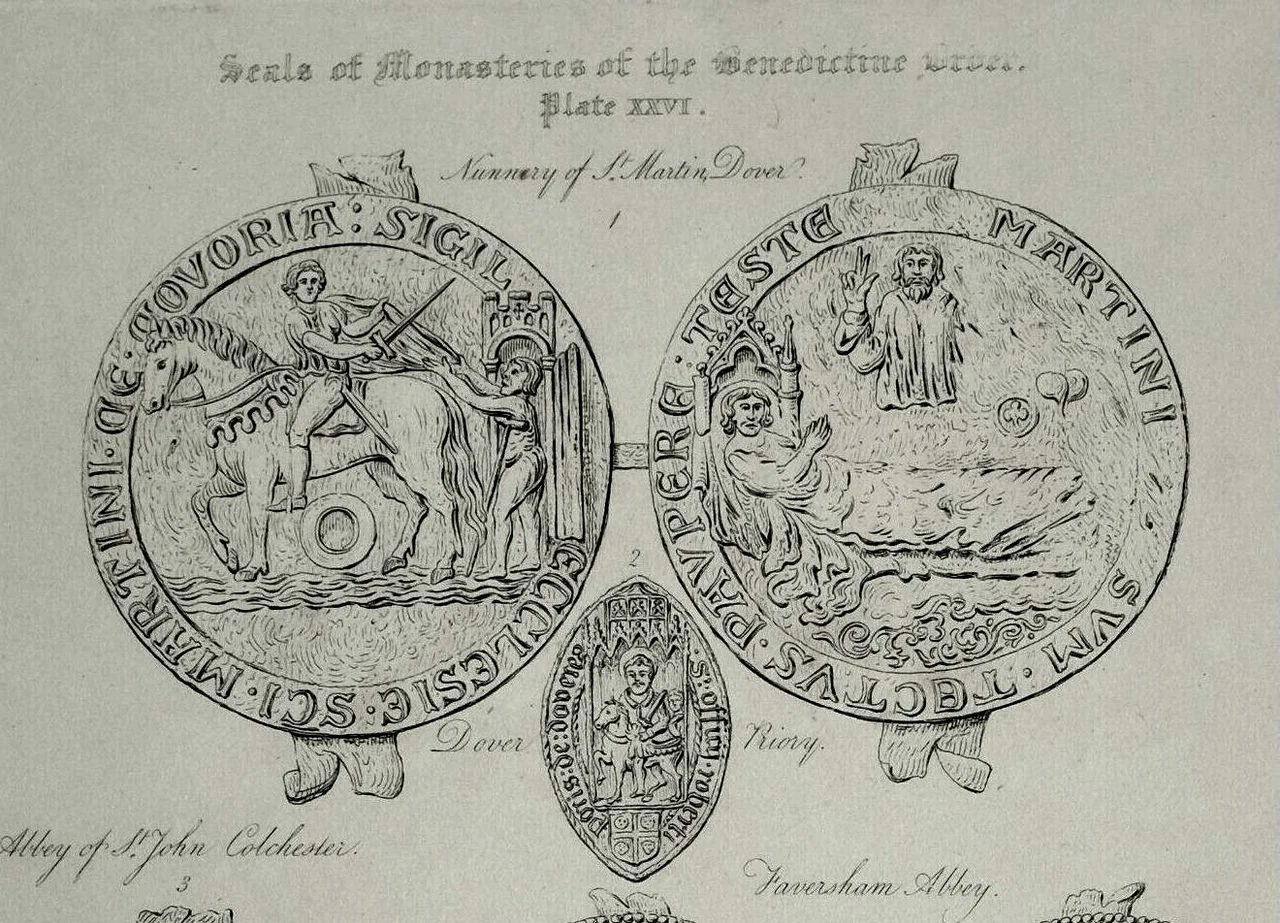

Dover Priory
Thomas Cromwell's commissioner, sent to inventory the priory church just before its suppression in 1538, sat down and wrote his master a sentence that has outlived everything else about the building: 'the fairest church in all that quarter of Kent.' Three times as long as St Mary's in Dover. A tower that would have stood where Effingham Street now meets Saxon Street. A cloister 110 feet square. A scriptorium that produced one of only six surviving giant Romanesque Bibles in the world. Today most of it lies under the Dover Priory railway station, under the houses of Norman Street, under the playground of a private boarding school. But the priory's twelfth-century guesthouse still stands, consecrated as a school chapel. Its refectory still serves dinners. And to read its lost church properly, you have to walk down Priory Road and let your eye reconstruct what time and the railway erased.
Saxon Beginnings at the Castle
The story starts in the early seventh century when King Eadbald of Kent installed twenty-two secular canons at the Saxon burgh inside what would become Dover Castle - probably attached to the church of St Mary in Castro, the old chapel that still stands beside the Roman lighthouse. Towards the end of the same century, King Wihtred kept a vow to St Martin by moving them down the hill to a new church on the site of what is now Market Square. Their living came from grants of land and tithe, and from half of certain dues levied at the port. The Normans arrived, and Odo, Bishop of Bayeux - half-brother to William the Conqueror - took the church and rebuilt it grandly on the foundations of an old Roman bathhouse. They renamed it St Martin's le Grand.
A Power Struggle, 1130
Because the canons had begun at the royal chapel inside the castle, they answered only to the king and, later, the pope - a 'royal peculiar', outside the Archbishop of Canterbury's authority. William de Corbeil, then archbishop, did not like this. In 1130 he persuaded Henry I to issue a charter transferring the canons' assets to a new priory under his control, leaving the old church in Market Square as Dover's parish church for the townspeople. The priory was called St Martin's of the New Work - Newark - to distinguish it from the parish church. Building began in 1131. Within five years, twelve canons regular were in residence. Archbishop Theobald finished the work around 1140 and in 1143 brought the priory into the Benedictine order as a cell of Canterbury Cathedral. Two centuries of arguments followed between the Canterbury monks and the Dover canons over what 'cell' really meant.
Fire, Murder, and the Dover Bible
King Stephen reportedly died at the priory in 1154, mid-journey. A fire damaged the buildings in 1201, and repairs followed in 1231. Then, on a night in August 1295, French raiders stormed the priory and a monk called Thomas de la Hale was murdered in the violence. The priory rebuilt itself, made extensive repairs in the 1480s, and quietly accumulated one of the finest medieval libraries in southern England. Its prize was the Dover Bible - a giant Romanesque illuminated manuscript, one of only six of its kind to survive in the world. When the Dissolution came in 1538 and the priory was suppressed, its library vanished from the records. Decades later, fragments began appearing on the open market. The Dover Bible eventually came to rest in the Parker Library at Corpus Christi College, Cambridge, where it remains - a single, magnificent book carrying the lost weight of an entire scriptorium.
Stone Hauled Away by Wheelbarrow
After 1538, the leading townsmen helped themselves. Stone, lead, timber - all carted off. Two barns, the gatehouse, the refectory, and a large hall were the only buildings left standing. Fishermen testifying in court in 1565 mentioned the priory casually: they used to take their tithe of fish there, they said, 'whiles it stood.' The remaining buildings turned agricultural. One of them, the Priory Barn, served as a refuge for vagrants during the harsh years of the 1590s and 1620s - perhaps because the building's old function as a religious refuge had lingered in folk memory. The lands passed first to a cleric named Richard Thornton, then to Archbishop Thomas Cranmer, who in December 1538 leased them on a 999-year lease to a gentleman of Wingham named Henry Bingham.
A College Rescues What Remains
Through the eighteenth and early nineteenth centuries, the ruins became a picturesque farm - two ponds, decaying Norman buildings, a quiet edge-of-town place where the Duke of Wellington celebrated his installation as Lord Warden of the Cinque Ports in 1839. The local cleric Dr F.C. Plumptre carefully mapped the foundations between 1845 and 1847, just before the developers arrived. In 1868 the ponds were drained for the railway. Effingham Street ran straight across what had been the dormitory and chapter house. Then in 1869, a Folkestone schoolmaster named Robert Chignell leased part of the surviving buildings for a private school. Local citizens formed the Dover College Company. The school opened in 1871 with the dual purpose of educating local boys and saving the priory's ancient buildings. The twelfth-century Strangers' Refectory was restored and still serves the college today. The guest-house was consecrated as the school chapel in 1879. The gatehouse, restored in 1881, holds the college archives. Famous alumni - the music executive Simon Cowell, the ballet choreographer Sir Frederick Ashton, the composer Dai Fujikura - have walked corridors where Benedictine monks once kept silence. Eight centuries, and the building still teaches.
From the Air
Dover Priory sits at 51.127°N, 1.307°E, immediately east of Dover Priory railway station and west of Effingham Street in central Dover. From the air, look for the railway yard cutting across the western part of what was once the priory grounds, with the dense rooftops of Norman Street and Saxon Street covering the rest. Dover Castle is visible 1.2 km to the northeast on its chalk headland. Nearest airport is London Ashford (Lydd) (EGMD) about 35 km west. Best viewed on clear days from low altitude when the layout of the medieval town centre is legible against modern Dover.
Nearby Stories
- HMS Hermes (1898) 7.3 km away
- Herne Bay Museum and Gallery 8.5 km away
- Benenden School 9.2 km away
- Boulonnais 9.4 km away
- Priestfield Stadium 12 km away
- 1382 Dover Straits Earthquake 17 km away
- Royal Sovereign Lighthouse 21 km away
- Battle of Boulogne 28 km away