
Herne Bay Museum and Gallery
Between 6 April and 13 May 1943, Royal Air Force test crews dropped prototype bombs into the shallow sea off Reculver, three miles east of Herne Bay. The bombs were Barnes Wallis's invention - rotating cylinders designed to skip across water like flat stones, bypass torpedo nets, and strike the side of a ship below the waterline. The dummy versions used here were filled with 'checol,' a mixture of concrete and chalk, to simulate the weight of high explosive. Some skipped. Some sank. Most stayed on the seabed, lost to the silt and the war's priorities. In 1997, more than fifty years later, the British Army located one of them and brought it ashore. It now sits in a Georgian house on William Street in Herne Bay, alongside Anglo-Saxon glass beakers, fossil sharks' teeth, and a baby's gas mask - the unlikely centrepiece of a museum a community had to fight to keep.
Sixty Million Years on William Street
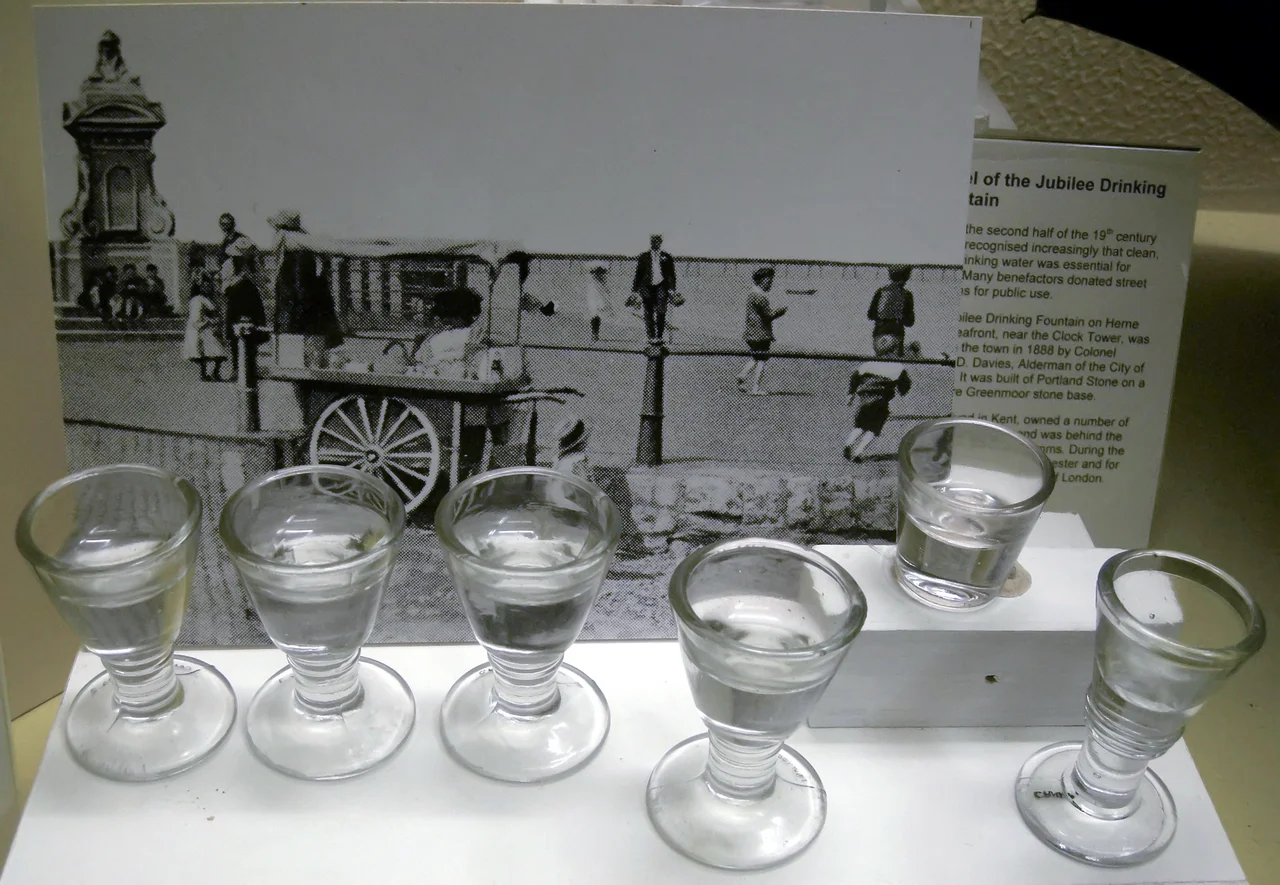
The Seaside Museum's collections sprawl across timescales that no town this size has any right to display. Fossils older than mammals share rooms with Stone Age hand axes; the hand axes share rooms with Anglo-Saxon glass from the cemetery at Marshside and Roman pottery from the fort at Reculver. There is a 7th-century church visible in fragments at nearby Reculver. There are penny-lick glasses - the small conical vessels Victorians passed between children to share scoops of ice cream, often spreading tuberculosis as they did. There is an 1884 model of the Ford waterworks pumping engine, made by the engineer-in-charge. There is a Saxony spinning wheel from the 'Make Do and Mend' exhibition. The William Street building is itself Georgian, sitting in a Conservation Area, on what was Herne Bay's main shopping street until at least 1883.
Dr Tom Bowes and the Salvaged Past
Without Thomas Armstrong Bowes, none of it would be here. Dr Bowes - born 1869, died 1954 - was the local GP, but his actual life's work was rescuing the town's history from the workmen who kept digging it up. F. W. J. Palmer, Council Surveyor between 1891 and 1915, was constantly excavating for drains and foundations, and Bowes was perpetually at his elbow, collecting the stone tools and pottery and oddments that emerged. He photographed everything with lantern slides for his lectures. He retired from medicine in 1930 and founded the Herne Bay Records Society and Museum in 1932, donating most of his collection in 1936. He served as president from 1949 to 1951. Today a wax model of him - rather startling on first encounter - presides over the permanent exhibition with his books and collection around him, a Victorian antiquarian eternally just about to deliver another lantern-slide lecture.
The Bouncing Bomb
The Highball was the smaller cousin of the Upkeep bomb that broke the Ruhr dams in May 1943 during Operation Chastise - the raid commemorated in The Dam Busters and its memorable Eric Coates march. Where Upkeep would be dropped from Lancaster bombers against dams, Highball was intended for use against capital ships, particularly the German battleship Tirpitz. The shallow water off Reculver was chosen for testing because it allowed easy recovery at low tide - which made it bitterly ironic that one prototype lay undisturbed in that shallow water for half a century. Highball was never operationally deployed; the war ended before it was needed. The recovered prototype has been conserved and displayed, a concrete-and-chalk-filled aluminium drum that connects this quiet Kent town to one of the strangest engineering achievements of the Second World War. Visitors stand around it. Children point. The thing is improbable even when you're looking at it.
Saved by Two Thousand Fans
In 2009 the museum was placed under threat of closure. Canterbury City Council voted in 2011 to close its museums entirely, citing budget pressures, though they agreed to fund operations through the 2010-11 financial year while seeking alternative arrangements. The response was small-town civic resistance at its most determined. Around 2,000 supporters mobilised, the local press carried the story week after week, and by 9 December 2010 the Herne Bay Times could announce that the Department of Culture, Media and Sport had agreed to a rescue plan. A modest £2 entry fee for non-residents would help fund the building; local residents and children would still enter free. In July 2015 management was awarded to the Herne Bay Museum Trust, and the museum reopened as The Seaside Museum Herne Bay. Two thousand people had refused to let sixty million years of accumulated local history vanish into a budget spreadsheet. Tom Bowes, wax-modelled in the upstairs room, would have approved.
From the Air
Located at 51.369°N, 1.128°E in central Herne Bay on the north Kent coast. The museum sits on William Street, a few hundred metres inland from the seafront and the Herne Bay Clock Tower. The Reculver towers - twin medieval church remnants about 3 nm east - are the most prominent navigation landmark from the air, marking the area where the bouncing bomb tests took place. London Manston Airport (EGMH, former RAF Manston) is approximately 9 nm east-south-east. Approaches to London City pass over the estuary just north of the town.
Nearby Stories
- Battle of Maldon 4 km away
- Dover Priory 6 km away
- HMS Hermes (1898) 7.7 km away
- Sissinghurst Castle Garden 9.4 km away
- Priestfield Stadium 11 km away
- Clacton Pier 13 km away
- 1382 Dover Straits Earthquake 19 km away
- Four Days' Battle 46 km away