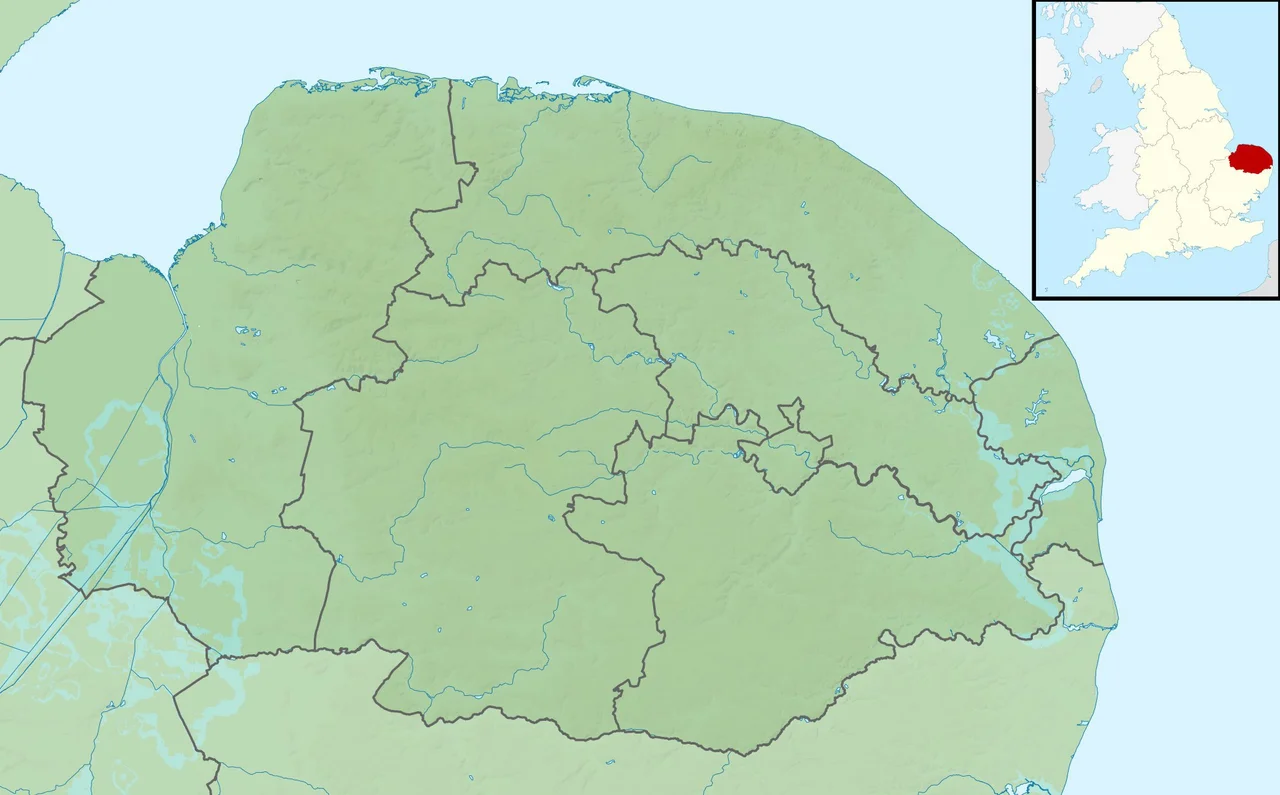

Narborough Bone Mill
One ton of German bone-dust, the saying went, saves the importation of ten tons of German corn. It was a crisp piece of industrial logic, and nobody in the early 19th century questioned what it implied. At Narborough, tucked a mile downstream from the village along the quiet River Nar in Norfolk, a waterwheel turned and millstones ground — processing bones from slaughterhouses, from the whaling industry at King's Lynn, and, for a time, from the exhumed cemeteries of Hamburg.
A Mill Built for Grim Work
The Marriott Brothers owned the mill in 1830, along with the navigation rights on the River Nar — a convenient arrangement, since everything the mill needed arrived and left by barge. There were no roads close by, and that suited everyone fine. The smell, which anyone who has been near a rendering operation can imagine, made remote locations preferable. Seven and a half miles to the north, at Congham on the River Cong, another mill processed whale carcasses brought in by horse and cart from the blubber factory at Lynn. The rendered bones then continued south by barge to Narborough for the final grinding. Two mills in remote corners of Norfolk, quietly processing the industrial byproduct of the world's whaling trade into something farmers could spread on their fields.
The Making of Bone Dust
The production process was methodical. First, the bones were boiled to make them brittle and to drive off the fat — that fat skimmed off and repurposed as grease for coaches and cart axles, nothing wasted. The softened bones were then chopped by hand or fed through a toothed cylinder to break them into manageable pieces. Finally the millstones, powered by the 16-foot waterwheel, ground the fragments into powder. The River Nar navigation had been opened in 1759 to carry coal and grain; by the early 19th century it was carrying something rather more unsettling. The mill also handled bones from local slaughterhouses, but its most controversial supply was human. The exhumed remains from Hamburg's cemeteries were shipped to King's Lynn and brought upriver to Narborough. Whether the people of north Germany knew what had become of their buried dead is not recorded.
Cut Off by a Drainage Board
The mill's end came not from scandal but from bureaucracy. In 1884, the Nar Valley Drainage Board purchased the navigation rights on the river and built a sluice that blocked further barge traffic. Without access for its raw materials and finished products, the mill had no purpose. Production wound down in the years that followed. By 1915 the buildings were still standing, but they did not last much longer — demolished piece by piece, the machinery sent to scrap, the rubble spread across farm tracks. What remained for more than a century was just the 16-foot waterwheel, rusting among the reeds, and the remnant of the main mill wall, keeping its own counsel beside the Nar.
What Remains
Heritage lottery funding eventually found Narborough Bone Mill. Restoration work on the waterwheel began in 2015, and the Munford family, who own the site, have worked to preserve what the decades left. It is not a grand ruin — no soaring arches, no romantic tumbledown grandeur. What it is, is particular: a trace of an industry so efficient and so unsentimental about its raw materials that it could reduce a whale, or a Hamburg burial ground, to powder and call the result good agriculture. The waterwheel is the thing to see. Sixteen feet across, patient beside the slow Norfolk river, it has outlasted the commerce it once powered and the ethics of the age that built it.
From the Air
Located at 52.68°N, 0.56°E in west Norfolk, near the village of Narborough along the River Nar. The mill site sits in low-lying river valley terrain, best identified from the air by following the Nar westward from King's Lynn. Nearest airports: Norwich Airport (EGSH), approximately 35 miles to the east. Recommended viewing altitude 1,500–2,500 feet for river valley context. Flat Norfolk countryside makes low-altitude navigation straightforward in clear weather.
Nearby Stories
- RAF Mildenhall 3.7 km away
- Hunstanton 3.9 km away
- Cley Marshes 5.4 km away
- RAF Attlebridge 6.8 km away
- Boston Guildhall 7.5 km away
- RAF Eye 7.5 km away
- St Ives, Cambridgeshire 7.8 km away
- Crowland Abbey 12 km away