.jpg)
Newark Castle
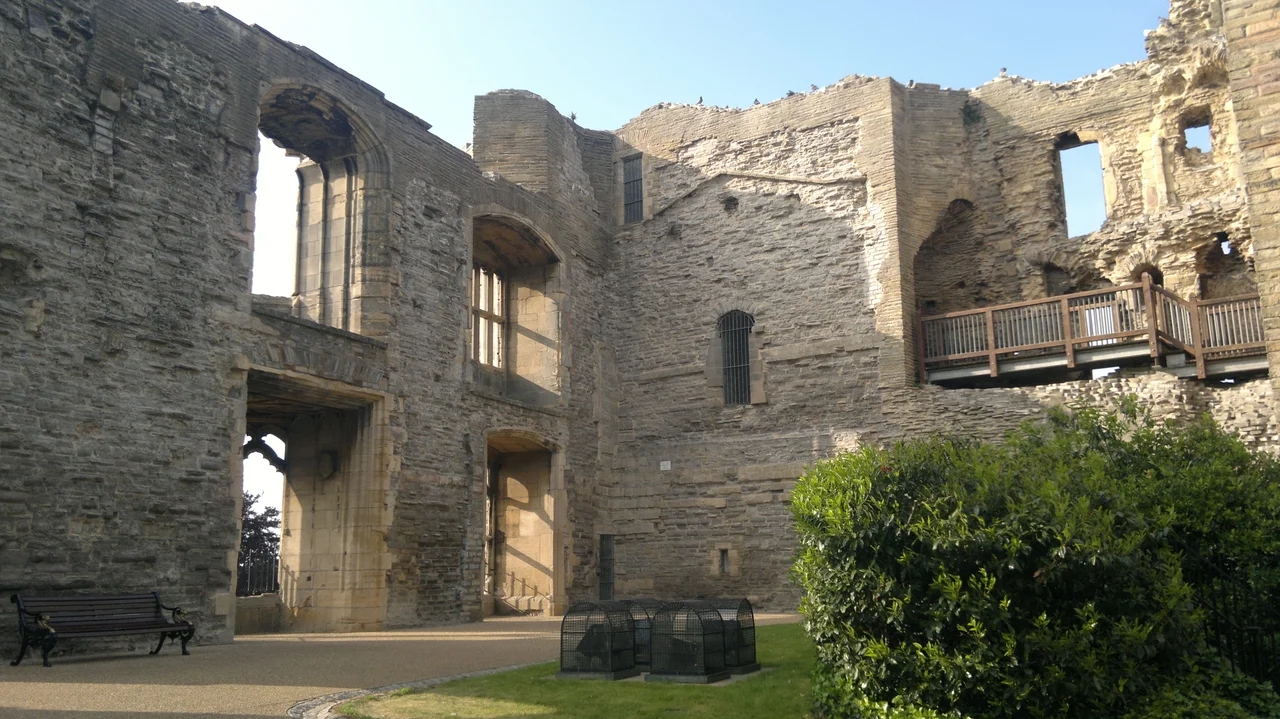
King John died here on the night of 18 October 1216, in a bedchamber at Newark Castle, with the Magna Carta crisis still unresolved and his royal treasure lost in the Wash. He was not the first monarch to use the castle, and he was very much not the last to fight over it. The fortress on the south bank of the River Trent was already eighty years old by then. It would survive another four centuries of royal politics, then take three Civil War sieges in the 1640s, and finally be blown apart with gunpowder on Parliament's orders in 1648. What stands today is partly medieval, partly Victorian, and entirely Newark's. The gatehouse is one of the finest twelfth-century examples in England, and you can walk through it for free.
A Charter and a Bishop
Newark Castle was the work of Alexander, Bishop of Lincoln, sometimes nicknamed Alexander the Magnificent for his free spending. A charter generally dated to 1135 granted him permission from King Henry I to fortify the river crossing at Newark, which controlled the meeting of the Great North Road and the Fosse Way. Alexander began with timber and earthworks. The stone castle that followed at the end of the twelfth century included the massive gatehouse, three storeys high and built of pale Lincolnshire limestone, with arrowslits and a central passage wide enough for a loaded wagon. The Bishop established a mint inside the bailey, because a castle at a major river crossing made an excellent place to strike coins under the protection of a royal licence. From a Norman bishop's point of view, Newark was as much a business as a fortress.
The Last Bed of King John
King John spent the autumn of 1216 fighting a war he was losing. His barons had invited Prince Louis of France to take the throne; John had crossed and recrossed the country trying to hold his remaining loyalists together. On 12 October, his baggage train was caught by an incoming tide while crossing the Wash and lost, an event chroniclers would later turn into the legend of the lost royal jewels. By the time John reached Newark Castle a few days later he had dysentery, which his contemporaries unkindly blamed on a meal of peaches and new cider. He died at the castle on the night of 18-19 October. His body was carried south to be buried at Worcester Cathedral, and his nine-year-old son Henry III inherited a kingdom on the brink of collapse. The barons who had been fighting John quietly switched sides to support the child, and the worst of the civil war ended within a year. Newark Castle had hosted one of the more consequential deaths in English history.
Three Sieges and a Slighting
Four centuries later the castle was at war again. Newark held for Charles I throughout the English Civil War, surviving three sieges between 1643 and 1646. The first, in February 1643, was a brief Royalist victory. The second, in early 1644, ended when Prince Rupert relieved the town. The third was a true siege, lasting from late 1645 into May 1646, a Scottish-Parliamentarian operation that ringed the town with earthwork forts and starved the garrison toward collapse. Charles I surrendered to the Scots at Southwell, nine miles to the south-west, on 5 May 1646, and ordered his Newark commander to lay down arms. After the war Parliament made an example of the castle. In 1648 the gatehouse was slighted, dismantled to make it indefensible, by detonating gunpowder at the corners. Walk around the surviving fabric today and you can still pick out where 1840s brickwork meets twelfth-century stone; the brick marks the explosion.
Anthony Salvin's Repair
The castle stood as a partial ruin for two centuries. Then in 1845 the architect Anthony Salvin, who had a long career restoring British castles and cathedrals, began three years of careful conservation work, putting the masonry back together without pretending the slighting had not happened. The corporation of Newark bought the site in 1889 and continued the work, opening the castle and its riverside gardens to the public. Today the castle is a scheduled monument and a Grade I listed building, first listed in 1950. The Gilstrap Heritage Centre, which once told the castle's story through a small exhibition, has been repurposed as the Newark Registration Office. Admission to the grounds is free, and the gardens slope down to the Trent where a footbridge crosses to the meadows on the far bank. From the riverside walk, the castle looks much as it did in early nineteenth-century watercolours, with the slighted west wall opening directly onto the water and the Norman gatehouse standing complete on the eastern flank.
From the Air
Newark Castle stands at 53.08°N, 0.81°W on the south bank of the River Trent, in the centre of the town of Newark-on-Trent. Best viewed at 1,500-3,000 feet to make out the castle, the parish church of St Mary Magdalene with its tall spire, the Market Place, and the curve of the Trent. The A1 trunk road bypasses the town to the east; the East Coast Main Line runs north-south through it. Nearest airports: RAF Syerston is about 5 nm south-west, and RAF Cranwell (EGYD) about 15 nm south-east. The Civil War siege earthworks of Queen's Sconce and King's Sconce survive on the southern edge of the town and are visible from low altitude.
Nearby Stories
- Heckington Windmill 4.4 km away
- Belper North Mill 6.4 km away
- Beauchief Abbey 10 km away
- Oakham 12 km away
- Murder of Bernadette Walker 14 km away
- Battlefield Line Railway 15 km away
- Battle of Gainsborough 16 km away
- RAF Binbrook 23 km away