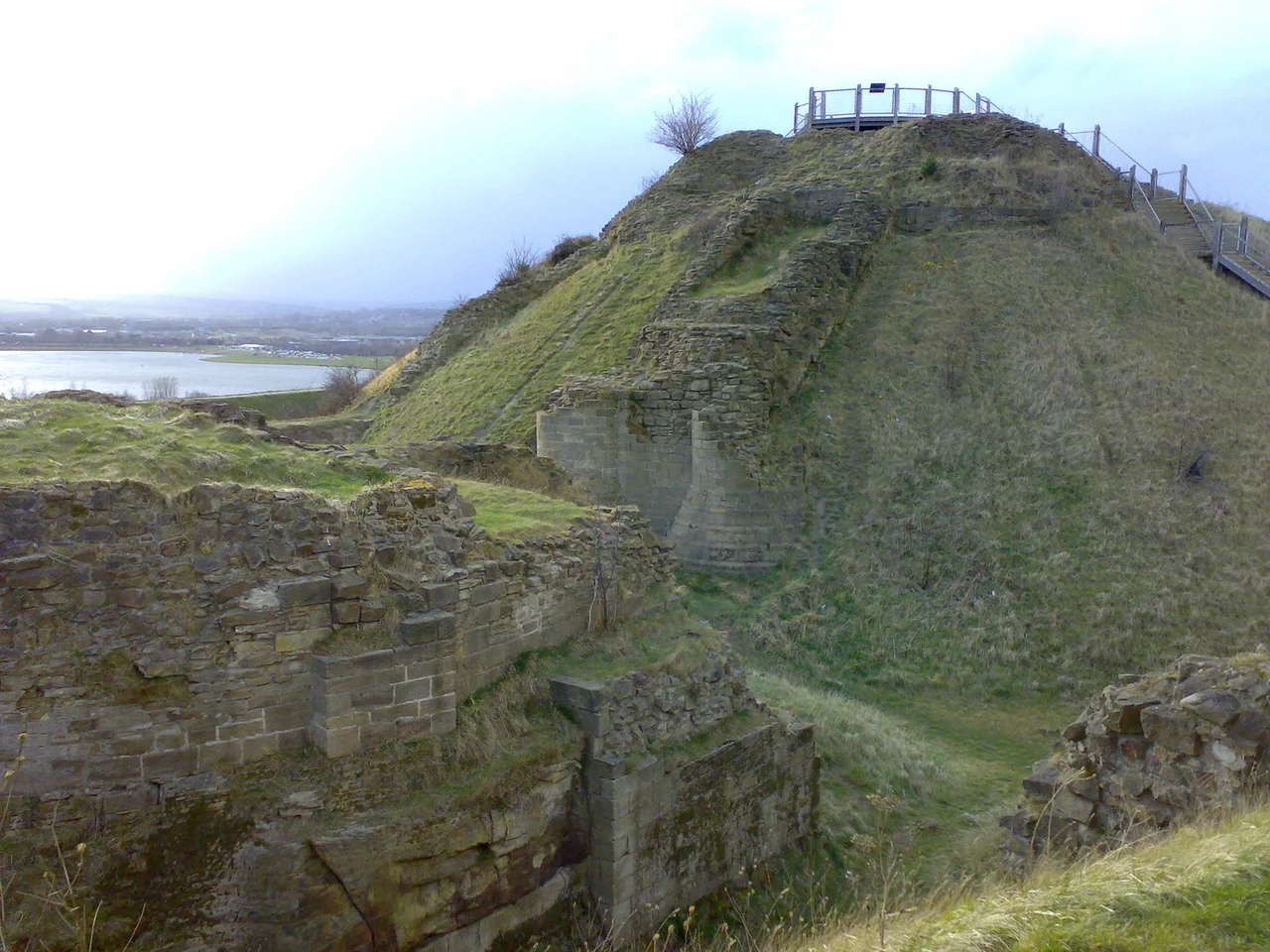

Sandal Castle
He had a claim to the throne, an Act of Parliament naming him Protector of the Realm, and somewhere between three and eight thousand soldiers behind him. On 30 December 1460, Richard Plantagenet, Duke of York rode out from the gates of Sandal Castle to take on Queen Margaret of Anjou's army. By nightfall he was dead, his teenage son Edmund was dead, and what is now a low green motte beside the River Calder in Wakefield was the setting for one of the most consequential reversals in English royal history. The Wars of the Roses would burn for another quarter century. The nursery rhyme came later.
The Warennes' Stone
Sandal began as timber. William de Warenne, 2nd Earl of Surrey was granted the Sandal estates in 1107 and built a motte-and-bailey castle on a natural sandstone outcrop called the Oaks Rock above the River Calder. The motte was raised ten metres high, with a seven-metre moat dug around it. For most of the 12th century the fortifications were wood. Hamelin de Warenne, the 5th earl, illegitimate son of Geoffrey of Anjou, married Isabel de Warenne in 1164 and is thought to have begun the conversion to stone. By the late 13th century the keep was circular with four four-storey towers, the gatehouse formed by two of them at close quarters. The east tower held a well 37 metres deep, sunk through solid sandstone. A double-walled keep meant guardrooms and storerooms on the ground floor, a great hall above, private apartments on the top. Lavatories built into the tower walls discharged on the outside, an arrangement that ensured everybody downwind knew exactly what station they held in life. By the 1270s the castle had its three-storey barbican with drawbridge and portcullis, the whole arrangement requiring attackers to take a right-angled turn under fire.
Battle of Wakefield
By 1460 Sandal belonged to the Dukes of York. The Wars of the Roses had been running for five years. Richard, 3rd Duke of York had pressed his claim to the throne and won an Act of Accord in October 1460 recognising him as heir and Protector of the Realm. The current king, Henry VI, was alive but considered unfit; his queen, Margaret of Anjou, was not done fighting. In December, Richard came north to Sandal Castle to consolidate his position. His force of perhaps three to eight thousand was outnumbered by Margaret's Lancastrian army marching from nearby Pontefract. On 30 December he rode out, and his army was caught and broken. Richard himself was killed in the field. So was his second son Edmund, Earl of Rutland, who was seventeen years old. The body of the Duke of York was paraded with a paper crown to mock his royal pretensions, then his head was set above the gate of the city of York. Two months later, his eldest son Edward marched south with another army, won the Battle of Towton in a snowstorm, and crowned himself Edward IV. The Wars of the Roses were nowhere near finished. But the path to the Yorkist throne ran through Sandal.
Richard III and the Civil War
Richard's youngest surviving son was Richard III. In 1483, having taken the throne in his own right, he chose Sandal as his northern base and ordered significant investment in the castle. The work was barely begun when he died at Bosworth Field in 1485, and the future of Sandal Castle died with him. The castle declined slowly through the Tudor century. By the time of the English Civil War in the 1640s, Sandal was a Royalist stronghold that was neglected enough to play little part in the major campaigns. In 1645 Parliamentarian forces besieged it three times. The garrison of ten officers and ninety men finally surrendered on 1 October 1645, on the promise of safe passage to Welbeck House. They handed over a hundred muskets, fifty pikes, twenty halberds, a hundred and fifty swords, and two barrels of gunpowder. No artillery. The capitulation left only Bolton Castle and Skipton Castle in Royalist hands in Yorkshire. Parliament then ordered Sandal made untenable. What you see today is what the slighting left behind.
Walking the Motte
The ruins have been worked over many times. Local stonemasons quarried the castle for building stone through the eighteenth century. Samuel Buck drew Wakefield with the ruin in the foreground in 1719 or 1722. The Yorkshire Archaeological Society made the first formal excavation in 1893. A nine-year campaign starting in 1964, a partnership between Wakefield Corporation, Wakefield Historical Society, and the University of Leeds, began as an experiment in adult education and grew into a proper excavation that uncovered flint tools suggesting a Mesolithic encampment on the spot around 5,000 BC. People had been living here a long time before anyone built a castle. In 2003 a wooden walkway was provided to let visitors climb the motte without eroding the slope. A visitor centre stands a hundred metres away. The castle is now a Scheduled Monument and a Grade II* listed building. Shakespeare set scenes from Henry VI, Part 3 here, and the play is sometimes performed on the ruins. Local folklore claims the Grand Old Duke of York refers to Richard III's troops marching to and from Sandal. Probably it does not. But the castle keeps the stories, and the motte still rises ten metres above the River Calder where it was raised nine hundred years ago.
From the Air
Sandal Castle sits at 53.66N, 1.49W on a low sandstone ridge above the River Calder in Sandal Magna, two miles south of Wakefield city centre. The ruins and motte form a distinctive green crown on the hill. Leeds Bradford Airport (EGNM) is 13 nautical miles north. Doncaster Sheffield Airport (former EGCN) was 20 nautical miles southeast. From altitude, look for the M1 motorway just east of the site, with the Calder valley running west to east. The motte makes a recognizable small green mound above the houses of Sandal.
Nearby Stories
- Stockport Air Disaster 4.5 km away
- Hillsborough Disaster 6.1 km away
- Murder of Sophie Lancaster 6.3 km away
- Battle of Stamford Bridge 9.8 km away
- Wressle Castle 12 km away
- Gordale Scar 12 km away
- Gainsborough Old Hall 19 km away