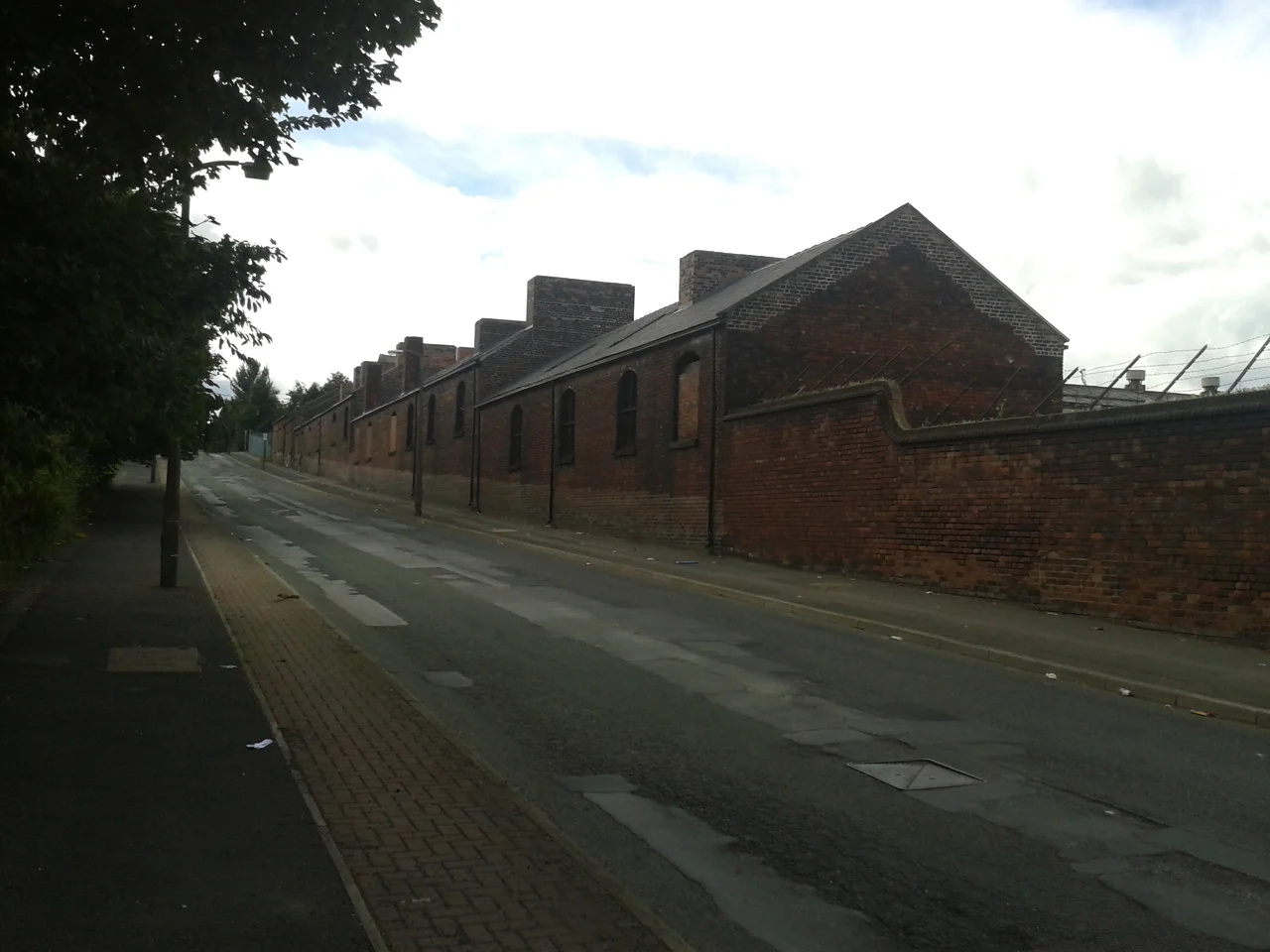

Darnall Works
Walk into the south-east shop at Darnall Works and look down. The floor is pitted with holes - 84 of them in this range alone, more in the adjoining workshops, 132 in total. Each one held a clay crucible. Each crucible held molten steel at temperatures hot enough to soften the soles of the puller-out's boots. This is the only place on earth where you can still see the full geography of crucible steelmaking laid out at scale, and for Sheffield - the city that practically invented industrial steel - that makes it sacred ground.
Sanderson's Big Idea
Naylor and Sanderson had been making cutlery and steel in Sheffield since 1776, working out of a tangle of premises near the city centre. When the Sandersons finally took the firm over and renamed it Sanderson Brothers, they wanted something purpose-built. In 1835 they took a 21-year lease on a site on the edge of the hamlet of Darnall, paying the oddly specific rent of thirteen pounds, thirteen shillings a year. The land already had industrial bones - the Don Glass Works had stood there since the 1790s, centred on a glass cone whose buried foundations English Heritage believes still survive underground. The Sandersons brought scale that the glassworks had never imagined.
Anatomy of a Furnace Floor
Crucible steelmaking, the process invented in Sheffield by Benjamin Huntsman in the 1740s, required brute patience. Iron bars were broken up, packed into clay crucibles with carefully measured carbon, and lowered into coke-fired holes in the floor. Each hole could melt about 30 kilograms of metal at a time. Two men - the puller-out and his mate - would haul the white-hot crucibles up using long tongs, then pour the molten steel into ingot moulds. The south-east shop at Darnall provided 84 holes for this work. The south range had 24, designed wider so several crucibles could be 'teemed' in continuous sequence to cast large objects in a single pour. A further west range matched the south. The 132-hole capacity made Darnall one of the largest crucible plants ever built.
The Gas Revolution
In 1873 and 1874 the Sandersons did something radical. They added a new range of crucible furnaces powered not by coke piled around the pots but by a Siemens regenerative gas furnace - a German innovation that recycled hot exhaust gases to preheat incoming air, dramatically reducing fuel consumption. One Siemens furnace at Darnall did the work of sixty traditional crucible holes. It was one of the first installations of its kind in Sheffield, a hint that even at the height of hand-pulled crucible work, the industry was already reaching for the technologies that would eventually replace it.
Survival
By the 20th century the open hearth and electric arc had made crucible steel obsolete for most purposes, though Sheffield's specialty steel firms held on stubbornly. In 1934 Sandersons transferred to Kayser Ellison, combining the sites into a larger Darnall Works. The old crucible shops were demoted - some to stores, others abandoned. By the 2000s the structures were leaking, the asbestos-cement roofs decaying, the survival of the world's last large crucible complex in genuine doubt. A 2006 scheme to bring steelmaking back collapsed when local residents refused to relocate. Instead, by 2010, £800,000 was raised to repair the roofs of the Grade II* listed south-east and south workshops. The buildings stand today as scheduled monument and working memory - a single-storey brick rebuke to the assumption that the past has nothing left to teach.
From the Air
Coordinates 53.3917°N, 1.42254°W. Best viewed from 2,000-3,000 feet AGL. The works sit in Darnall, about 3 miles east of Sheffield city centre, near the M1 corridor. Nearby airports: Sheffield/Doncaster (EGCN) 22 nm east, Manchester (EGCC) 36 nm west. Look for the long single-storey brick ranges with mixed slate and corrugated roofing, set back from Main Road. Best light is morning, when the low sun rakes across the workshop roofs.
Nearby Stories
- Rochdale Pioneers Museum 3.4 km away
- Adlington Hall 4 km away
- National Coal Mining Museum for England 4.2 km away
- Sneyd Colliery Disaster 6.6 km away
- Southwell Minster 6.8 km away
- Belper North Mill 9 km away
- Selby Rail Crash 13 km away
- RAF Finningley 15 km away