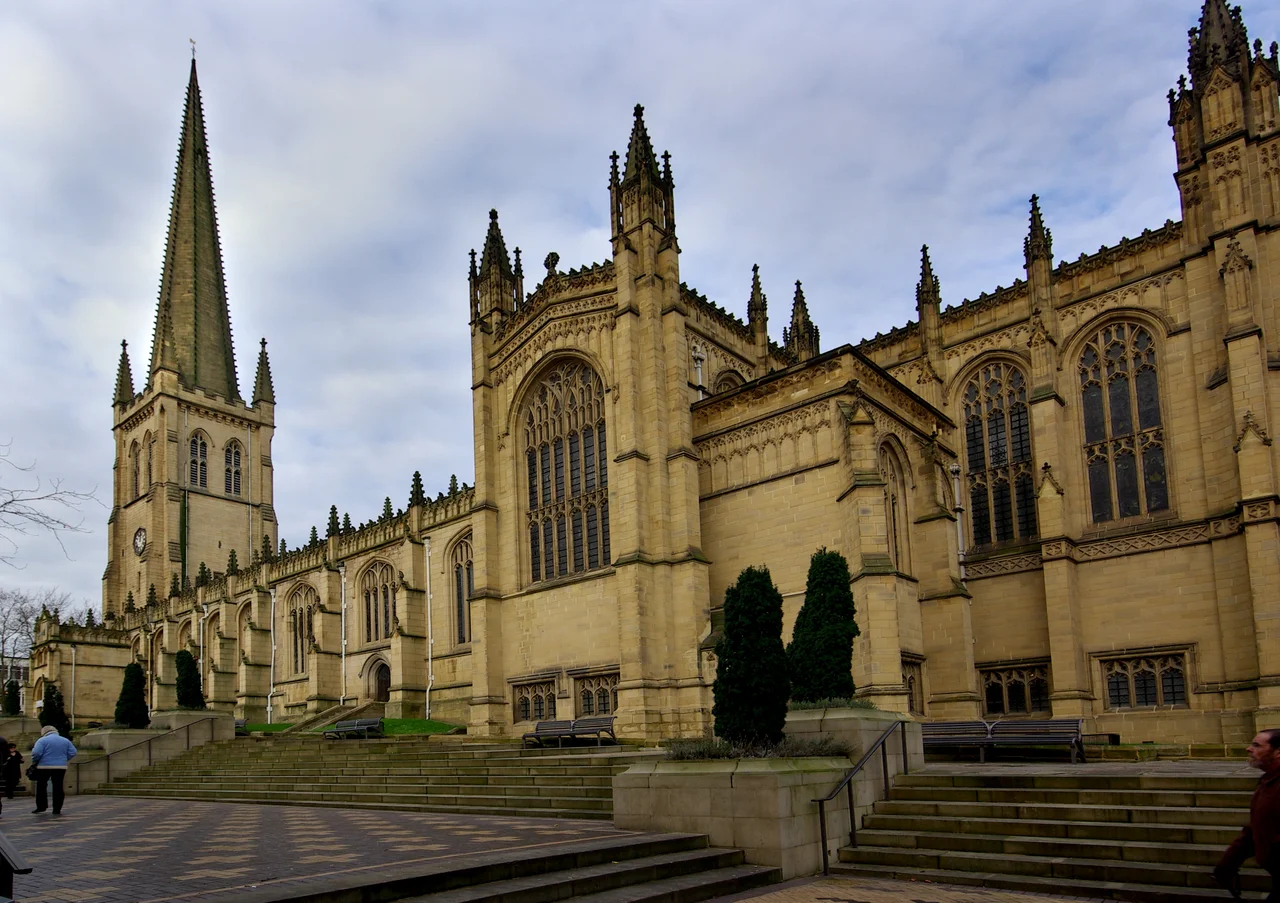

Wakefield
They call it the Merrie City. The phrase goes back to medieval times, when John Leland's 1538 description noted that a right honest man could fare well in Wakefield for tuppence a meal. The town is also the capital of the Rhubarb Triangle, the small patch of Yorkshire countryside where rhubarb is forced to grow in dark warm sheds, producing the slender pink stalks that travel to Borough Market in London by night. And in 1460 it was where Richard, Duke of York rode out of Sandal Castle and into a battle that lost him his head. Wakefield has been a quiet contender for English consequence for nine centuries.
Waca's Field
The name is probably either Waca's field, the open land belonging to a Saxon called Waca, or a derivative of the Old English wacu meaning a watch or wake, with feld for the open ground where the festival was held. The Domesday Book records it as Wachefeld. Flint tools at Lee Moor and bronze implements at Lupset show human activity here from prehistory. The Brigantes held the area until the Roman conquest in AD 43, and a Roman road from Pontefract crossed the Calder by a ford near the site of Wakefield Bridge. After the Romans the Angles came in the 5th or 6th centuries; after AD 876 the Vikings, who founded twelve thorpes around the settlement and named the streets that still exist. Westgate, Northgate, and Kirkgate take their suffixes from the Old Norse gata, meaning road. Kirkgate, the road to the church, was named for the kirk that became Wakefield Cathedral. The settlement grew at the river crossing on the north bank of the Calder, on a low hill that is still the geographical center of the city.
Market, Battle, and Bridge
After the Norman Conquest the manor was granted to William de Warenne, 1st Earl of Surrey. His descendants the Earls Warenne built Sandal Castle on the south side of the river in the early 12th century, and another smaller castle called Lawe Hill on the north side, which was later abandoned. In 1203 a market grant was issued. In 1204 King John granted a fair on All Saints Day. From the 13th century Wakefield grew as an inland port for the woollen and tanning trades. In December 1460 the Wars of the Roses came to its outskirts. Richard Plantagenet, Duke of York, marched out from Sandal Castle to confront Margaret of Anjou's Lancastrian army and was killed in what became the Battle of Wakefield. His son became Edward IV three months later. In 1356 the Chantry Chapel of St Mary the Virgin was built on Wakefield Bridge. It still stands. There were four such bridge chapels built in medieval England. Wakefield's is the oldest and the most ornate of the four surviving.
The Coal Capital and the County Town
Wakefield was a Royalist stronghold in the Civil War until Sir Thomas Fairfax stormed it in May 1643. The Aire and Calder Navigation, authorised by Parliament in 1699, gave the town access to the North Sea and made it an inland port at scale. By 1885 more malt was made here than anywhere else of similar size in the kingdom. The cattle market on George Street was one of the biggest in the north. From 1810, with the first West Riding Court House on Wood Street, Wakefield became the administrative capital of the West Riding of Yorkshire, a role it kept until local government reorganisation in 1974. The county hall went up in 1898 in Queen Anne style. The West Riding Pauper Lunatic Asylum at Stanley Royd, where Henry Maudsley and James Crichton-Browne did pioneering work in 19th-century psychiatry, opened in 1816. Wakefield Prison, originally a 1594 house of correction, became a maximum-security prison still in use today. In 1842 the Miners' Association of Great Britain and Ireland, the country's first national trade union for miners, was founded in Wakefield. The coal mines closed early under Margaret Thatcher's government; the pits at Lofthouse, Manor, Newmarket, Newmillerdam, Parkhill, and Walton all shut between 1979 and 1983. The Selby Coalfield opened to the east and absorbed many of the displaced miners.
Hepworth and Rhubarb
Barbara Hepworth was born in Wakefield in 1903. The Hepworth Wakefield gallery, which opened on the south bank of the Calder in May 2011, is thought to be the largest purpose-built gallery to open in the UK since 1968 and brought 500,000 visitors in its first year, adding about £10 million to the local economy. It displays Hepworth's work alongside that of fellow Yorkshire sculptor Henry Moore. The novelist George Gissing was born here in 1857; his childhood home in Thompson's Yard is maintained by the Gissing Trust. The singer Jane McDonald was born here in 1963. The Theatre Royal on Westgate, designed by Frank Matcham, opened in 1894 as the Opera House. And then there is the rhubarb. The Rhubarb Triangle, the small patch of countryside bounded roughly by Wakefield, Morley, and Rothwell, produces forced rhubarb in dark sheds where the stalks reach for nonexistent light and turn slender and pink. A bronze sculpture commemorating the trade was unveiled in July 2005. The Wakefield Festival of Food, Drink and Rhubarb takes over the last weekend of February. Wakefield Trinity, the rugby league club founded in 1873, plays at Belle Vue and was promoted back to the Super League in 2024. The Cathedral spire still rises 247 feet above Kirkgate. The pits are gone. The market goes on.
From the Air
Wakefield sits at 53.68N, 1.50W on the eastern edge of the Pennines in the lower Calder Valley, nine nautical miles southeast of Leeds and on the M1/M62 motorway intersection. The cathedral spire, the tallest in Yorkshire, marks the city centre. Leeds Bradford Airport (EGNM) is 12 nautical miles north. Doncaster Sheffield (former EGCN) is 22 nautical miles southeast. From altitude, look for the M1/M62 intersection northwest of the city, the Calder Valley running west to east, and the cathedral spire as the prominent vertical landmark.
Nearby Stories
- Stockport Air Disaster 4.5 km away
- Hillsborough Disaster 6.1 km away
- Murder of Sophie Lancaster 6.3 km away
- Battle of Stamford Bridge 9.8 km away
- Wressle Castle 12 km away
- Gordale Scar 12 km away
- Gainsborough Old Hall 19 km away