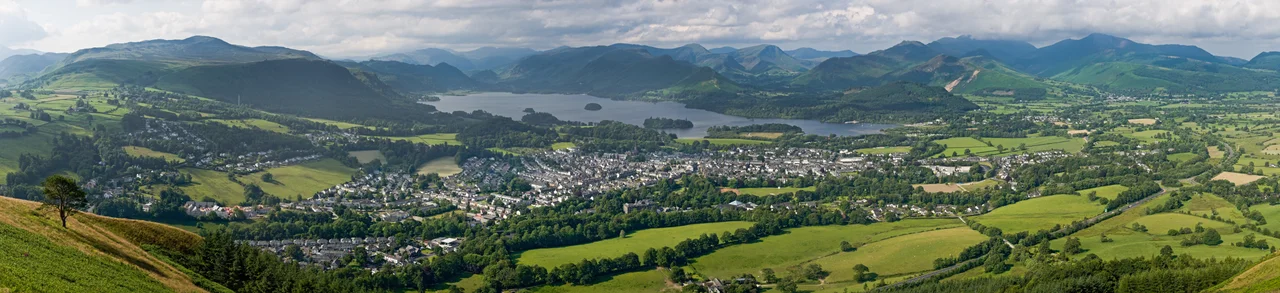

Keswick
Six months after William and Dorothy Wordsworth moved into Dove Cottage at Grasmere in late 1799, Samuel Taylor Coleridge could not stand being twelve miles away. He leased a house called Greta Hall in Keswick and moved his family in. Three years later his brother-in-law Robert Southey joined him there. The Wordsworths walked over the fells to visit. So did Charles and Mary Lamb. So did Thomas De Quincey, William Hazlitt, Percy Bysshe Shelley, and Sir Walter Scott. For about a decade Greta Hall held an extraordinary share of the literary energy of Romantic England, and Keswick became, almost by accident, a town that the rest of the country wanted to visit.
Greta Hall and the Lake Poets
Coleridge moved in around the middle of 1800. Southey arrived in 1803 - the marriage of his sister to Coleridge had made them brothers-in-law - and stayed for forty years. After Coleridge left in 1804 (his life had become difficult; his opium use had become much worse), Greta Hall remained Southey's family home until his death in 1843. The roll of visitors over those four decades reads like a syllabus. Charles Lamb, the Londoner devoted to his city, found himself doubtful about the attractions of the Lake District. Most of the other guests fell hard for the scenery and wrote about it - travelogues, essays, letters, poems - and the cumulative effect was a kind of unintended national advertisement. By the second half of the 19th century, the Lake District had become one of the most-visited landscapes in England, and Keswick, with its convenient market square and its bracing valley setting, had become its market-town capital.
The Pencil Town
Long before the poets arrived, Keswick had quietly become the pencil capital of the world. The graphite mined from Borrowdale - a unique deposit of pure solid carbon, found nowhere else on Earth - was brought down to Keswick to be sawn into sticks and inserted into wooden cases. The first pencils were sold in Keswick markets in the late 16th century. The industry grew. The Cumberland Pencil Company, founded in Keswick in 1832, made the town a household name in classrooms across the British Empire. The Borrowdale graphite eventually ran out, but the manufacturing skill stayed. The factory finally closed in 2007 after nearly two hundred years of continuous production, and the building has since been converted into the Cumberland Pencil Museum. The museum is small, eccentric, and includes the world's longest pencil. Visitors who expect to find pencils boring usually leave reasonably charmed.
Sir John Bankes and the Vegan
The town's local history before and after the Lake Poets is full of figures who do not quite fit any one frame. Sir John Bankes was born at Castlerigg near Keswick in 1589 and rose to become Charles I's Attorney General and Chief Justice. He was a leading Royalist in the English Civil War. A bust honours him in upper Fitz Park, and in 2014 a bar opened in the former courthouse named for his full title - The Chief Justice of the Common Pleas. Frederic Myers, born in Keswick in 1843, became a classical scholar, an essayist, a poet, and one of the founders of the Society for Psychical Research, a Victorian organisation that tried to study ghosts and telepathy with scientific rigour. Donald Watson, who founded the Vegan Society in 1944 and coined the word "vegan" itself, lived in Keswick after retiring from teaching. The town also produced George and Ashley Abraham, pioneering mountain photographers whose 1887 shop on Lake Road - taken over decades later by mountaineer-outfitter George Fisher - still trades on the Abrahams' legacy.
Walpole and the Herries
Of the literary figures who came after the Lake Poets, the novelist Hugh Walpole was the one most fully claimed by Keswick. He moved into a house called Brackenburn in 1924, set on the wooded slope above Derwentwater, between Keswick and Grange. He lived there until his death in 1941. Like the Lake Poets a century before, he wrote enthusiastically about the Lake District; like them, he made it the setting for a major work - the four-novel Herries Chronicles, which trace a fictional Cumbrian family across three centuries. "That I love Cumberland with all my heart and soul," Walpole wrote in 1939, "is another reason for my pleasure in writing these Herries books. That I wasn't born a Cumbrian isn't my fault." The novels are largely out of print now. Walpole's house still stands. The view from it has not changed.
A Working Market Town
Keswick is a market town, not a museum. It has been since the Middle Ages, and the Moot Hall - the oddly-shaped market building at the centre of the square - has been the focus of town life since at least the 17th century. The Keswick Music Society has presented classical concerts every year since its founding in 1947; the Theatre by the Lake, opened on the southern edge of Hope Park in 1999, runs a year-round repertory programme. Climbers, walkers, lake-cruisers, children, dogs and an enormous number of Gore-Tex jackets pass through the square every weekend. The fells around it - Skiddaw and Blencathra to the north, Catbells and Walla Crag flanking the lake, the high spine of Helvellyn just out of sight to the south-east - keep the weather interesting and the town busy. Keswick exists, in the end, because it stands at the meeting-point of seven valleys, and people have been buying and selling and meeting and walking through it for the better part of a thousand years.
From the Air
Keswick sits at 54.60 degrees north, 3.14 degrees west, at the northern end of Derwentwater in the northern Lake District. From the air the town reads as a tight cluster of slate-roofed buildings on the lake's northern shore, with Skiddaw (931 m) rising sharply directly north. The A66 road skirts the town to the north. Derwentwater extends south. Bassenthwaite Lake lies a few miles to the north-west. The Borrowdale valley extends south from the lake. Nearest airfields: Carlisle Lake District (EGNC) approximately 22 nm north, Newcastle (EGNT) about 60 nm east. Cruise altitudes of 4,000-6,000 feet give views over both Derwentwater and Skiddaw. Cap cloud often forms on Skiddaw's summit ridge even in otherwise clear weather.
Nearby Stories
- Parton railway station 4.4 km away
- Brough Castle 11 km away
- Cartmel Racecourse 13 km away
- Caerlaverock Castle 15 km away
- Vindolanda 18 km away
- Yorkshire Dales 25 km away
- Cashtal yn Ard 55 km away