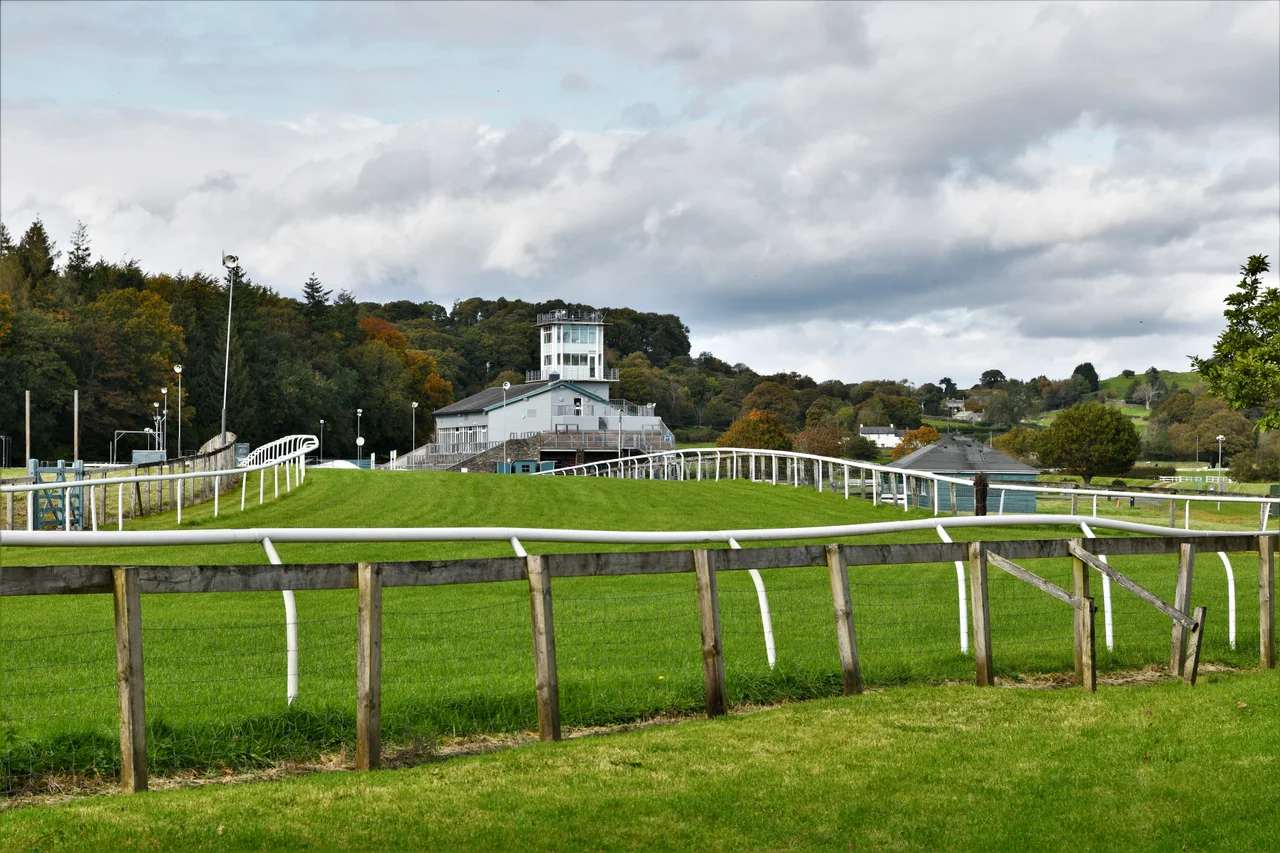

Cartmel Racecourse
Every winning connection at Cartmel goes home with a sticky toffee pudding. It is the small detail that tells you most of what you need to know about this little Cumbrian racecourse - that it is unselfconscious enough to give out puddings instead of mere prize money, and proud enough of its village's most famous export to make the gesture stick. Cartmel is a national hunt course in a village of 1,500 people, with a small grandstand, mostly temporary facilities, and a habit of pulling crowds of 20,000 to its biggest meetings. Only Aintree and Cheltenham average higher.
Mule Races and Monks
The origins are rather obscure. One persistent story has it that racing at Cartmel began with the medieval monks of Cartmel Priory, who organised mule races to make their journeys across the sands of Morecambe Bay to Lancaster more interesting. The Priory itself dates from 1190 and survived the Dissolution because its parish church function was preserved. Whether the monks really raced is harder to confirm than to imagine. The records get sharper in 1856, when the village hosted Innkeepers' Stakes of £15 and Tradesmen's Stakes of £30. Hound trailing and foot races were part of the programme then - rural Cumbrian sports that often shared a calendar with the horses. At the 1869 meeting there were not enough horses entered, and the human runners drew the crowd's attention instead. A man named T. Dowrie won three races on foot. In 1875, foot races were dropped and the meeting was brought under Grand National Rules. Cartmel had become, formally, a racecourse.
Nine Days a Year
Cartmel does not race often. Nine racedays are held each year, spread across three meetings at the Whitsun weekend in late May, in July, and on the August Bank Holiday weekend. The three-day May meeting actually takes place over five days - a day off for racegoers to enjoy the Lake District countryside between each day at the races. The crowds arrive so early in the day and leave so late that there is not time to clear up and turn the course around for consecutive days. This is a kind of consideration rare in modern sport: the recognition that the experience is the whole of the experience, not just the races. The two-day July meeting takes place over three days, with the same recovery day in the middle. Its centrepiece is the Cumbria Crystal Hurdle Race, worth over £40,000 - the most valuable race at the course. The August meeting features the Cartmel Cup, a hurdle race, and the Cavendish Cup, a steeplechase.
The Layout and the Run-In
The track is about a mile round, with six fences, and runs in a slightly squashed oval through farmland just outside the village. Its standout feature is the steeplechase run-in: four furlongs - 804 metres - from the last fence to the finish, the longest in Britain. A horse can clear that final fence in front and still be caught by a strong finisher coming through. The hurdle run-in is shorter, slightly under two furlongs at 402 metres. The finishing straight bisects the centre of the course, dividing the gathering crowd into two camps. On one side sits a very large fairground - dodgems, rides, food stalls, the noise and smell of a country fair grafted onto a race meeting. On the other side stand the Parade Ring and Winners' Enclosure. The village shops are a short walk away. People come for the day and stay; they wander between the track and the village and the fair, and the racing fits inside the whole.
The Gay Future Coup
In 1974, Cartmel became the site of one of the most elaborate betting coups in British racing history. The plan was organised by Tony Murphy, a millionaire Irish builder and racing enthusiast, working with Scottish trainer Antony Collins. It depended on a peculiarity of the course at the time: limited telephone communications, so it was nearly impossible for bookmakers in London to communicate quickly with the course. A horse entered as Gay Future was switched - a poor lookalike was stabled openly in Collins' yard in Scotland to suit the betting public's expectations, while the real Gay Future was trained secretly and brought south to race. Conspirators placed accumulator bets across London bookmakers tied to Gay Future winning at Cartmel and two other entries that, by design, would not run. By the time London realised what had happened, Gay Future had won, the other horses had been withdrawn, and the bookmakers owed huge sums. The conspirators were eventually convicted of conspiracy to defraud. The coup became part of British racing folklore. Cartmel itself was the unwitting stage; the village racecourse had been chosen precisely because the rest of the betting world could not see what was happening here. The most celebrated course specialist in recent memory was Soul Magic, who won at the track on seven occasions between 2010 and 2013, a record since equalled by Tonto's Spirit.
From the Air
Located at 54.2031 N, 2.9558 W in the southern Lake District near Morecambe Bay. Recommended viewing altitude 2,000-3,500 ft for course context. Visual landmarks: a small oval racetrack just outside Cartmel village, the medieval Cartmel Priory church visible to the south, Morecambe Bay opening to the south. Nearest airports: BAE Warton (EGNO) 30 nm south, Blackpool (EGNH) 35 nm south, Carlisle Lake District (EGNC) 30 nm north. Race days bring crowds of up to 20,000 and significant additional ground traffic; check NOTAMs for any temporary restrictions during meetings.
Nearby Stories
- Red Tarn 4.2 km away
- Fleetwood Lifeboat Station 4.3 km away
- St Bees Priory 5 km away
- Brough Castle 9.5 km away
- Sawley Abbey 9.8 km away
- Hawes Junction Rail Crash 15 km away
- Egremont Castle 28 km away
- Celtic Array 63 km away