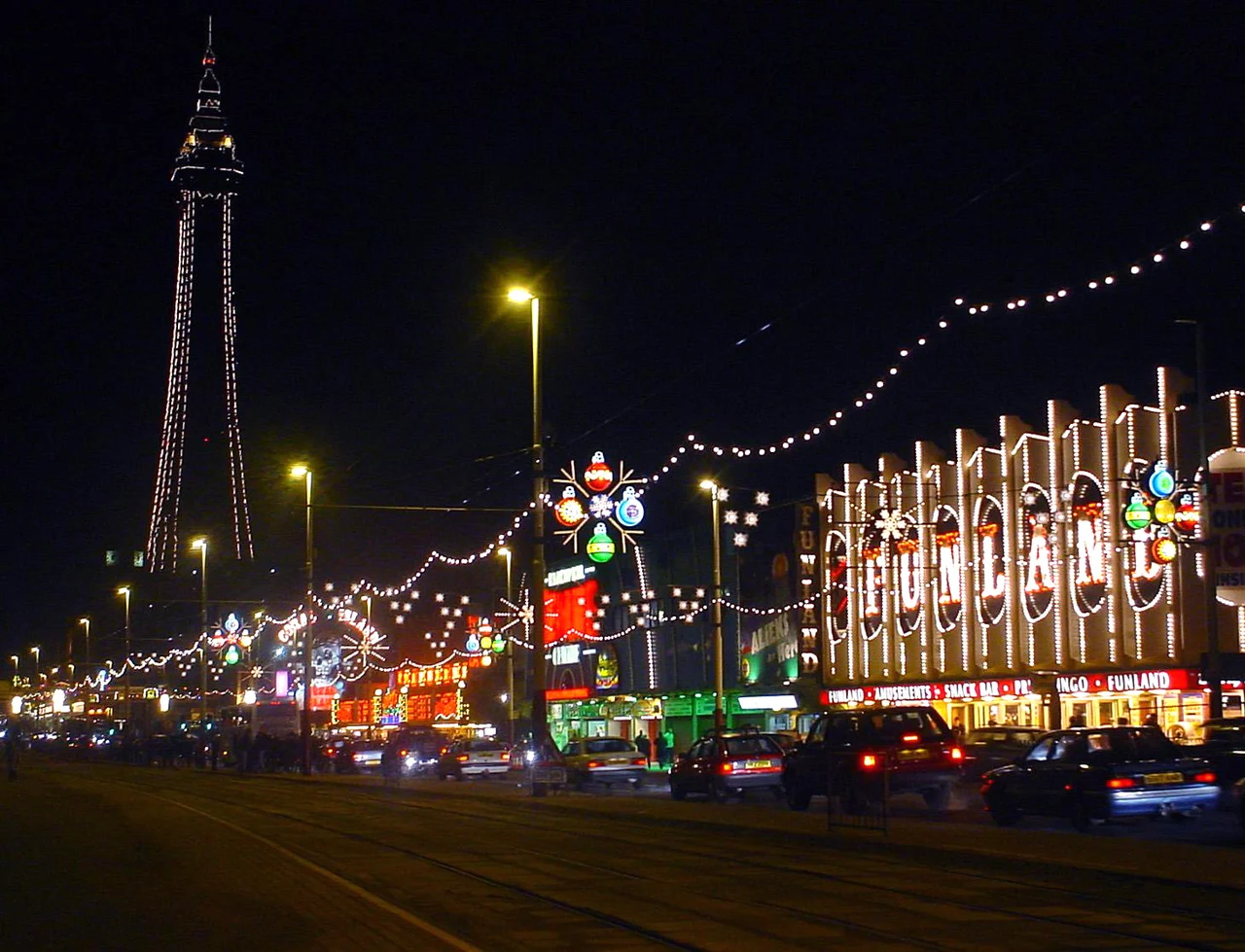

Blackpool Illuminations
Eight electric arc lamps came on along Blackpool Promenade on 18 September 1879. The local press called the effect artificial sunshine. Mains electricity had only just become a thing - the Edison incandescent bulb was still a year away from patent - and most of England still ran on gaslight. Already, before the Tower existed and before the trams clattered along the front, Blackpool was turning itself into a place that would not let summer end. Today the Illuminations stretch six miles, use over a million LED bulbs, lasers and animated tableaux, and pull tens of thousands of visitors a night through autumn and into the new year.
A Season That Refused to End
The first display recognisable as a modern Illumination came in May 1912, when Princess Louise opened a new stretch of promenade called Princess Parade. The seafront was draped in what newspapers called festoons of garland lamps, about 10,000 bulbs in all. Blackpool's chamber of trade looked at the response and asked the council to do it again in September, as a way to keep visitors coming after the school holidays ended. They did. By 1913 it was an established end-of-season event. The First World War shut it down. So did the Second. There were no displays from 1939 through the lean post-war years, until the lights finally came back on in 1949. The Lights of Leamington Festival in Warwickshire tried to rival them through the 1950s and gave up in 1961.
A Fifteen-Year-Old Switches On
In 1935 the Mayor of Blackpool, Alderman George Whittaker, was due to perform the Switch-on. On the day, he met fifteen-year-old Audrey Mosson, the reigning Railway Queen - a national title given to a young woman from a railway family - and on impulse asked her to do the honours instead. The crowd loved it. Fifty years later, in 1985, Audrey was invited back to do it again, this time alongside the actress Joanna Lumley. The ceremony has been broadcast live ever since BBC Radio 1 first put Status Quo on the switch in 1993; Radio 2 took over from 1997 to 2010, then commercial stations under Real Radio and Smooth Radio. Each year a guest celebrity throws the lever in front of a crowd packed onto the central promenade.
From Garland Lamps to Lasers
It takes about twenty-two weeks to put the modern Illuminations up and nine weeks to take them down again. The annual budget runs over two million pounds. Most of the network operates on low voltage now - 12V and 24V - and in 2003 a switch to more efficient technology cut electricity use by 11%. In 2004, wind turbines at the Solarium on New South Promenade started feeding power back into the display, which is a tidy thing for a coastal show running through the windy autumn. The tableaux at North Shore stretch over 5,000 square metres along the cliff between the Promenade and the tramway, and visitors can walk the length on a dedicated path. Designer Laurence Llewelyn-Bowen, of Changing Rooms fame, has been involved for twenty years; for the 2025-26 season he prepared a dragons installation called Guardians of the North.
A North-South Divide in Six Miles
Most visitors come from the north - the north-west of England in particular, plus Scotland in droves. The lights are not really a national event so much as a regional pilgrimage. Llewelyn-Bowen, who lives in the south, has joked about a bit of a north-south divide in awareness. The illuminated heritage trams have a starring role: an open-top tram glides slowly under arches and past spaceships and dancing figures, with the sea on one side and the tableaux on the other. The Western Train tram, first run in 1962, was restored in 2008 with a £278,000 Heritage Lottery Fund grant after years of campaigning by the local newspaper, the Blackpool Gazette. The Rocket tram followed.
The Lights We Still Switch On
Strip away the celebrity switch-ons and the designer brands and what the Illuminations are, really, is an act of municipal stubbornness. A seaside town that knew its season ended in August decided that the season would not end. Whatever recession or war or shift in holiday taste came along - the package holiday boom, the rise of the Mediterranean, the gradual emptying of Britain's old seaside resorts - the lights kept going on. Every September the cherry pickers go up. Every autumn the dragons and aliens and dance figures take their places. Every visitor who drives the prom slowly at night, kids leaning out the window pointing at the next tableau, becomes part of the same long tradition that started with eight arc lamps and a chamber of trade that did not want summer to end.
From the Air
The Blackpool Illuminations run along the seafront at 53.82 N, 3.06 W, from Starr Gate in the south to Red Bank Road at Bispham in the north - about six miles of continuous lighting. From the air at night between late August and early January, the entire seafront strip reads as an unbroken ribbon of light along the Fylde Coast, instantly recognisable. The closest airport is EGNH Blackpool, about 2 nm east of the central promenade. The Blackpool Tower (a Visual Reporting Point known on charts as 'the tall tower') is the dominant landmark, with the lit promenade extending miles to either side. Manchester (EGCC) is 35 nm southeast. Liverpool John Lennon (EGGP) is 28 nm south. Avoid low-altitude transit over the central promenade during peak Illumination weekends in October.
Nearby Stories
- RAF Cark 3.1 km away
- Bolton Steam Museum 3.2 km away
- Clitheroe Castle 4.5 km away
- Scarisbrick Hall 4.5 km away
- Hawes Junction Rail Crash 24 km away
- Abergele Rail Disaster 37 km away
- Egremont Castle 38 km away
- Celtic Array 60 km away