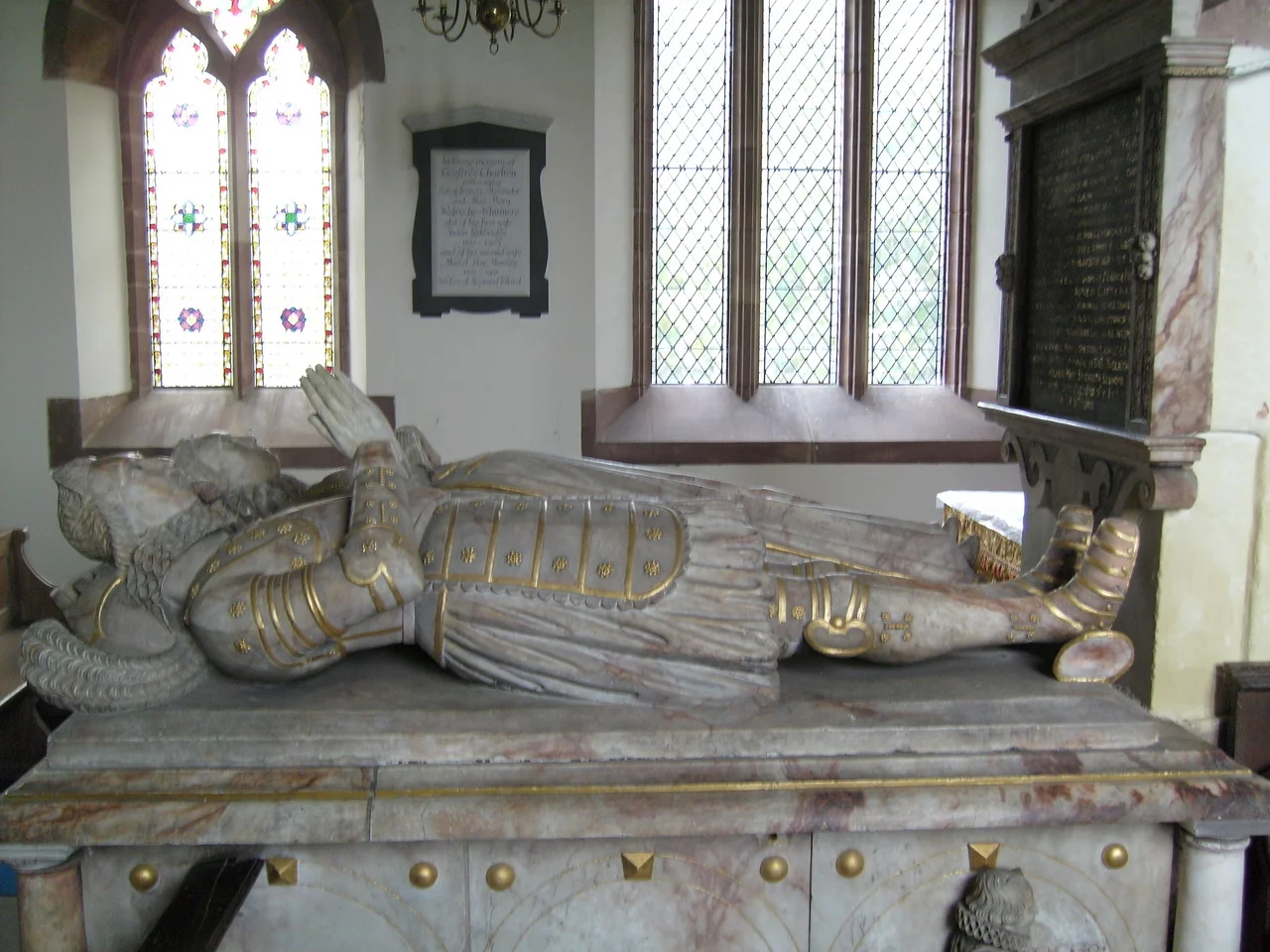

Dudmaston Hall
In 1814 Charles Babbage, the man who would design the first general-purpose computer, married Georgiana Whitmore of Dudmaston Hall and spent significant stretches of his life living here in the Shropshire countryside. He even engineered the house's central heating system. A century and a half later, in the same drawing rooms where Babbage tinkered with hot-water pipes, the National Trust would describe Dudmaston's collection as one of Britain's most important public assemblies of modern art. The hall has spent six hundred years quietly accumulating eccentrics, reformers, and obsessions, and it shows.
Six Hundred Years in One Family
The Wolryche family acquired Dudmaston in 1403 when William Wolryche of Much Wenlock married Margaret de Dudmaston, the heiress of the previous owners. The estate has stayed in the same family or its in-laws ever since, an unbroken line that includes the Wolryche-Whitmores and the Hamilton-Russells. The current Hall is a sandstone H-plan country house begun around 1700 by Sir Thomas Wolryche, the third baronet, on the model of Belton House in Lincolnshire. Francis Smith of Warwick, prolific architect of the early Georgian Midlands, appears to have provided the design. Thomas died in 1701 before the house was finished. His son and heir, the fourth baronet, then drowned in the Severn in 1723 trying to ford the river after a day at the Chelmarsh races, leaving heavy debts and no male heir. The estate's survival owed itself to his sister Mary and her mother, who spent fifty patient years steadying the books.
Civil War Scars
Sir Thomas Wolryche the first, who got his baronetcy in 1641 from Charles I, was made governor of Bridgnorth Castle when the war started. When Parliamentary forces arrived in 1646, his garrison set fire to the town as they retreated into the castle, destroying most of medieval Bridgnorth in the process. The garrison surrendered shortly afterwards anyway. Parliament fined Wolryche 730 pounds 14 shillings, and he was one of the few royalists who never recovered his money even after the Restoration in 1660. The destruction is still commemorated on a plaque at Bridgnorth Museum. It is the sort of footnote that explains why some Shropshire families never quite recovered the wealth they had before the Civil War.
A Reforming MP and a Painted Garden
William Wolryche-Whitmore, who inherited in 1815, spent his twenties on a Grand Tour that included a personal visit to Napoleon in exile on Elba. He came home to a parliamentary career devoted to causes that ought to have damaged his class interests: parliamentary reform, Catholic emancipation, the end of Caribbean slavery, repeal of the Corn Laws. He warned the Commons about the consequences for India of British colonialism, opposed convict and slave labour wherever it was used, and campaigned for working-class emigration as a means of opportunity rather than punishment. Meanwhile he was reshaping the western view from the house: combining three small lakes into the Big Pool, terracing the slope, planting the American Border that today holds rhododendrons and a wide range of Asian and American shrubs. The Dingle, the small wooded valley to the south of the house, had been laid out earlier by his mother Frances Lister and the gardener Walter Wood, with quarried cliffs and rustic bridges in the Picturesque style fashionable in the late 18th century.
Henry Moore and Spanish Modernism
The modern art that fills Dudmaston today comes mostly from Sir George Labouchere, a career diplomat from a Huguenot family, and his wife Rachel Hamilton-Russell, who inherited the estate from her uncle in 1966 on the condition that it eventually pass to the National Trust. George had been Britain's ambassador to Francoist Spain from 1960, and the Laboucheres collected the artists of the left-wing opposition to the regime: an entire room of mid-20th-century Spanish painting and pottery that you would not expect to find in Shropshire. They added sculpture by Henry Moore and Barbara Hepworth, and Rachel, who had trained as a botanical artist at Flatford Mill, built up a serious collection of plant drawings. The National Trust took possession in 1978 but the Laboucheres kept living there, Rachel famously chatting to visitors right up until her death in 1996. She left a memorandum specifying that the house should always have a family in residence, and the descendants of her second cousin Colonel James Hamilton-Russell still live there today.
Pigs, Asparagus, and Fell Ponies
Dudmaston is not a museum. The estate still farms, still raises pigs, still grows asparagus, and still occasionally tushes timber out of the woods with a Fell pony when a tractor cannot reach. Fell ponies were originally pack animals for the Cumbrian lead mines, and watching one pull a log down a wet woodland track is to watch a piece of working pre-mechanical agriculture survive in the year of social media. The 350 acres of garden and parkland slope down to the Severn, and the hall sits in the middle of it all: an unshowy sandstone box that has somehow become a national gallery for both English sculpture and Spanish dissident painting, while still feeding pigs and growing asparagus out the back.
From the Air
Located at 52.50 N, 2.38 W in the Severn Valley, south of Bridgnorth. At 2,500 to 4,000 feet, the Big Pool and parkland are clearly visible on the east bank of the Severn, with Bridgnorth and the river curving north. Nearest airports: RAF Cosford (EGWC) about 9 nm east-north-east, Wolverhampton Halfpenny Green (EGBO) about 6 nm east.
Nearby Stories
- White Lion Inn 3.6 km away
- National Motorcycle Museum (UK) 4.5 km away
- Siege of Worcester (1643) 4.6 km away
- Stokesay Castle 4.7 km away
- Burton Abbey 11 km away
- Stafford Castle 12 km away
- Whittington Castle 20 km away
- Hay Castle 26 km away