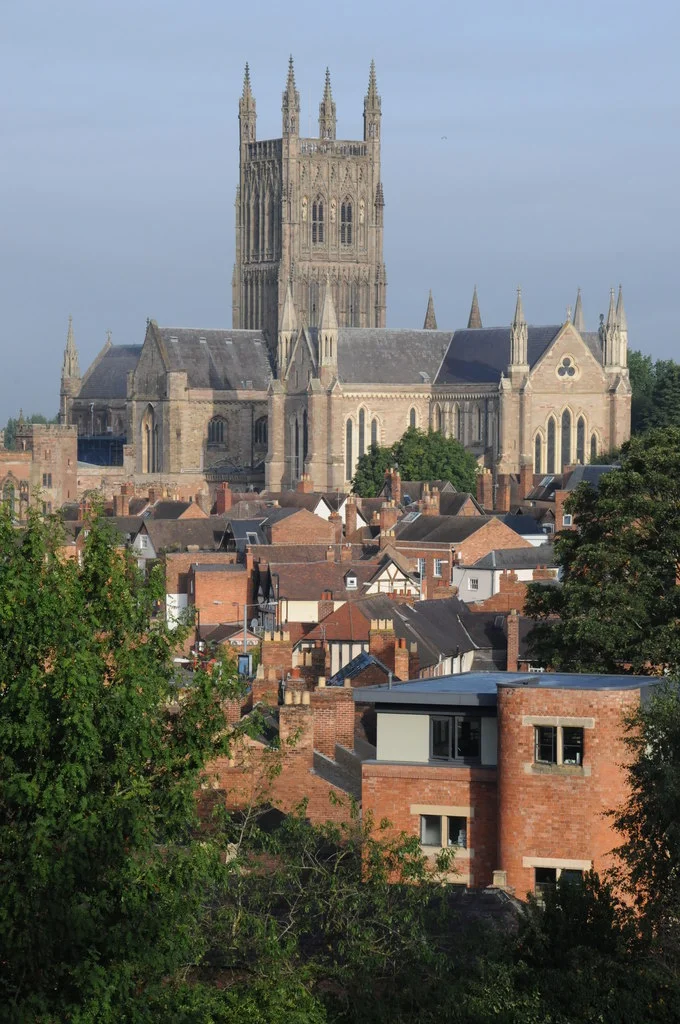

Siege of Worcester (1643)
Sir William Waller's trumpeter rode up to Worcester's Sidbury Gate at dawn on 29 May 1643 and demanded the city's surrender. Colonel William Sandys, the acting Royalist governor, told him with elaborate rudeness to get lost. The trumpeter, who knew the rules of war, refused to leave without a proper reply. Sandys came back. The trumpeter answered again, insultingly. Captain Beaumont, beside Sandys, ordered the sentry to shoot, and the sentry shot the trumpeter through the thigh. He fell from his horse mortally wounded. Worcester had not yet been besieged for an hour and already the city had made an enemy of one of the most popular generals in the Parliamentary army.
Why Waller Came
He had come because he could not afford not to. Six weeks earlier, on 13 April 1643, Sir William Waller had been beaten by Prince Maurice at the Battle of Ripple Field, and the Royalists had paraded one of his captured colours through Oxford. To recover his reputation, Waller defied orders to return to Bristol and instead raced for Hereford with 2,500 men, took the city on 25 April, looted what he could carry, and turned his eye on Worcester. The Royalist garrison there was under-supplied, internally divided, and presumed to have a pro-Parliamentary faction in the city ready to open the gates. Waller's spies told him the place would fall if he merely showed himself. Sandys, the acting governor, had heard the same rumours and was waiting. He had rebuilt the city walls, raised 300 volunteers from among the citizens, and put his 1,500-strong garrison on alert.
Three Days at Diglis
After the trumpeter fell, Waller opened with his guns at six in the morning. The artillery duel ran for hours - some accounts say it continued from dawn until ten that night - without his eight cannons ever silencing the city's forts. An assault on the eastern walls, near the Friary Gate, was repulsed with heavy loss. South of the city, at Diglis, Waller did better: his men seized a house outside the walls belonging to a Mr Berkeley and used it as a firing platform until Sandys's troops counterattacked, drove the Parliamentarians out, and burned the house behind them. Then came the sortie that decided things. A Royalist cavalry detachment burst out of St Martin's Gate, fell on Waller's right flank, and drove it back on the centre at Greenhill. Sixty or seventy Parliamentarians died in the fighting. Waller, with wounded piling up and a report (false but credible) that Prince Maurice was racing from Oxford to cut his line of retreat, decided to leave.
Retreat by River
His withdrawal was a piece of dark improvisation. Waller commandeered every boat he could find on the Severn around Worcester, loaded his guns, his baggage, and his wounded onto them, and sent them downriver to Gloucester. He then sent foragers as far north as Ombersley to confiscate horses - particularly those belonging to Colonel Sandys and his brother Martin, a private revenge as well as a logistical necessity. At one in the morning on 31 May 1643, Waller began his retreat south through Tewkesbury. Five or six of his captains and 160 soldiers were dead; barges were full of his wounded. The Worcester garrison claimed, with obvious bravado, to have lost only two men and three women. Their gunners had fired 200 great shot and burned eleven barrels of powder.
What the Worcester Women Did
The most striking story to come out of the siege is what happened after. Waller had been able to advance in cover only because of the trees, hedges, and small houses that lay outside the city walls, and he might come back. The garrison decided that everything within musket-range of the walls had to be cleared - and the women of Worcester, organised by ward, formed companies and did it themselves. They worked through what was left of the night and into the next day, levelling fences, demolishing buildings, tearing down hedges, denying the next attacker the shelter that Waller had used. The chronicles call them simply "the women of Worcester." The contemporary account preserved as a Wikisource document records that they "freely formed companies and levelled all the fortifications that were left behind by the Parliamentarians." It is one of the few moments in the English Civil War where the people doing the work of war are named not as soldiers but as citizens.
What It Cost Waller
He had not lost the war; he had lost something subtler. Until Worcester, William Waller had been the most popular Parliamentary general in the country. The pamphlets had nicknamed him "William the Conqueror." After Worcester he was a man who had attacked a fortified city with insufficient force, lost his colours and his trumpeter, and slunk away by river. The Lord General the Earl of Essex, who had long been jealous of Waller's reputation, censured him severely. Six weeks later, on 13 July 1643 at the Battle of Roundway Down, Waller would suffer a defeat so total that his cavalry was effectively destroyed. He never recovered his former standing. Waller himself acknowledged it. "Worcestershire," he was reported to have said, "was not a lucky place for him." The city remained Royalist for another three years - until a second, far longer siege in 1646 finally ended the First Civil War where it had started in the Midlands.
From the Air
Located at 52.19°N, 2.22°W in the centre of Worcester, on the east bank of the River Severn. Best viewed at 2,000-3,000 ft AGL. The cathedral tower (about 200 ft) and the river itself are the unmistakable landmarks; Diglis, where most of the 1643 fighting took place, lies just south of the cathedral where the modern lock complex now sits. Nearest airfields: Gloucestershire (EGBJ) 17 nm south, Wolverhampton (EGBO) 22 nm north, Birmingham (EGBB) 24 nm north-east.
Nearby Stories
- Kidderminster 2.5 km away
- Stokesay Castle 5.4 km away
- White Castle, Monmouthshire 6.2 km away
- National Motorcycle Museum (UK) 7.7 km away
- Church of the Holy Trinity, Stratford-upon-Avon 8.2 km away
- Prinknash Abbey 8.3 km away
- Dore Abbey 18 km away
- Woodstock Palace 27 km away