
Kidderminster
If you have ever stuck a stamp on an envelope, you owe a small debt to a man born in Blackwell Street, Kidderminster, in 1795. Sir Rowland Hill invented the Penny Black and with it the modern postal system: prepaid, adhesive, paid by sender rather than receiver, the same flat rate across the kingdom. There is a statue of him by Thomas Brock in Vicar Street outside the town hall. Kidderminster has a habit of producing people who quietly changed how the world works without ever quite being famous for it.
Carpet Town
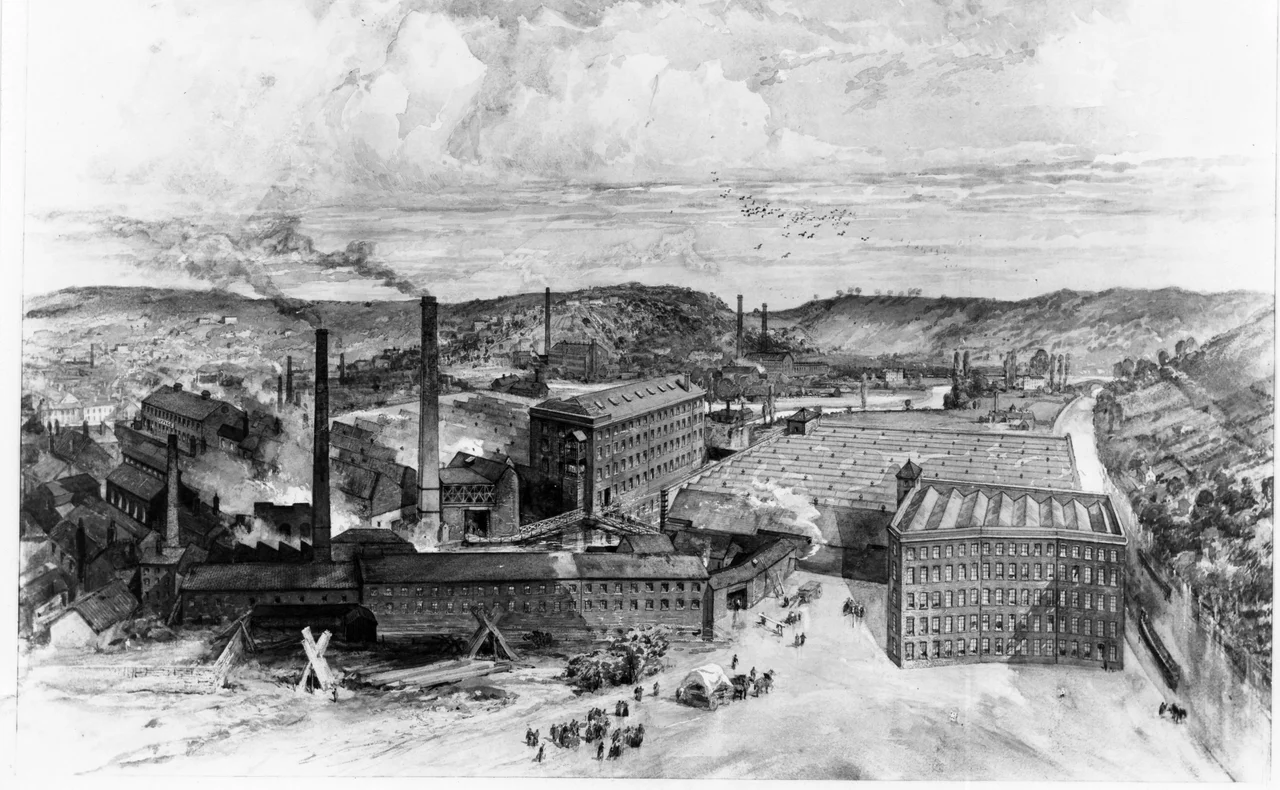
Kidderminster is Worcestershire's largest town, and it owes that size to a single industry. Carpet weaving took root here in the 18th century and by the Victorian era had made Kidderminster one of the most important carpet-making centres in the world. The Brussels carpet, the Wilton, the Axminster: most of the great names of British floorcovering passed through Kidderminster looms at some point, and the long brick mills along the River Stour and the Staffordshire and Worcestershire Canal still mark the skyline even though most of the factories have closed. Sir Herbert Smith, 1st Baronet, made his fortune in Kidderminster carpets and bought Witley Court with it. Walter W. Law was born to a Kidderminster carpet dealer, emigrated to America, made a second fortune in carpets and founded the village of Briarcliff Manor in New York. The town's wealth went out into the world; some of it came back.
Rowland Hill and the Penny Black
In the 1830s, sending a letter in Britain was an aristocratic privilege. Postage was paid by the recipient at rates that depended on distance and number of sheets, and ordinary working people often refused delivery because they could not afford the charges. Rowland Hill, the Kidderminster-born educator and reformer, proposed a radical simplification: a single low rate, a penny, prepaid by the sender, signified by a small adhesive label affixed to the letter. The first such label, the Penny Black, was issued on 6 May 1840. Mail volumes exploded. Hill's system spread to every country with a postal service, and over a century later it is essentially still how letters move. The town hall once had a pub called The Penny Black opposite it, named for the local hero.
Ukawsaw Gronniosaw's Kidderminster Years
In the 1760s and 1770s a man named James Albert, born Ukawsaw Gronniosaw, lived in Kidderminster with his family. He had been kidnapped as a child from what is now Nigeria, sold into slavery in the West Indies, eventually freed, and converted to Christianity. While living in Kidderminster he dictated his life story to a secretary from Leominster, and the book was published in Bath around 1772 as A Narrative of the Most Remarkable Particulars in the Life of James Albert Ukawsaw Gronniosaw, an African Prince. It is considered the first Black African autobiography published in Britain, a foundational text in a literary tradition that would later include Olaudah Equiano. He was an ordinary working man, often desperately poor, and the book exists because he wanted his life and his faith known. That this happened in a small carpet town in Worcestershire is one of the surprising facts of 18th-century English religious dissent.
Richard Baxter's Ministry
In April 1641, with Civil War about to break, a young Puritan minister named Richard Baxter accepted the lectureship at St Mary's parish church in Kidderminster. He stayed nineteen years. His sermons drew huge crowds, his pastoral care reshaped the town, and his books, written in odd hours stolen from parish work, made him one of the most influential English theologians of the 17th century. The inscription on the statue outside St Mary's records his hope for unity and comprehension in religion, the irenic instinct that drove him to argue for tolerance between denominations at a moment when most of his colleagues were busy hating each other. He had to leave at the Restoration, was repeatedly fined and briefly imprisoned, and never went home.
Robert Plant's Town
Kidderminster's later cultural exports include Robert Plant, who grew up in the town and went on to front Led Zeppelin. There is no plaque on the house, no Stairway to Heaven mural, but ask in the right pub on Vicar Street and someone will point you toward Stourport Road and where the family lived. Tom Watson, former Deputy Leader of the Labour Party, attended King Charles I School here. The film director Robert Hamer, who made the 1949 black comedy Kind Hearts and Coronets with Alec Guinness, was born here. So was Walter Nash, who would emigrate to New Zealand and become its Labour Prime Minister. Peter Collins, the Ferrari Formula One driver who was killed at the 1958 German Grand Prix at the Nurburgring, was born in Kidderminster. The town is too working-class to make much of these connections, but the list goes on.
Today
Most of the looms are silent. Kidderminster's old carpet mills have been converted to flats and offices, and the town centre is the slightly battered mix of pedestrianised high street, Victorian arcades, and 1960s shopping precinct that you find in a hundred English mill towns. The Severn Valley Railway, the heritage steam line, runs from the town's restored Edwardian station up the Severn through Bewdley toward Bridgnorth, and on a summer Saturday the platforms smell of coal smoke and bacon sandwiches. The Stour, the river that drove the original mills, still cuts through the centre. So does the Staffordshire and Worcestershire Canal, lined with narrowboats. Kidderminster has not become a tourist town. It is still a working town that happens to have produced a startling number of people who did interesting things somewhere else.
From the Air
Located at 52.39 N, 2.25 W on the River Stour in northern Worcestershire. From 3,000 to 5,000 feet, Kidderminster appears as a dense urban patch with the Severn Valley curving west toward Bewdley, the Black Country pressing in from the east, and the Clent Hills rising south. Nearest airports: Birmingham (EGBB) about 15 nm east-south-east, Wolverhampton Halfpenny Green (EGBO) about 9 nm north.
Nearby Stories
- White Lion Inn 3.6 km away
- National Motorcycle Museum (UK) 4.5 km away
- Siege of Worcester (1643) 4.6 km away
- Stokesay Castle 4.7 km away
- Burton Abbey 11 km away
- Stafford Castle 12 km away
- Whittington Castle 20 km away
- Hay Castle 26 km away