
Stokesay Castle
Laurence of Ludlow paid 266 pounds for the tenancy of Stokesay in 1281 because he had made a fortune in wool. He was the most important wool merchant in England, exporting bales of Welsh Marches fleeces to Flanders and Italy, maintaining offices in Shrewsbury and London, lending money to nobles, helping shape royal trade policy. He did not need a castle. He wanted a country house that looked like one. The result, finished in the 1290s, is the strangest survival in English medieval architecture: a battlemented manor with arrow slits that don't work, a Great Hall with windows where its walls should be, and a Civil War siege so polite that nobody died. Almost no other 13th-century domestic building anywhere in England has come down to us this complete.
A House for a Wool Merchant
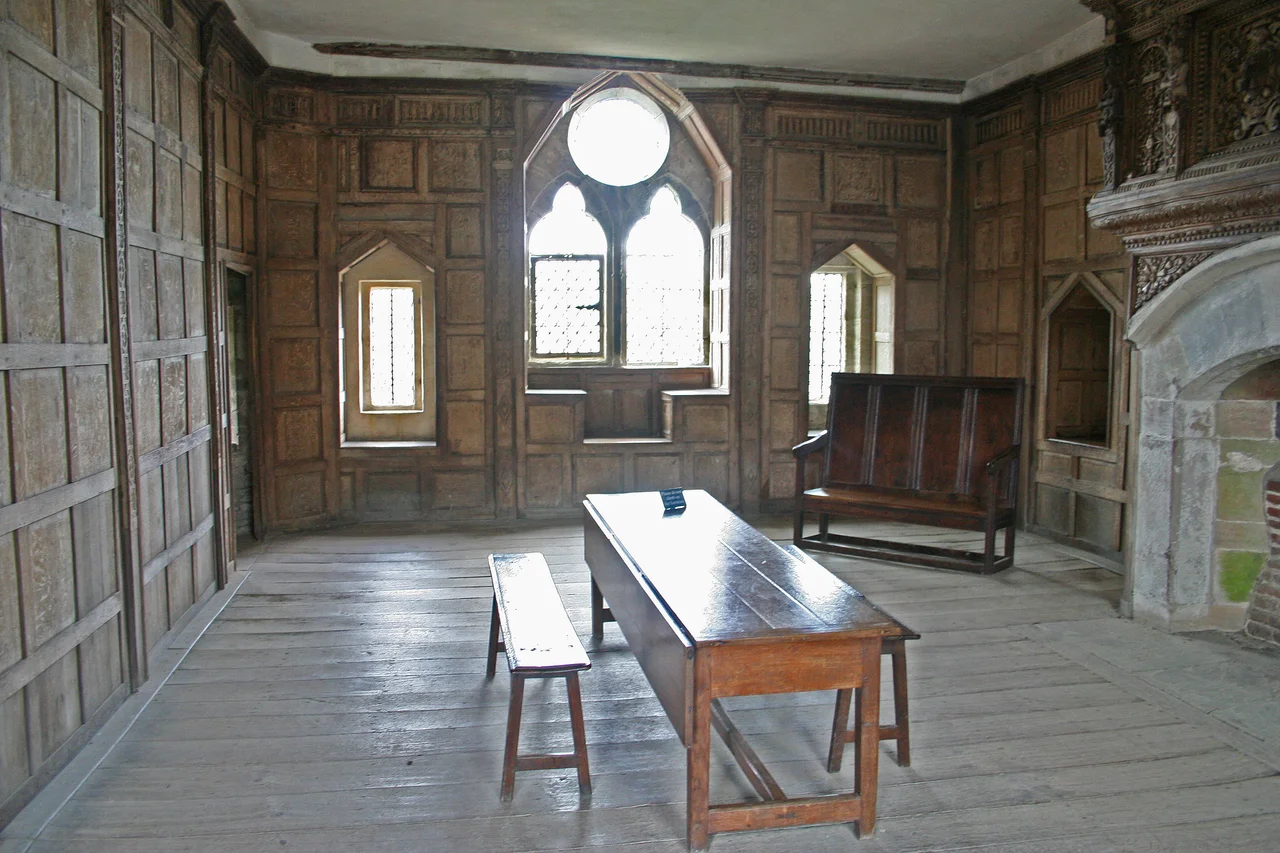
Laurence got his licence to crenellate from Edward I in 1291 and used it to add a south tower that scowls down at the moat with proper martial intent. The rest of Stokesay is something gentler. The Great Hall, built in the 1280s, still has its original 13th-century timber roof, the cruck beams arching overhead seven hundred years on. Tall windows reach almost to the floor, an absurd weakness in any real defensive building, but exactly what a wealthy merchant wanted for light and air. The solar block beside it gave the family private chambers. A 17th-century timber gatehouse, all carved figures and plaster work, replaced an earlier stone one and stands across a moated court from the hall. The style was meant to echo, at a domestic scale, the fortress-cathedrals Edward I was building in North Wales: Conwy, Caernarfon, Harlech. Stokesay was the home of a man who had grown rich on the same wool trade those castles were built to protect. He drowned at sea in November 1294, possibly before the work was quite finished, but his descendants kept the family name Ludlow and the manor for two more centuries.
The Politest Siege
By 1642 Stokesay was leased by William Craven, 1st Earl of Craven, a Royalist who spent the Civil War mostly in exile in The Hague. He installed a garrison and gave money to King Charles. In June 1645, after Parliament had taken Shrewsbury, a force of eight hundred Parliamentarians pushed south toward Ludlow and stopped at Stokesay along the way. The Royalist captain Daurett knew he could not hold the new gatehouse, which was carved oak and plaster, not stone. Both sides ran the protocol carefully. The besiegers demanded surrender; the garrison refused; the besiegers demanded surrender again; the garrison surrendered with dignity. Nobody was killed. A Royalist relief force led by Sir Michael Woodhouse tried to retake the castle three days later and was routed in a skirmish at nearby Wistanstow. Parliament ordered Stokesay slighted in 1647 but only knocked down the curtain wall, leaving the rest intact. Most English castles emerged from the war with their towers blown out and their roofs gone. Stokesay emerged with its 13th-century roof still on, its windows still glazed, and a new lease ready for the Baldwyn family who took it through the Commonwealth years.
Three Owners Who Knew Better
By 1813 the antiquarian John Britton called Stokesay 'abandoned to neglect, and rapidly advancing to ruin'. Rain was coming through the roof, the cruck beams were rotting at their bases, and a smithy in the south tower had set the place on fire in 1830. What saved Stokesay was a sequence of three owners with an unusual instinct for the period: leave things alone. William Craven, 2nd Earl of Craven, repaired but did not rebuild in the 1830s. Frances Stackhouse Acton, a local landowner with strong views, oversaw further careful work in the 1850s. In 1869 the wealthy industrialist John Derby Allcroft bought the estate and paid for a major restoration in the 1870s with the same restraint. This was deeply unfashionable Victorian conservation; most owners of the period would have rebuilt freely in the Gothic Revival style. Stokesay's owners kept what was there. The castle opened to paying visitors in 1908 and has stayed open more or less ever since.
Almost Untouched
In 1986 Jewell Magnus-Allcroft signed the castle into the guardianship of English Heritage. She left it to them on her death in 1992. English Heritage carried out further conservation in the late 1980s and has since taken the deliberate decision to keep the place largely unfurnished and to display very little interpretative material. The point is to let the architecture speak. The historian Henry Summerson calls Stokesay one of the best-preserved medieval fortified manor houses in England, and the qualifier matters: this is not a castle in the military sense, it is the merchant-class version of one. Stand in the Great Hall in late afternoon and the same light falls through the same windows that fell on Laurence of Ludlow's table seven hundred years ago. About 39,000 people came to see it in 2010. From the air the moat reads as a perfect square of water around a small grey complex of buildings, the 17th-century gatehouse's timber frame just visible across the courtyard from the south tower's stone bulk. England has very few buildings this old this complete. It happens to also be small, charming, and easy to visit.
From the Air
Stokesay Castle is at 52.43 degrees N, 2.83 degrees W in the village of Stokesay, just south of Craven Arms in southern Shropshire. The castle sits at roughly 400 ft elevation in the valley of the River Onny. Best viewed at 1,500-2,500 ft AGL to pick out the moated complex with its north and south towers, gatehouse, and Great Hall. Clun Castle is 12 nm to the southwest; Ludlow Castle is 7 nm south-southeast; Wigmore Castle is 8 nm south. Nearest airfields: Shobdon (EGBS) to the south, Welshpool (EGCW) to the northwest, Shawbury (EGOS) to the north-northeast.
Nearby Stories
- Kidnapping and Murder of Lesley Whittle 6 km away
- Malvern Museum 14 km away
- Battle of Maserfield 15 km away
- Hay Castle 18 km away
- Battle of Mynydd Hyddgen 20 km away
- Battle of Blore Heath 20 km away
- Cymer Abbey 26 km away
- Talley Abbey 42 km away