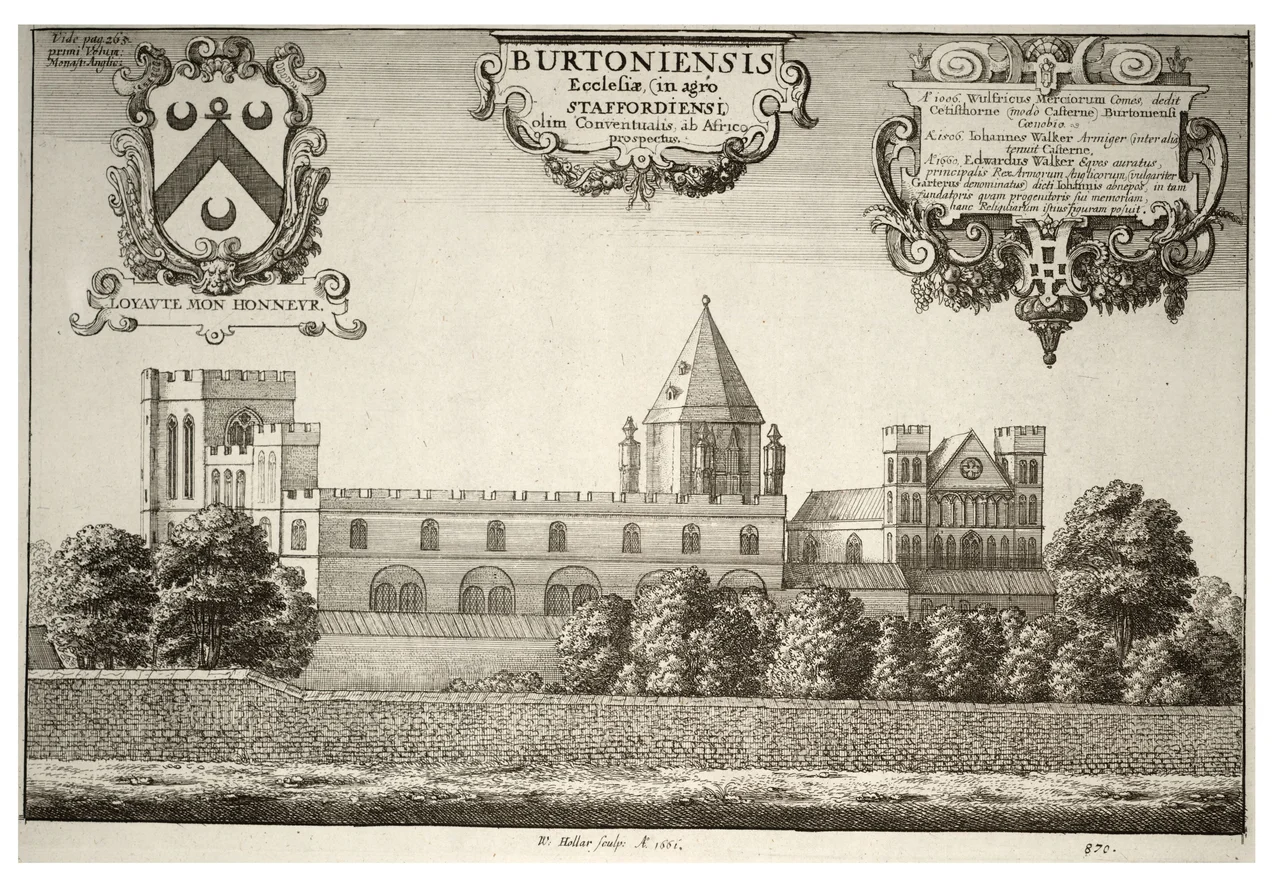
.jpg)
Burton Abbey
In 1310 the monks of Burton Abbey filed what amounts to a medieval poverty plea, declaring themselves the smallest and poorest Benedictine community in all of England. Nobody at the time could have guessed that the same modest precinct on the bend of the River Trent would one day become the launching pad for Britain's beer empire. The abbey itself is gone now, demolished in stages between 1539 and the 1720s, but its bones still shape the town. The parish church that replaced it still draws its dedication from the woman who probably started the whole story: St Modwen, the Irish-born nun who founded a religious house here in either the seventh or ninth century, depending on which medieval chronicler you trust.
The Thegn's Bequest
Whatever Modwen built fell silent for generations until 1003, when a Mercian nobleman named Wulfric Spott decided to refound the place as a proper Benedictine abbey. Wulfric was a thegn of significant means, and the charter he secured from King Aethelred the Unready in 1004 confirming the gift still survives, an Anglo-Saxon document of remarkable detail listing the lands he transferred. He was buried in the cloister in 1010, beside the grave of his wife, anchoring the abbey to the soil with the bodies of its patrons. By the time the Domesday commissioners arrived in 1086, Burton controlled estates scattered across Staffordshire, Derbyshire, and Leicestershire, holdings in Mickleover and Stapenhill, in Appleby Magna and Coton in the Elms. The map of its possessions reads like a tour of the East Midlands.
A Small House in a Big Net
Burton Abbey was always poor for its station. In the thirteenth and fourteenth centuries perhaps thirty monks lived here. By the 1520s the number had nearly halved. Mismanagement and outright fraud by various abbots kept the books in chaos for stretches of the medieval period. Yet despite the bad arithmetic, Burton mattered. By the 1530s it was the wealthiest religious house in Staffordshire, and its abbot moved in serious circles. He served on royal and papal commissions, collected clerical taxes for the diocese, and was summoned to Parliament at various points between 1295 and 1322, and again in 1532. The monks even composed the Annals of Burton, a Latin chronicle that is now one of the most important sources historians have for thirteenth-century English politics. A poor abbey, but a literate one.
Royal Guests
Kings came and went. William the Conqueror stopped here. Henry II passed through. Edward I made the abbey a stop on his northern progresses. For a small Benedictine house in a market town, this was unusually high traffic, and the abbey paid the price of hospitality in food, wine, and stretched accounts. Then Henry VIII's commissioners arrived in 1539, and the dissolution swept through Burton as it had swept through everywhere else. In a strange epilogue, the abbey was briefly refounded in 1541 as a small college, the last abbot reinstalled as dean, but four years later that too was dissolved. The lands and ruins were granted to Sir William Paget, a courtier on the make, and the chapter house began its long decay into scattered stone.
From Cloister to Cask
The most surprising afterlife of Burton Abbey was commercial. Around 1712 a man named George Hayne opened the River Trent Navigation and leased the abbey grounds to build a wharf. The monks were long gone, but the water that had served the abbey now served barges, and the barges carried barrels. Burton's hard, gypsum-rich water happened to be perfect for brewing pale ales, and within a generation the town was sending beer down the Trent to Hull, then by sea to the Baltic, then eventually to India for the troops of the East India Company. The brewing dynasties that built modern Burton, Bass, Worthington, Allsopp, all traced their access to the river through that original 1712 lease on abbey land. A medieval monastery became, by accident, the launchpad of an industrial export economy.
The Vault Beneath the College
Fragments of the old abbey still surface unexpectedly. In 1967 construction workers extending Burton Technical College broke through into two underground vaults, almost certainly the abbey's wine cellars. The larger chamber was given a second life that the Benedictines could not have foreseen: it became the student union's nightclub, christened, with grim wit, The Vault. Above ground, the parish church of St Modwen, rebuilt between 1719 and 1728 on the site of the abbey nave, still carries the saint's name forward. Two domestic buildings survive in altered form, one as a former manor house and one, the old infirmary, now an inn called simply The Abbey. The poorest Benedictine house in England turned out, in the end, to be the most adaptable.
From the Air
Burton upon Trent sits at 52.80°N, 1.63°W on the floor of the Trent valley in southern Staffordshire. From cruise altitudes the river makes an obvious silver line winding south past the town center; the parish church of St Modwen and the abbey precinct are tucked just east of the river crossing. East Midlands Airport (EGNX) lies 14 nautical miles to the east-northeast, the closest major field. Birmingham (EGBB) is roughly 23 nm to the south-southwest. Recommended viewing altitude is 2,500 to 4,500 feet for the best sense of the river, the brewery sheds, and the town's medieval grid.
Nearby Stories
- Broad Eye Windmill 1.9 km away
- Cromford Mill 3.1 km away
- Murder of Naomi Smith 5.5 km away
- Grantham Canal 6.5 km away
- Round Oak Steelworks 8.1 km away
- Nottinghamshire 9.7 km away
- Battle of Naseby 16 km away
- Sandbach Crosses 18 km away