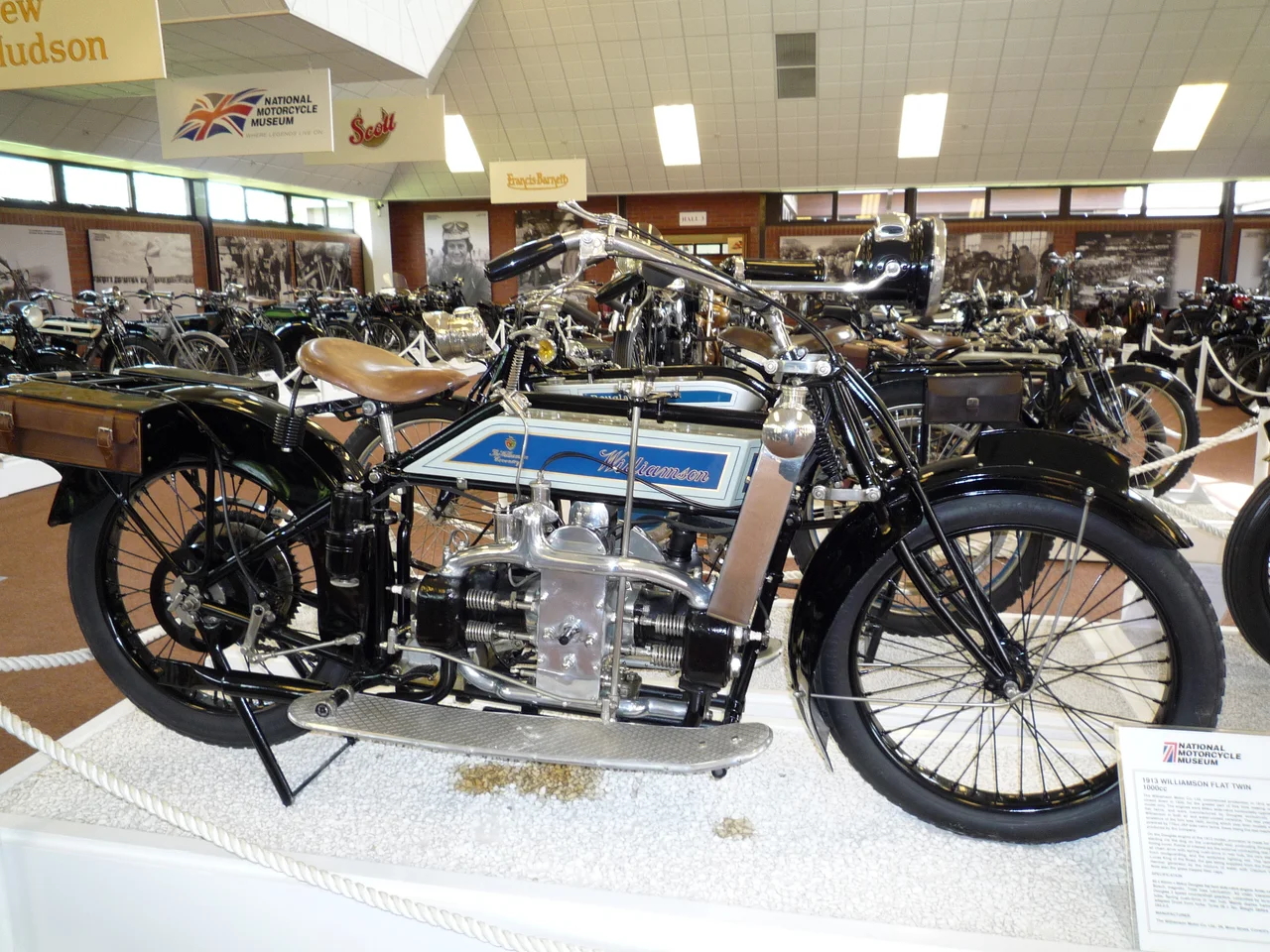

National Motorcycle Museum (UK)
Shortly before 5pm on 16 September 2003, someone in a designated smoking area outside the National Motorcycle Museum stubbed out a cigarette, or thought they had. The butt landed in a pile of cardboard boxes holding old air-conditioning filters. Within an hour the fire had climbed into the museum's dropped ceilings and run laterally through the entire complex. Staff and conference delegates ran inside again and again, wheeling motorcycles out by hand. They saved more than three hundred. Three of the five exhibition halls burnt to their footings, and 380 motorcycles were lost. The fire was visible for fifteen miles across the West Midlands countryside. It cost roughly £14 million in damage. The world's largest collection of British motorcycles had, in ninety minutes, become significantly smaller.
One Man's Collection
The National Motorcycle Museum was the personal project of W.R. Roy Richards, a construction entrepreneur and self-made millionaire who had begun collecting British motorcycles in the 1970s. By 1984 he had amassed enough to open a museum, on an eight-acre site at Bickenhill in Solihull, close to the junction of the A45 and the M42 and within sight of Birmingham Airport. It opened in October 1984 with an initial collection of 350 machines. The location was deliberate. The museum sat next to the National Exhibition Centre, on a road every Birmingham-bound motorway driver passed, and so an extraordinary number of casual visitors became regulars. Conference facilities were added in 1985 and have generated income to support the collection ever since. By the time Roy Richards died in 2008, the collection had grown to over a thousand machines covering the entire century of British motorcycle manufacture, and the museum was attracting over 250,000 visitors a year.
Iron of a Vanished Industry
What the displays show is a national industry that no longer exists. BSA, Triumph and Norton, the three names that defined the British bike to the rest of the world in the mid-twentieth century, all collapsed in the 1970s under competition from Japanese manufacturers who built faster, more reliable, less leaky machines for less money. The Triumph brand has since been revived, but the BSA and Norton names today belong to companies that have only the most attenuated connection to their post-war originals. The museum holds the survivors of all of them, alongside more obscure marques whose names tell their own stories: Coventry-Eagle, the Coventry firm that built motorbikes from 1899 to 1939; Montgomery; New Imperial. The point is not just to display the bikes but to record the world that built them, the chains of small engineering firms across the Midlands and the North, the apprentices who knew how to set a magneto, the tea rooms where Brough Superior owners parked their machines along the kerb.
The Golden Dream
One Brough Superior in the collection has no equivalent anywhere. The Brough Superior Golden Dream is the prototype George Brough built for the 1938 Olympia motorcycle show in London, a hand-built showpiece engineered with the help of the racer and tuner Freddie Dixon. Its engine has two pairs of horizontally opposed cylinders, one pair above the other, with two longitudinal crankshafts geared together: one driving the rear wheel, one driving the oil pump and the magdyno. The arrangement was meant to give vibration-free running. Two Brough Dream Fours were built, but the Second World War cut short development. The second example, finished in black and chrome, is privately owned. The museum has the other. Beside it sits a 1912 Wilkinson Luxury Tourer, built by the same firm that made Wilkinson Sword razor blades, in the years when Wilkinson briefly sold motorcycles with optional sidecar-mounted Maxim guns to military buyers, and with steering wheels instead of handlebars for civilian touring.
Rebuilt with Sprinklers
After the 2003 fire, Roy Richards spent £20 million rebuilding. The new halls included a £1.2 million sprinkler system; the original buildings had carried smoke detectors and fire alarms but not sprinklers, which was the difference that mattered. The fire crews had also been hobbled by an inadequate on-site hydrant, and the rebuild fixed that too. On 1 December 2004, fifteen months after the disaster, the museum reopened. 150 of the motorcycles destroyed in the fire had been fully restored from their burnt remains and put back on display. Some had been so far gone that the restoration involved rebuilding around little more than a frame number. Many emerged in showroom condition. The museum, however, was not done with crime: on the evening of 27 August 2014, burglars broke in and took more than a hundred competition trophies from a glass-fronted cabinet. A £20,000 reward was offered. The trophies were a smaller loss in money than the motorcycles in the fire, but for the families of the riders whose names they bore, the loss was substantial. The bikes are still there; the trophies are not.
From the Air
Located at 52.4444°N, 1.7069°W at Bickenhill in Solihull, immediately adjacent to the National Exhibition Centre. Best viewed from 1,500 to 3,000 feet above ground level. The site reads as a cluster of large display halls and a sizeable car park, north of the M42 junction with the A45. Birmingham Airport (EGBB) is the dominant landmark, 1 mile to the west, and its CTR/CTA airspace effectively surrounds the museum site. Coventry Airport (EGBE) sits 8 miles to the east. Coordinate with Birmingham ATC for any approach below 2,500 feet.
Nearby Stories
- Round Oak Steelworks 1.7 km away
- RAF Gaydon 6.6 km away
- Ashby-de-la-Zouch 7.3 km away
- Battle of Naseby 7.3 km away
- Stafford Castle 7.5 km away
- Siege of Worcester (1646) 7.8 km away
- Asfordby Colliery 9.7 km away
- Silverstone Circuit 15 km away