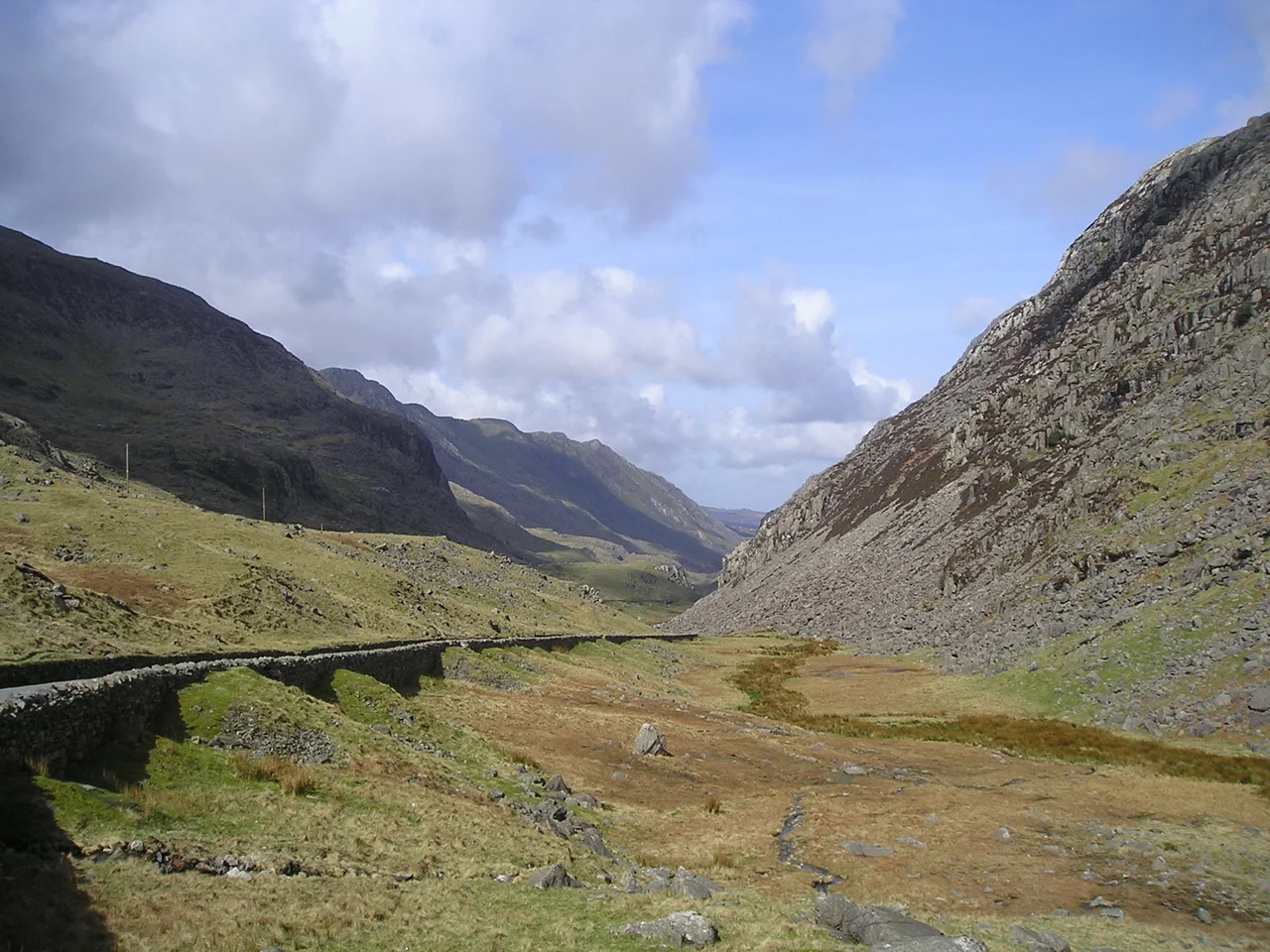

Llanberis Pass
The road squeezes between two of the highest mountain ranges in Wales for three and a half miles, and on a clear evening every layby along it holds a car with chalk-dust on the seats. The Llanberis Pass, summit elevation 359 metres, carries the A4086 over Pen-y-Pass and down into the village of Nant Peris. It is a road that drivers think of as a scenic alternative to the A5. To climbers, it is something closer to a sanctuary. The cliffs flanking the road - Dinas Cromlech, Carreg Wastad, Clogwyn y Grochan, Craig Ddu, Dinas Mot - are the lecture theatre where modern British rock climbing learned what was possible.
Between Snowdon and the Glyderau
The pass is a glacial defile, cut by ice that drained northwest from the high ground around Pen-y-Pass. To its south rises the Snowdon massif; to its north, the Glyderau, anchored by Glyder Fawr at 1,001 metres. The Nant Peris valley descends from the summit to the village, then opens out into the broader basin holding Llyn Peris and Llyn Padarn, and eventually the Afon Rhythallt flows on past Caernarfon to the Menai Strait. The valley itself is narrow and straight, with steep crags and boulders pressing in on both sides of the road. There is no slow gentle scenery; the place is all walls. In low evening light, with mist rising from the Llanberis side, it has been called the most theatrical valley in Wales.
The Crucible of British Climbing
The cliffs on the north side - Dinas Cromlech, Carreg Wastad, Clogwyn y Grochan, called the Three Cliffs - became one of the testing grounds for serious British rock climbing in the 1930s. Dinas Cromlech holds Cenotaph Corner, a Joe Brown route from 1952 still climbed today, possibly the most famous trad pitch in Britain. John Menlove Edwards put up classic lines in the 1930s and 1940s; Joe Brown and Don Whillans owned the place in the 1950s and 1960s; Ron Fawcett and Peter Livesey pushed the grades in the 1970s; in the 1980s a generation including Johnny Dawes, Jerry Moffatt and John Redhead took it further still. Most of those names are now monumental in the sport. They learned to do what they did on roadside crags in a Welsh valley. The 1953 British Mount Everest expedition - the one that put Hillary and Tenzing on the summit - trained in the pass too, basing themselves at the Pen-y-Gwryd Hotel at the eastern end.
The Battle of the Boulders
In 1973 the local authority announced a road-widening scheme along the Llanberis Pass that would have destroyed the Cromlech Boulders - a cluster of large roadside rocks famous among boulderers and as a route-finding landmark. The proposal triggered a six-year protest campaign by local people, climbers, historians, conservationists, and geologists, the most sustained piece of conservation activism the area had seen. Eventually the road authority backed down. The boulders remain by the bridge, smoothed by a thousand pairs of climbing shoes, still being problem-solved today. The pass kept its character - which is to say, it stayed narrow, awkward, and brilliant - because a group of people refused to let it be widened into a more efficient stretch of road.
Pen-y-Pass and Pen-y-Gwryd
Two hotels bookend the pass. At the western summit, the Pen-y-Pass Hotel is now a YHA youth hostel; from its car park three different paths set off up Snowdon - the Pyg Track, the Miners' Track, and the Crib Goch start - while two more lead east to Glyder Fawr and Glyder Fach. The car park fills daily; a Sherpa shuttle bus runs from Llanberis via Nant Peris where overflow parking is provided. At the eastern end, beyond Pen-y-Pass and down toward Capel Curig, sits the Pen-y-Gwryd Hotel, the famous Everest expedition base. Walls hung with ice axes, ropes, and signed photographs. Climbers stop there to drink. The British 1953 team came home to Pen-y-Gwryd to celebrate the summit of Everest. The hotel remains family-run; the front parlour smells of woodsmoke and old climbing magazines.
Walls of Memory
What is striking about the Llanberis Pass is how much human history sits on its cliffs in invisible ink. Every line on Dinas Cromlech has a name, a grade, and a story attached - the first ascent, the first solo, the first repeat. The crag, rated by guidebook authors as one of the most concentrated bodies of classic rock in the world, can be read like a book if you know the routes. The casual driver passes through in ten minutes and sees only crags. The pass keeps its names mostly in the heads of climbers and the pages of guidebooks, but they outnumber the named buildings in many Welsh towns. On a misty evening in the valley, with belay torches blinking on the dark north walls, the place feels less like a road than like a long open-air monument to a particular kind of human concentration.
From the Air
Located at 53.09°N, 4.05°W. Summit at Pen-y-Pass reaches 359 m. The pass runs roughly north-east to south-west between Snowdon (south) and the Glyderau (north), a narrow corridor 3.5 nm long. Best viewed from 2,500-4,000 ft AGL on tracks paralleling the valley. Llyn Peris and Llyn Padarn open out to the northwest below Llanberis village. Nearest airports: EGCK (Caernarfon Airport) 7 nm WSW, EGOV (RAF Valley) 21 nm WNW. Watch for severe venturi acceleration and rotor turbulence in westerly flow; the pass funnels wind dramatically.
Nearby Stories
- Tudweiliog 3.6 km away
- Denbigh Castle and Town Walls 6.4 km away
- Rhoscolyn Lifeboat Station 7.6 km away
- Butlin's Pwllheli 20 km away
- East–West Interconnector 20 km away
- New Brighton Lifeboat Station 31 km away
- Battle of Oswestry 31 km away
- Celtic Array 44 km away