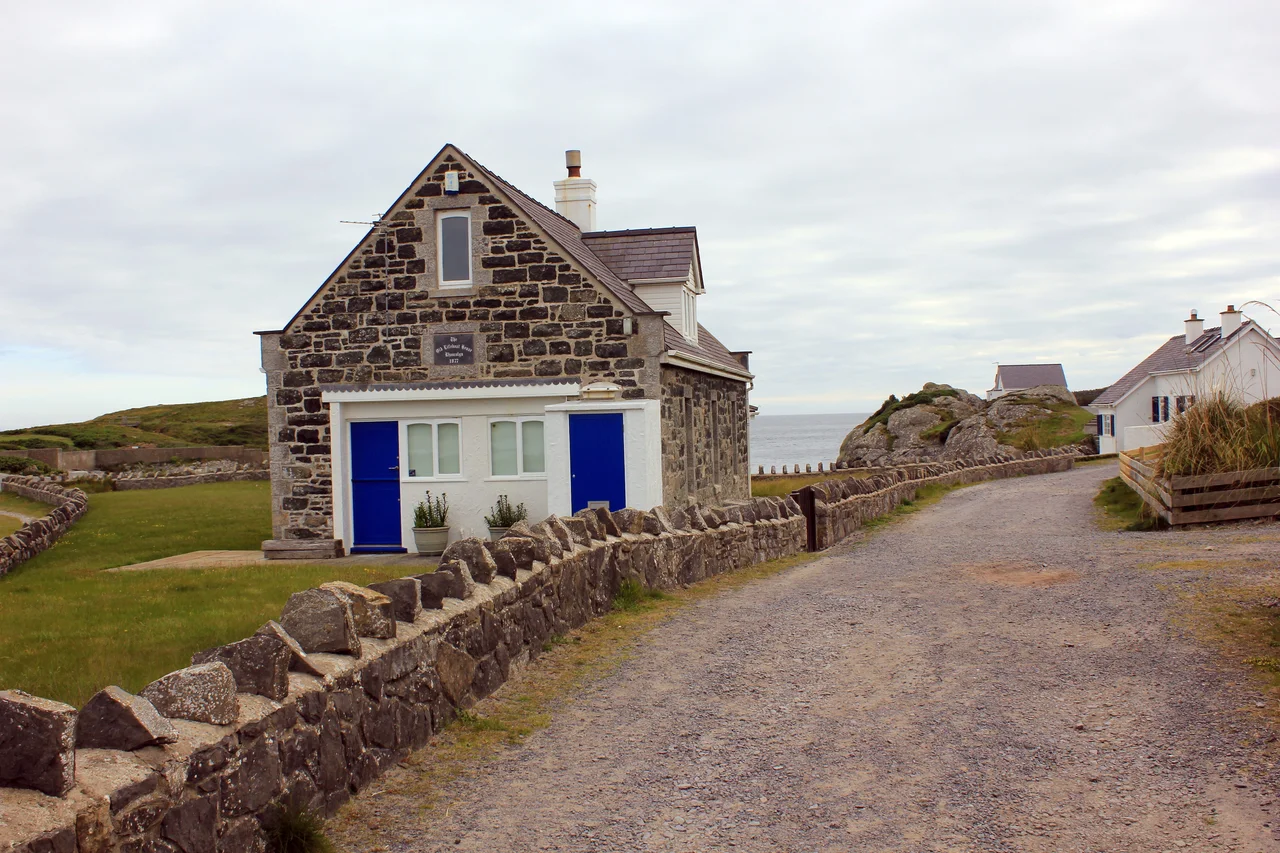

Rhoscolyn Lifeboat Station
On 26 March 1823, the Reverend James Williams and his wife Frances stood on the cliffs at Cemlyn on the northern coast of Anglesey and watched the vessel Alert break up on the rocks below. One hundred and forty people drowned, and they could do nothing. Five years later they had founded the Anglesey Association for the Preservation of Life from Shipwreck and started raising money for a lifeboat. The first one went into the water at Porth-y-Corwgl, the little cove south of Rhoscolyn village, in 1830. Ninety-nine years later, on the cliffs at St Gwenfaen's Church a mile away, a memorial was unveiled to the five Rhoscolyn men who never came home from the wreck of the coaster Timbo in December 1920.
What Williams Could Not Forget
James Williams was rector of Llanfair-yng-Nghornwy on the north coast of Anglesey, a parish whose people lived from the sea and watched it kill them. The Alert disaster in 1823 changed his life. The Royal National Institution for the Preservation of Life from Shipwreck -- the body that would become the RNLI -- was founded in London the following year, but the Anglesey coast was already losing ships faster than London could respond. Williams and his wife organized locally. By 1828 they had the Anglesey Association up and running, by 1830 they had a boat in the water at Rhoscolyn. The first lifeboat was a 26-foot Palmer-designed pulling boat that cost sixty pounds -- a year's wages for a labourer -- built by McVeagh of Holyhead. The first stone boathouse was thirty feet by ten. A second boathouse was put up in 1859, a third in 1877 funded by the widow of a Spanish nobleman, a fourth in 1903 with a roller slipway for fast launching when seconds mattered.
Owen Jones and the Alhambra
On the last day of 1845, in a gale running hard from the west, the vessel Alhambra was being driven onto the rocks off Rhoscolyn. The lifeboat crew were launching their boat into the surf, knowing they would not reach the ship in time, when a local man named Owen Jones did something extraordinary. He swam across the open water to Ynys Traws, the little island between shore and ship, and stood on the rocks waving a flag at the Alhambra's master. The master saw him, understood the warning, and dropped anchor immediately. The ship stopped short of the rocks. The lifeboat reached her and took off twenty-three crew. Owen Jones got the RNLI Silver Medal -- the highest award the lifeboat service gave for bravery. The same medal would later go to Coxswain Hugh Hughes for the 1901 service to the schooner J. W. Waring, when the Rhoscolyn boat was beam-ended in the surf, filled with water, righted herself, and pulled five men off a vessel that broke up minutes later on Porth Saint Rocks.
The Ramon Cabrera
The strangest patron in the station's history was Marianne Catherine Cabrera, Countess of Morella. She was the English widow of a Spanish Carlist general, Ramon Cabrera y Grino, who had fought in the brutal civil wars of nineteenth-century Spain on the losing side and then died in exile in Britain. In his memory she gave the RNLI two thousand pounds in 1877 -- a vast sum -- to fund a complete rebuild of the Rhoscolyn station. The new 33-foot mahogany self-righting boat was named Ramon Cabrera. So was its successor, the 37-footer of 1899. The names of a long-dead Spanish soldier and a grieving English wife rode on lifeboat hulls into the Welsh storms for more than fifty years, saving people who had never heard of either of them. The connection between Carlist Spain and the coast of Anglesey is not the kind of thing a coastal history book usually has to explain.
The Timbo
On 3 December 1920 the small coaster Timbo, bound for Ireland from Holyhead, was caught in a storm off South Stack and began to drift down the coast. The Rhoscolyn lifeboat went out to her in heavy seas, made repeated attempts to get a line aboard the ship, and could not. The cox decided that no more could be done and turned for home. Near Ynys Llanddwyn the lifeboat capsized in the swell. Five of the thirteen men in her drowned: Coxswain Owen Owens, sixty-one years old; Evan Hughes, thirty-four; Richard Hughes, only seventeen; Owen Jones, thirty-eight; William Thomas, nineteen. Four men from the Timbo died as well before that ship finally stranded at Dinas Dinlle. The memorial at St Gwenfaen's Church, unveiled on 12 November 1922, lists the lifeboat men's names. The station carried on for nine more years, but the disaster had broken something in the village. Rhoscolyn Lifeboat Station closed in 1929, ninety-nine years after the Alert had set its history in motion. At least 49 lives saved before 1859; another 41 in the seventy years after. The boathouse at Porth-y-Corwgl is now a private dwelling. The memorial is still in the churchyard.
From the Air
Located at 53.24N, 4.59W on the west coast of Holy Island, Anglesey, at Porth-y-Corwgl cove just south of Rhoscolyn village. Nearest airport: Valley (EGOV) on the main Anglesey island about 5 nm northeast across the Cymyran Strait. Best viewed at 1,500-2,500 ft AGL flying along the west coast of Holy Island. The cove and the rocky coastline are unmistakable; the present-day building is a private house. The memorial to the lost lifeboat men is in the churchyard of St Gwenfaen's, about a mile north.
Nearby Stories
- HMS Conway 3.4 km away
- Tudweiliog 8.5 km away
- East–West Interconnector 12 km away
- Barmouth 24 km away
- German submarine U-1051 25 km away
- HMS Tyler 28 km away
- Greystones 53 km away
- Formby 77 km away