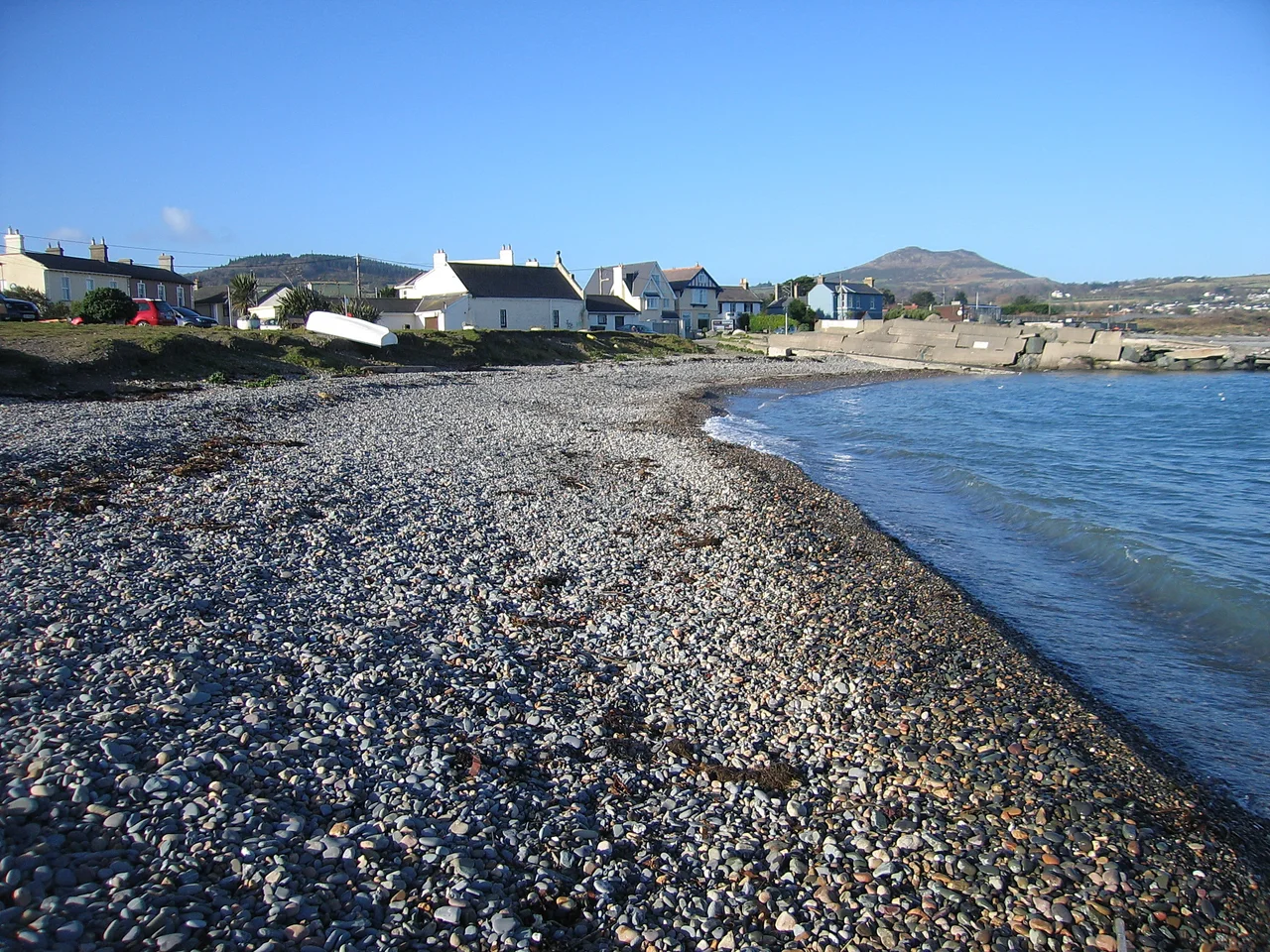

Greystones
When Greystones first appears in print in 1795, the antiquarian William Wenman Seward describes it as "a noted fishing place four miles beyond Bray." That is all. The fishing village would have stayed small if not for the railway. The line from Dublin reached Bray in 1854, and a year later it was extended south to Greystones - a difficult engineering job that was performed in consultation with Isambard Kingdom Brunel, the man who built the Great Western Railway in England and the SS Great Eastern in London. The station was placed precisely on the boundary between two great estates: the La Touche family of Bellevue and the Hawkins-Whitshed family of Killincarrig House. What grew up around it was shaped by both families - especially by an extraordinary Victorian woman named Lizzie Le Blond who developed Ireland's first planned housing estate here in the 1870s. Today Greystones has 22,009 residents and the most expensive postcode in Ireland outside Dublin.
Brunel and the Difficult Line
The Dublin to Wexford railway south of Bray ran into geological problems immediately. The terrain around Bray Head, a sea cliff of greywackes and quartzite, required a tunnel, a viaduct, and constant battles against coastal erosion that have continued ever since - the original alignment of the line had to be relocated inland later as the cliffs collapsed into the sea. Brunel consulted on the engineering. The line opened on 30 October 1855, and Greystones railway station, today the southern terminus of the electrified DART commuter network, has been the central fact of the town's life ever since. The trains, sparse and threatened with closure in the 1980s, came back to life with the arrival of the electrified DART in the 1990s. Now the line runs north thirty-one stations through Bray, Dun Laoghaire and central Dublin all the way to Howth and Malahide.
Lizzie Le Blond's Garden Town
Elizabeth Hawkins-Whitshed, who inherited the Hawkins-Whitshed estate in 1871, was one of the more remarkable Irish Victorian women. She married Colonel Frederick Gustavus Burnaby - a celebrated explorer who almost never visited Wicklow - and is better known to mountaineering history as Lizzie Le Blond. She climbed in the Alps, took photographs, made films, wrote books on mountaineering, fiction, and travel. From her estate at Killincarrig she developed Ireland's first planned housing estate, the area today known as the Burnaby, named for her short-lived husband. She donated, for a nominal rent, the site on which the public library still stands. The street names on her side of the station carry the family memory still: Hawkins, Whitshed, Burnaby. On the adjoining La Touche estate, William Robert La Touche laid out Church Road, Victoria Road and Trafalgar Road, building Victorian villas that filled rapidly with Dublin commuters. The two families effectively planned the entire shape of the modern town between them.
The Harbour That Almost Wasn't Built
Between 1885 and 1897, the people of Greystones campaigned for a harbour to support their fishing industry and to allow coal imports. The original pier, dock and sea wall they finally won survived a century in steadily worsening condition. In 1968, the foundation of the old Kish lighthouse, decommissioned out at sea, was floated in and added to the end of the pier. Coastal erosion meanwhile ate away at the North Beach Road, eventually destroying most of the houses on it and forcing the costly inland relocation of part of the railway. In the early 2000s a €300 million harbour redevelopment - apartments, a 230-berth marina, public plaza - drew over six thousand objections from An Bord Pleanala, more than 6,200 of them critical. The plan was approved with thirteen conditions and then collapsed in the 2008 financial crisis. NAMA wrote off €50 million owed. The harbour facilities, though, were eventually built and opened to the public; the apartments are still slowly going up. Where coal once landed, paddle-boarders now launch.
Swimrise and the Quiet Boom
Greystones today is something between a commuter suburb of Dublin and a wellness town. The population has nearly doubled since 1986, with major housing developments at Charlesland, Seagreen, Glenheron and Archer's Wood pushing the boundaries outward; Wicklow County Council plans for 24,000 residents by 2028. Notable current and former residents include the present Tanaiste Simon Harris, the wildlife film-maker Eamon de Buitlear, the musicians Damien Rice and Ronnie Drew of the Dubliners, the actress Geraldine Fitzgerald, the wrestler Finn Balor, and Marten Toonder, the Dutch artist who created the comic strip Tom Poes (Olivier B. Bommel) and lived here for thirty years. A community of sunrise sea-swimmers, calling themselves Swimrise, takes to the cold water of the South Beach most mornings; mobile and barrel saunas have appeared along the seafront. Greystones Cricket Club has three senior men's teams, one ladies' team, taverners and juniors. The Cliff Walk to Bray, six kilometres around Bray Head, is closed for repairs as of early 2025 but expected to reopen - one of the great short coastal walks in Ireland.
From the Air
Located at 53.14°N, 6.07°W on the Irish Sea coast, 3.5 km south of Bray and 24 km south of Dublin. Best viewed at 2,000-3,500 ft AGL; the long crescent of beach and the recently rebuilt harbour are clearly visible, with the Little Sugar Loaf mountain rising inland to the west. Nearest airports: Dublin (EIDW) 27 km north, Newcastle Aerodrome (EINC) 4 km south.
Nearby Stories
- Malahide Castle 1.2 km away
- Castlemartin House and Estate 6.4 km away
- Avoca, County Wicklow 8 km away
- Trim, County Meath 15 km away
- German submarine U-1051 29 km away
- County Carlow 29 km away
- HMS Tyler 32 km away
- Irish Sea Bridge 46 km away