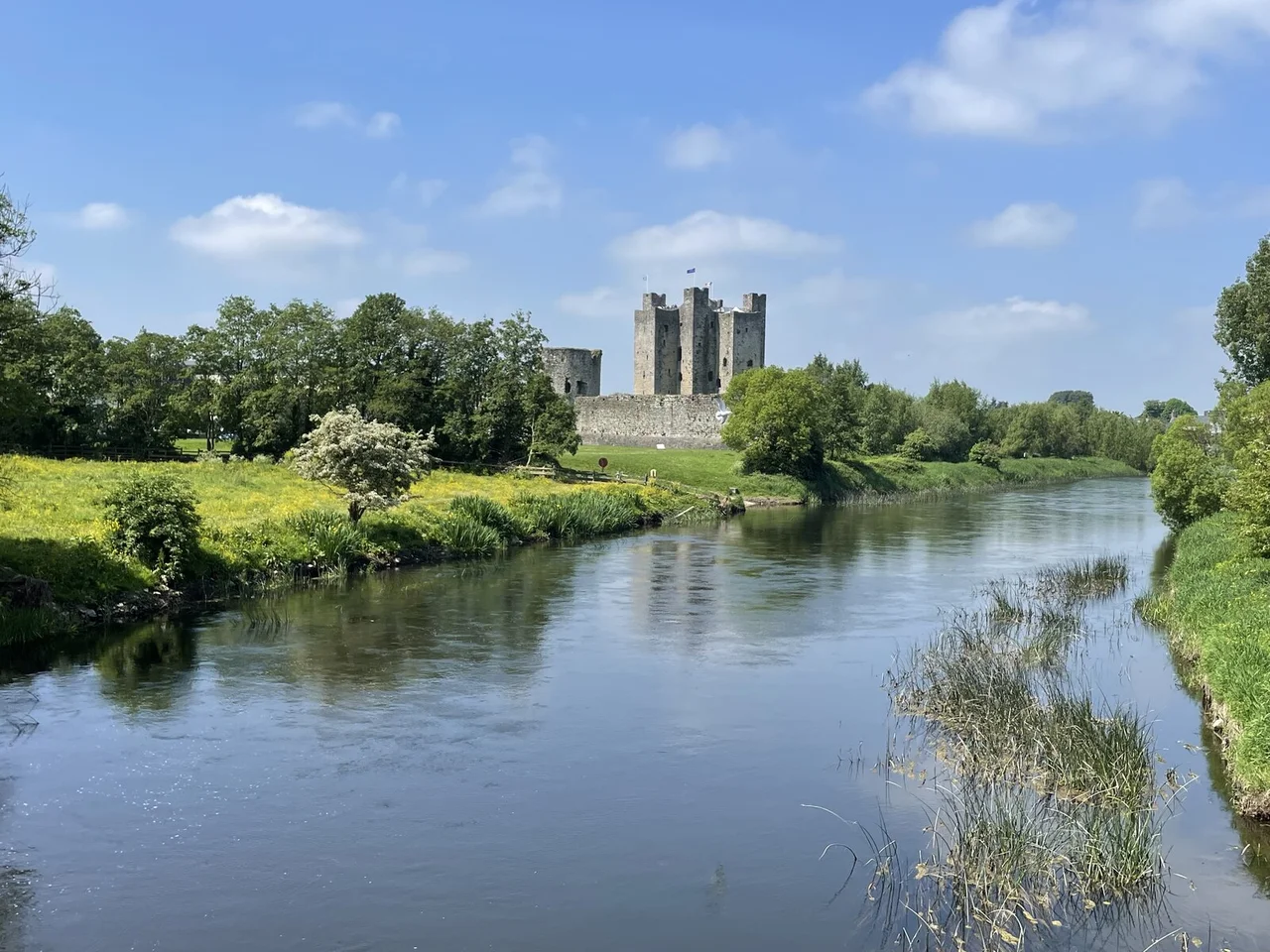

Trim, County Meath
If you have seen Braveheart - the scene where Robert the Bruce broods on castle battlements, the long shot of the medieval English fortress at York - you have seen Trim Castle. Mel Gibson's crew put up Scottish saltires on the towers and called it England. The real place is a square keep of grey limestone on the south bank of the Boyne in County Meath, built by Hugh de Lacy in the 1170s, and it is the largest Norman castle in Ireland. The town that grew up beneath it is 9,500 people now, and it has been winning the national Tidy Towns competition since 1972.
The Lord of Meath
When Henry II of England granted the lordship of Meath to Hugh de Lacy in 1172, he was handing one of his most ambitious barons a kingdom in everything but name. De Lacy and his son Walter spent the next half-century building Trim Castle into a statement of power. The keep is unlike any other in Ireland - a square central tower with four smaller towers projecting from its sides like the cross-pattern stamped on a coin. The walls are over three metres thick. Inside, the great hall could host the Norman-Irish parliament when it met here in the fifteenth century. Richard II of England stayed within these walls in the 1390s before the rebellion that ended his reign. Trim was, for a time, a candidate to be the capital of Ireland. Elizabeth I once designated it as the planned location for what became Trinity College Dublin, before Sir Francis Drake argued the case for Dublin instead.
Wellington's Town
Arthur Wellesley - the future Duke of Wellington, the man who would defeat Napoleon at Waterloo - is reputed to have been born at Dangan Castle, a few miles from Trim, in 1769. He spent some of his childhood here, and from 1790 to 1797 he sat as MP for Trim in the Irish Parliament before crossing to a military career. The townspeople were proud enough of the connection that in 1817, two years after Waterloo, they put up a column topped with his statue at the foot of Castle Street. The column still stands. Beyond Wellesley, Trim claims another extraordinary line of residents - Jonathan Swift, who lived nearby after 1700 and whose satirical legacy is celebrated each year at the Trim Swift Festival; William Rowan Hamilton, the nineteenth-century mathematician who discovered quaternions; and Lord Dunsany, the fantasy writer whose castle still stands at nearby Dunsany. The town has a way of attracting and producing people whose ideas outlast them.
Burnings and Rebuildings
Trim has been burned more than once. In 1649, after Cromwell sacked Drogheda 30 miles east, the garrison here fled and the New Model Army moved in. In September 1920, during the Irish War of Independence, the local IRA company took the RIC barracks and burned it down. The Black and Tans returned days later and burned a large part of the town in reprisal. Townspeople sheltered along the Boyne for several nights while businesses and the town hall went up in flames. The Lalor brothers of Castle Street, prominent in the local IRA, kept memorabilia of those years - letters from Michael Collins, a tricolour embroidered by Constance Markievicz that was meant to fly over the GPO during the 1916 Rising, a pair of Eamon de Valera's slippers. Most of the collection has since disappeared, but photographs remain in the Navan library. The town rebuilt, as it always had, and in the early 2000s became the first place outside Dublin to host a major Irish government department when the Office of Public Works moved its headquarters here.
Yellow Steeples and Black Friaries
The castle is the obvious thing, but Trim is layered with medieval ruin. The Yellow Steeple, named for the way the setting sun warms its stone, rises on a hillside opposite the castle - it is all that remains of fourteenth-century St Mary's Abbey, and it is still the tallest building in town. Newtown Abbey, a fifteen-minute walk downstream along the Boyne, was once the largest Augustinian abbey in Ireland; its roofless arches still stand among the gravestones, with information boards showing what was lost. St John's Priory, on the opposite bank, was a medieval hospital. The Black Friary - a thirteenth-century Dominican house just outside the old town walls - has been excavated since 2010 as a community archaeology project, slowly revealing the layout of a building that vanished above ground. Even the town walls survive in fragments - the Sheep Gate stands intact, an arched stone passage between the castle and the Yellow Steeple, marking where livestock once entered the medieval town. Walk the Boyne river walk from the castle to Newtown and back, and you cross seven hundred years of Irish religious architecture in forty minutes.
Hay, Cars and the Halloween Fire
Modern Trim takes its history out of its display cases once a year. The Trim Haymaking Festival on the third Sunday of June brings out scythes and horse-drawn machinery to cut the year's first hay by hand in the Porchfields by the river. The Royal Meath Show in September has been running since 1929, judging cattle, sheep, and home industries on the same fields. The Vintage Car Show in July fills the Porchfields with five hundred classic vehicles. And every Halloween, the Púca Festival lights the Samhain fire on the nearby Hill of Ward, where in pre-Christian Ireland the druid Tlachtga was said to have lit the bone-fires that marked the end of harvest - the same festival that, exported with Irish emigrants, eventually became Halloween. Two thousand years on, the fire still burns on the hill, the procession still winds through the town, and the doorways to the Otherworld, in local belief, still open for one night a year.
From the Air
Trim is at 53.55 degrees north, 6.79 degrees west, on the River Boyne 30 miles northwest of Dublin in County Meath. Trim Aerodrome operates general aviation and microlights but has no public airline service - the nearest major airport is Dublin (EIDW), about 35 miles southeast. From 2,000-4,000 feet in clear weather, Trim Castle's square central keep is unmistakable on the south bank of the Boyne, with the Yellow Steeple rising on the north bank opposite. The river loops east toward Navan and the great Neolithic complex at Bru na Boinne. Meath weather follows the usual Irish midlands pattern - frequent cloud, occasional bright clear days, best visibility in spring.
Nearby Stories
- County Offaly 7.9 km away
- County Westmeath 8.2 km away
- Irish Military Intelligence Service 8.8 km away
- Swords 10 km away
- Carrickmines Castle 10 km away
- Cabra Castle 15 km away
- Killeshandra 27 km away
- Carlingford 30 km away