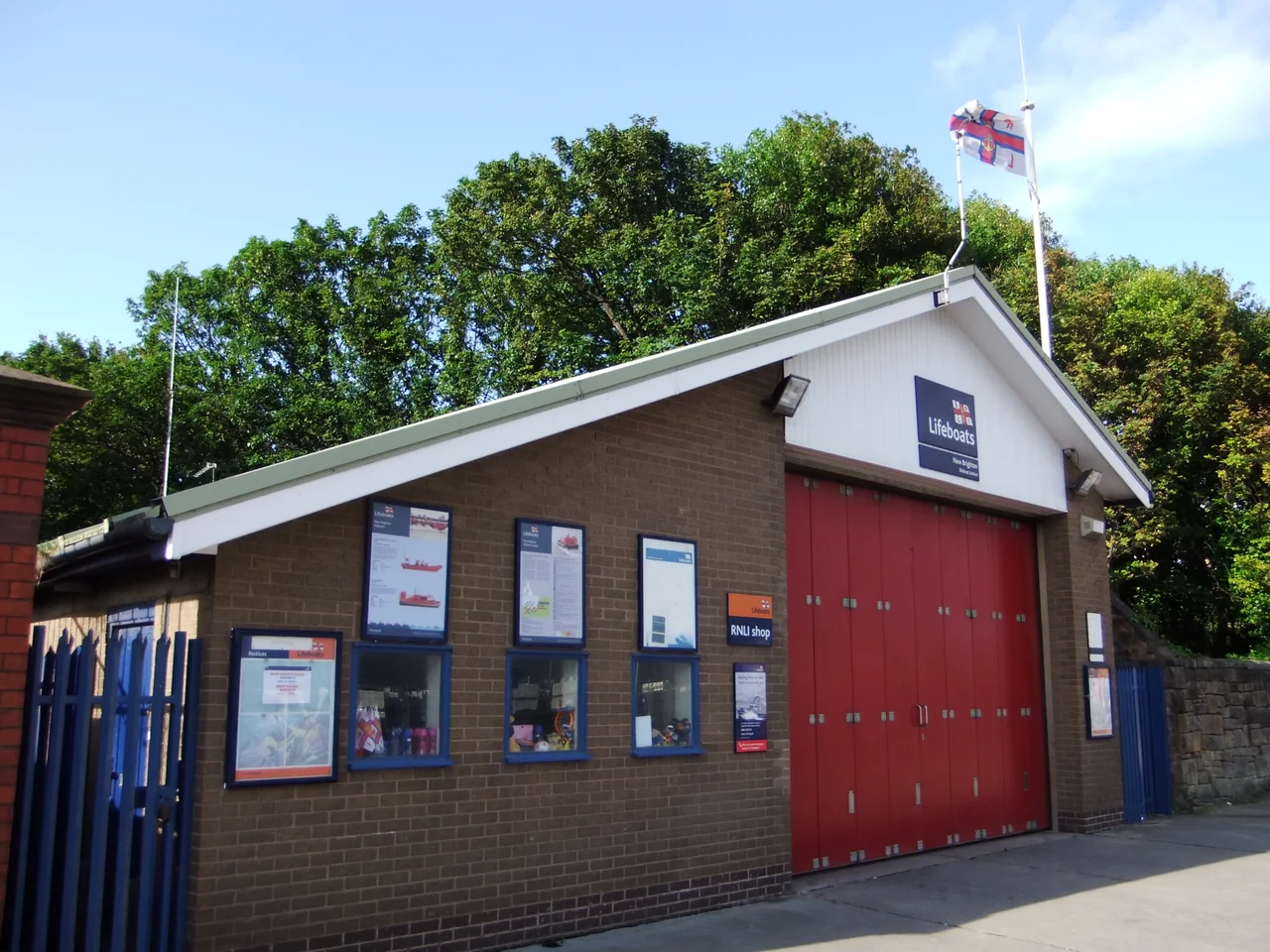

New Brighton Lifeboat Station
Before the lifeboat, there was the gunpowder. Every vessel arriving at the Port of Liverpool in the eighteenth century was required by law to first deposit its barrels of powder at a secluded magazine on the Wirral shore, well clear of the crowded docks across the river. A village grew up around that magazine, and in 1827 the Liverpool Dock Trustees decided that anywhere boats anchored to unload explosives was also a sensible place to keep a boat that could rescue men from the water. A boathouse went up in 1828. The lifeboat that lives on Kings Parade today, a fast inshore craft called Charles Dibdin, traces an unbroken line of duty back to that original Magazines crew.
Why the Mouth of the Mersey Needs Watching
The Mersey estuary funnels Atlantic weather straight into Liverpool Bay, and the sandbanks that protect the river also trap unwary ships. By 1862 the Magazines station no longer sat where it was most useful. A public meeting that year argued for a boat at New Brighton itself, where Wallasey's expanding suburbs met the bay and a faster launch could reach trouble before it became tragedy. The Royal National Lifeboat Institution agreed. In January 1863 the boat Rescue arrived, an unusual craft built for the new station by J. Hamilton Jnr at Liverpool's Windsor Works. Within eighteen months demand justified a second boat, a thirty-three-foot iron-hulled craft called Willie and Arthur, a rarity in an era when nearly every lifeboat was wood.
The Gold Medal from America
On the wall of the boathouse hangs a memory that explains everything about this work. In 1875 the crews of the New Brighton and Liverpool lifeboats received Gold Medals from the United States government for rescues at sea, a foreign honour that the RNLI rarely matched. The names recur in the station's roll of honour like family lines: Evanses, Joneses, Robinsons, Browns. Thomas Evans served as coxswain at both Magazine and New Brighton in the 1860s and earned the RNLI Silver Medal twice. George Robinson, coxswain in 1928, won the Gold Medal of the French Government for a service that also brought bronze medals to seven of his crew. These were not professional sailors but Wallasey men who left their work when the maroons went up.
Charlotte's Sons, and the Joneses, and the Long Line
What surprises visitors who read the citations carefully is how often the same surnames appear across decades. William Stephen Jones earned the Bronze Medal in 1947 as Second Coxswain, then again in 1950 as Acting Coxswain. John Rowland Nicholson appears as crew in 1928 and Second Coxswain in 1938. Michael Jones is named as crew in 1982, helm in 1995, helm again in 2000. Lifeboat service runs in families on the Wirral the way fishing once did, taught from father to son and uncle to nephew over the kitchen table. Anthony Joseph Jones, awarded the MBE in the 2026 New Year Honours, comes from this same long thread, a continuity that began the year the first boathouse went up at Magazine Village in 1828.
What the Boat Does Now
The Charles Dibdin is a B-class Atlantic 85 inshore lifeboat, in service since 2009 and named for Charles Dibdin, a Victorian civil servant who founded the Civil Service Lifeboat Fund in 1866 and later served as RNLI Secretary until his death in 1910. Its work has changed since the days of full-rigged vessels going aground on Horse Bank. Today the crew launches for jet-skiers, dinghy sailors, paddleboarders, swimmers caught by the tide on Wallasey's broad sands, and the small boats that still cross the estuary in weather they should not have left harbour in. The Wirral coast is one of the busiest recreational stretches of British coastline, and the call-out tempo reflects it. The station is right beside Fort Perch Rock and its decommissioned lighthouse, two of the Wirral's most photographed landmarks.
A Place to See It From
Kings Parade follows the curve of the river mouth where it widens into Liverpool Bay. Stand on the promenade at low tide and the scale of what the crew works in becomes clear: vast wet sands stretch toward the horizon, the channel cuts a darker line through them, and the wind that blows across this opening carries no obstacles for a thousand miles. The boathouse is unceremonious, painted in RNLI orange and blue, easily missed if you have come for the lighthouse and fort. Walk past at the right moment and you may catch the crew preparing for an exercise launch, the tractor rumbling across the sand, the boat sliding into water the colour of slate.
From the Air
Coordinates 53.439 N, 3.047 W on the Wallasey shore at the mouth of the River Mersey. Recommended viewing altitude 2,000 to 3,500 feet, low enough to pick out Fort Perch Rock and the lighthouse alongside. Nearest airports: Liverpool John Lennon (EGGP) 13 nautical miles southeast across the Mersey, Hawarden (EGNR) 17 nautical miles south, Blackpool (EGNH) 28 nautical miles north. The estuary fills with reflective wet sand at low water, useful for orientation. Crosswind landings at Liverpool often run parallel to this shore.
Nearby Stories
- Blackpool Pleasure Beach 4.4 km away
- Whalley Abbey 4.8 km away
- Worsley 5.4 km away
- Second Battle of Middlewich 7.7 km away
- Chester Zoo 7.9 km away
- Llanrwst 23 km away
- Abergele Rail Disaster 27 km away
- Sea Lion Rocks railway station 73 km away