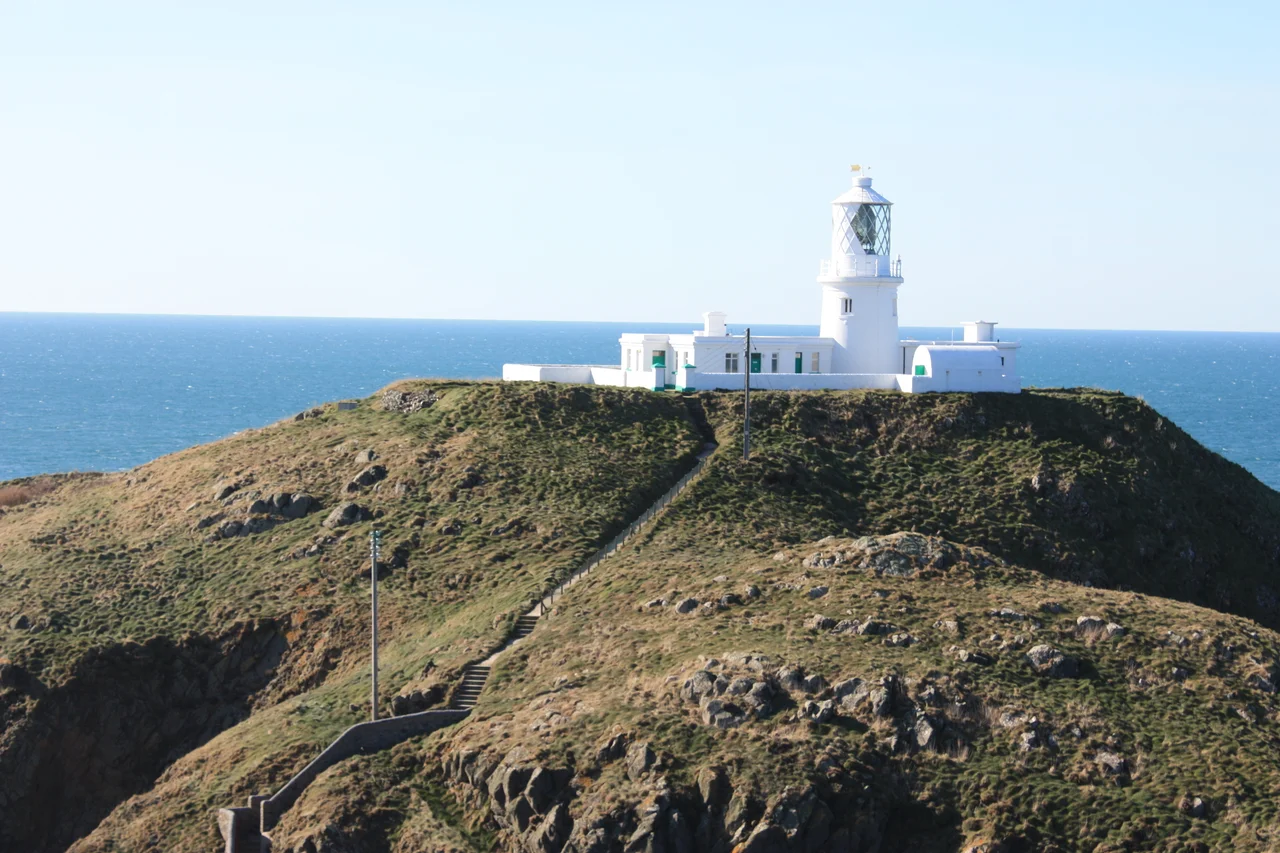

Strumble Head Lighthouse
The lens turns on mercury. At Strumble Head Lighthouse, perched on the rocky islet of Ynys Meicel five miles west of Fishguard, the great glass Fresnel lens floats on a bath of liquid metal, balanced so perfectly that a fingertip could spin it. The mercury bath was a Victorian engineering trick that reduced friction to almost nothing, allowing massive optics to rotate steadily for hours on a tiny clockwork mechanism. Most British lighthouses lost theirs to electrification and automation. Strumble Head, which received its electric light in 1949 but kept its original 1908 lens, still has the mercury, and the lens still floats.
A Long Argument with the Sea
Trinity House first proposed a lighthouse at Strumble Head in 1825, a year after the Royal National Institution for the Preservation of Life from Shipwreck was founded. The argument was straightforward. Ships rounding the Welsh coast bound for Fishguard or for the open Atlantic had to navigate one of the most exposed points in Britain, where the tides off Cardigan Bay rip past at six knots in a spring ebb. A lightship had been moored offshore for decades, but lightships drift, anchor cables part, and crews die. The case for a proper lighthouse was strong; the cost was steep enough that it took eighty-three years for Trinity House to act. The present tower was finally erected in 1908, one of the last new lighthouses built in Britain and similar in design to Skokholm Lighthouse twenty miles south.
Ynys Meicel
The lighthouse stands on Ynys Meicel, which translates from Welsh as St Michael's Island, a rocky outcrop separated from the Pencaer mainland by a deep tidal gap. The original means of reaching it was an iron footbridge with a handrail that doubled as a fuel pipe, siphoning paraffin across to the lantern. Parts of that ingenious apparatus still survive. The bridge itself was replaced in 1963. The tower is 55 feet of circular dressed stone, ringed by a low gallery, with the original lantern complete with Chance Brothers Fresnel lens. Chance Brothers of Smethwick made most of the great British lighthouse optics in the nineteenth and early twentieth centuries, and Strumble's lens is a working example of their craft.
The Psalm in the Lantern Room
Inside the lantern room, set into the wall where the keepers would see it each time they climbed the stairs to wind the clock, is a plaque bearing four lines of Psalm 127: "Except the Lord build the house, they labour in vain that build it; except the Lord keep the city, the Watchman waketh but in vain." It is an oddly philosophical text for an engineering monument, and yet entirely apt. The keepers' job was watching, and the long night watches of a Pembrokeshire lighthouse rewarded the contemplative. Beneath the lantern sits a water tank that collected the rain off the roof and supplied the keepers' accommodation. An electric fog-signal was installed in 1969, replacing the older system that fired small explosive charges at intervals. The light was fully electrified in 1965 and fully automated in 1980, after which the keepers left for good.
The Invasion That Failed Here
Stand at Strumble Head and look out, and you are looking at the place where one of the strangest events in British military history began. On February 22, 1797, four French warships appeared off this coast, carrying 1,400 troops of La Légion Noire under the Irish-American commander William Tate. The plan was to march inland, raise the Welsh peasantry against the English, and create a diversion that would aid the planned French landing in Ireland. None of it worked. The French troops, many of them ex-convicts, scattered as soon as they got ashore at Carregwastad Point just east of Strumble Head, looting farms and getting drunk on local wine. They surrendered to a hastily assembled militia within two days. It was the last hostile foreign invasion of mainland Britain. The lighthouse, of course, was still 111 years from being built.
Strumble VOR
Pilots who fly the North Atlantic tracks know Strumble by its other identity. The Strumble VHF Omnidirectional Range, located near the lighthouse, is one of the boundary navaids for entry into oceanic airspace from the British Isles, and "Strumble" appears in flight plans flown from Heathrow to New York every day. Most of the controllers reading that name will never see it. The actual headland is monitored now from Trinity House's Operations Control Centre in Harwich, with a single attendant making regular visits. Stores arrive by helicopter to a pad west of the lighthouse. The light still flashes four white flashes every fifteen seconds. The mercury bath is still there. The Fresnel lens still turns.
From the Air
Strumble Head Lighthouse sits at 52.03°N, 5.07°W on Ynys Meicel, a rocky islet just off the Pencaer headland five miles west of Fishguard. The white tower with its black lantern is highly visible from the air against grey-green cliffs. Strumble VOR (frequency 113.10 MHz) is co-located near the lighthouse and serves as an oceanic boundary navaid for transatlantic flights. Nearest airfield is EGFE (Haverfordwest) sixteen miles south. The North Pembrokeshire coast at this point is dramatic; consider a viewing altitude of 1,500-2,500 feet AGL. Carregwastad Point, site of the 1797 French landing, lies just east of the lighthouse along the same coastline.
Nearby Stories
- RAF Angle 0.9 km away
- Cardigan Bay Special Area of Conservation 5.4 km away
- Abercych 11 km away
- Cantre'r Gwaelod 12 km away
- Burry Port Lifeboat Station 22 km away
- Johnstown Castle 61 km away
- Hook Lighthouse 92 km away
- 1979 Fastnet Race 157 km away