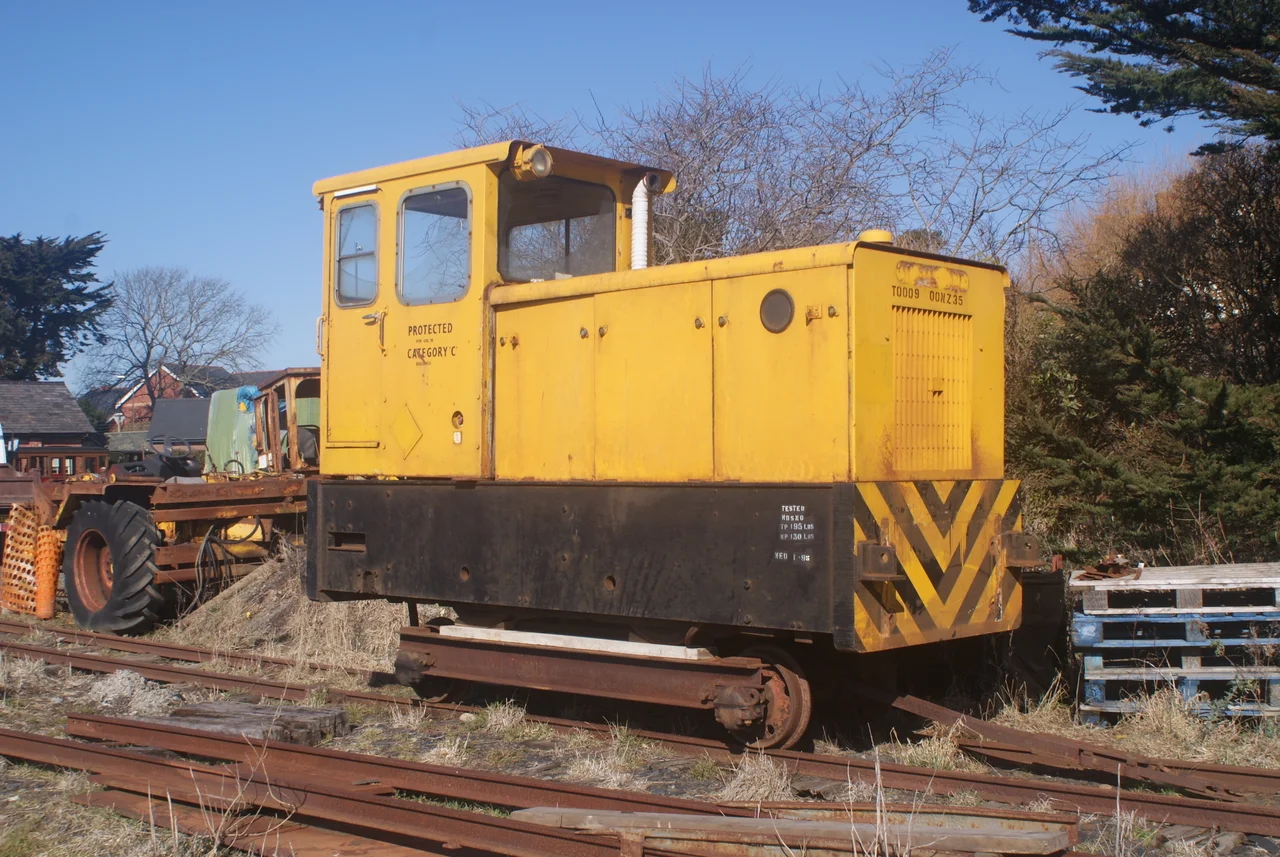

RNAD Trecwn
Copper does not spark. That single fact dictated the design of one of the strangest railways ever built in Britain. The narrow-gauge line that wound through the Royal Naval Armament Depot at Trecwn had to share its valley with naval mines, depth charges, and, by the height of the Cold War, the warheads for Polaris and Trident missiles. A steel wheel striking a steel rail in the wrong place could end the whole operation in a single flash. So the engineers built the rails out of copper, the wagons with sliding roofs and no side doors, and arranged the entire site to minimize the moment when a human hand had to touch a piece of live ordnance.
A Valley Chosen for Hiding
Trecwn lies three miles south of Fishguard in a steep-sided wooded valley, the kind of place that you could drive past without noticing. That was precisely the point. Construction began in 1938, in the months before the Second World War, with the Royal Navy needing a deep-water Atlantic supply chain insulated from Luftwaffe bombing. The valley was already on the spur line of the former North Pembrokeshire and Fishguard Railway, giving a direct rail connection to Fishguard harbour and onward to Neyland for Milford Haven. The Ministry of Defence built three housing estates around the existing village to house the workers, plus a wastewater treatment plant. A Victorian schoolhouse at Barham, built in 1877 and Grade II listed, became the village school for the depot's children until falling rolls closed it in 2001.
Fifty-Eight Doors Into the Hill
The site's defining feature is a herringbone of cavern entrances cut into the limestone valley sides. Fifty-eight chambers, each roughly 200 feet long, were tunnelled into solid rock to store mines, torpedoes and warheads. Every chamber could be reached three ways: by road for personnel and contractors, by standard-gauge rail from the mainline, or by the copper-railed narrow-gauge that ran the entire site. A gauge-exchange shed sat near the entrance where weapons were transferred from one system to the other. The wagons themselves were specially built, with overhead gantries loading munitions through sliding roofs so that nothing ever had to be passed through a doorway. Two reservoirs were dug into the hillside above the depot, on either side of the valley, to feed high-pressure water to fire hydrants inside every cavern and outside every surface building.
Cold War Tempo
At its busiest, in the 1970s and 1980s, four hundred people worked at Trecwn. Standard-gauge supply trains ran daily to Fishguard harbour, where the line extended past the ferry terminal and along the breakwater so that munitions could be lifted directly onto Royal Navy ships. Other trains served Neyland for Milford Haven and, until that sub-depot closed, Pembroke Dock. Workers reached the site on dedicated passenger trains from Fishguard and Goodwick station until 1964, after which buses took over. The depot's growth tracked the Royal Navy's nuclear posture. As Polaris gave way to Trident in the 1980s, Trecwn's role grew, and the security fences grew with it. Photography was forbidden. The valley appeared on Ordnance Survey maps as a blank.
What the Cold War Left
Trecwn was placed on care and maintenance in the early 1990s and formally decommissioned in 1992. In 1998 the entire site was sold to an Anglo-Irish consortium called Omega Pacific for £329,000, the price of a modest house in much of Britain. The buyers wanted to use the surface buildings for aircraft engine maintenance and rent the caverns as low-level nuclear waste storage. Local opposition and a missing planning consent ended that plan in court in 2002, and the site was forced into the hands of the Manhattan Loft Corporation. A 25-megawatt biomass plant was conditionally approved in 2015, but as of 2018 no work had started. In 2015 the depot found a different kind of fame when Channel 4 filmed its SAS: Who Dares Wins reality series among the empty caverns and crumbling shed roofs.
Where the Copper Went
The narrow-gauge railway, with its careful copper rails and special enclosed wagons, has been entirely removed. Some of the rolling stock survives. Stock has been transferred to the Welshpool and Llanfair Light Railway, which uses the same 2 ft 6 in gauge, while other items went to the Talyllyn Railway and the Welsh Highland Heritage Railway. Children riding behind a steam engine in mid-Wales are, without knowing it, riding wagons designed to carry torpedoes. The caverns remain, locked. Network Rail kept the connecting branch alive and refurbished it, leaving the option open for the site to operate one day as an intermodal freight terminal serving Fishguard. The valley still has its herringbone of doors. Most of them have not been opened in three decades.
From the Air
Former RNAD Trecwn sits at 51.96°N, 4.96°W, three miles south of Fishguard in a wooded valley that runs roughly east-west. From altitude, look for a long narrow clearing in otherwise green countryside, with surface buildings and the dark mouths of cavern entrances along both hillsides. The site lies five miles east of Strumble Head Lighthouse and around twenty miles north of EGFE (Haverfordwest). The A40 trunk road passes about two miles to the south. A spur of the West Wales line still serves the site, branching from the Fishguard-Clarbeston Road railway.
Nearby Stories
- RAF Angle 0.9 km away
- Cardigan Bay Special Area of Conservation 5.4 km away
- Abercych 11 km away
- Cantre'r Gwaelod 12 km away
- Burry Port Lifeboat Station 22 km away
- Johnstown Castle 61 km away
- Hook Lighthouse 92 km away
- 1979 Fastnet Race 157 km away