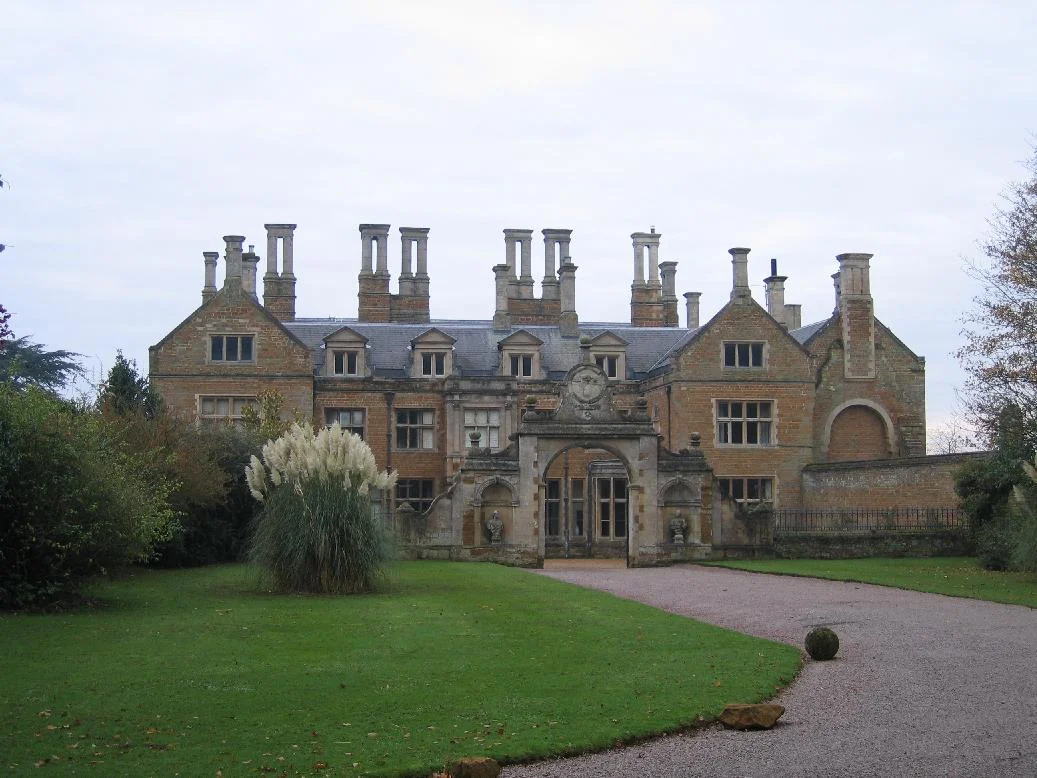

Holdenby House
Sir Christopher Hatton built Holdenby for one specific visitor, and he refused to sleep there until she had. The visitor was Queen Elizabeth I. The house was finished in 1583, at roughly 78,750 square feet across two courtyards the size of village greens, with symmetrical facades, mullioned windows, and Doric arcades that announced its owner had been studying drawings out of Italy. Thomas Heneage, writing to Hatton that July, called it 'the best house that hath been built in this age.' Elizabeth did eventually sleep at Holdenby, after which Hatton finally permitted himself to do the same. Sixty-four years later the same house was where the king of England waited, under guard, for whatever was going to happen to him next.
A house built for a queen who barely came
Hatton was Lord Chancellor under Elizabeth, courtier, dancer at court, and a man who had decided that loyalty to the crown deserved a stage on the scale of architecture. Holdenby was that stage. The two great courtyards were larger than those at Audley End or Theobalds, two of the other showpiece houses of the age, and the exterior modelled the Renaissance discipline of order and symmetry then drifting north through Flanders into England. Hatton spent himself building it and his queen visited rarely. He died in 1591, his accounts in disarray, owing the Crown money the Crown decided to forgive only in part. The house outlived its builder by less than a generation in the form he had intended.
Bought, then dismantled
In 1607 James I acquired Holdenby through his agent John Thorpe and intended it as a residence for his son Charles, then Duke of York. Anne of Denmark stayed there in August 1608. Charles, of course, would later inherit the throne and lose it, and the house with him. After the First English Civil War the Scots handed Charles over to the English Parliament at Newcastle, and in February 1647 the captured king was lodged at Holdenby under the Long Parliament's custody. He stayed five months, walked the gardens, played bowls. In June, with the New Model Army in open conflict with Parliament over what to do with him, a young officer named Cornet George Joyce arrived at the head of five hundred soldiers and seized the king. Charles asked to see Joyce's commission; Joyce gestured at his troops behind him and said, in effect, that they were it. The king left for Newmarket, then Hampton Court, then eventually a scaffold at Whitehall. Parliament sold the estate. Captain Adam Baynes, the new owner, demolished almost the whole house and kept only a small domestic wing.
A smaller house on bigger ground
Holdenby passed in 1709 to the Marlborough family and then by sale to their kin the Clifdens, whose female-line descendants the Lowthers still own it. In 1873 the architects Richard Carpenter and William Slater designed a replacement built into the surviving fragment, in a style meant to echo the Elizabethan ghost it sat on. The new house was about one eighth the size of the original. The footprint of the great courtyards is now lawn and topiary. A door salvaged from the demolition is believed to live on inside Morningside Cottage in the nearby village of Creaton, a Grade II listed building doing quiet work as a piece of the lost palace.
The afterlife in stories
Holdenby has been a useful place for film and television to borrow when they need somewhere imposing. In July 2011 the BBC dressed its exterior as Satis House for an adaptation of Dickens's Great Expectations, the dilapidated mansion where Miss Havisham presides over a stopped clock and a wedding cake gone to dust. Parts of the 1986 film Biggles were filmed here. An episode of An American Aristocrat's Guide to Great Estates featured the house in 2020. The grounds have a working falconry centre, and the estate hires itself out for weddings and corporate events, which is how a Grade II* listed building like Holdenby pays its bills in the twenty-first century. On open days you walk a garden that has its bones in the Elizabethan original, including yews older than the house standing on them.
The view from above
From the air, Holdenby reads as a compact rectangular block set in a broad green setting, with the parterre garden geometry to the south side and the village of Holdenby a short distance away. Althorp, the Spencer family seat, sits two miles to the west, its lake catching light. Northampton's spires lie six miles to the southeast. The land here rolls gently, the kind of countryside that nineteenth-century writers called 'the spires and squires' part of England. On a clear day you can see the silver thread of the M1 motorway and, just past it, the great green-and-grey weave of Northamptonshire's central farmland, the same view, more or less, that Sir Christopher Hatton's queen would have had if she had ever bothered to come up the long approach he had built for her.
From the Air
Coordinates 52.304°N, 0.985°W, 6 miles northwest of Northampton, set in parkland next to the village of Holdenby. Recommended viewing altitude 2,000-3,000 ft AGL. Visual landmarks: the rectangular stone house with formal gardens immediately south, the Althorp estate lake 2 nm west, and the M1 motorway running north-south 3 nm west of the property. Nearest airfield is Sywell Aerodrome (EGBK), 10 nm east. Cranfield (EGTC) lies 17 nm southeast.
Nearby Stories
- Battle of Bosworth Field 3.6 km away
- Murder of Ross Parker 7.2 km away
- Royal Leamington Spa 8.8 km away
- Buckingham 9 km away
- St Neots 9.4 km away
- Letchworth 10 km away
- Uppingham School 11 km away
- Sudeley Castle 39 km away