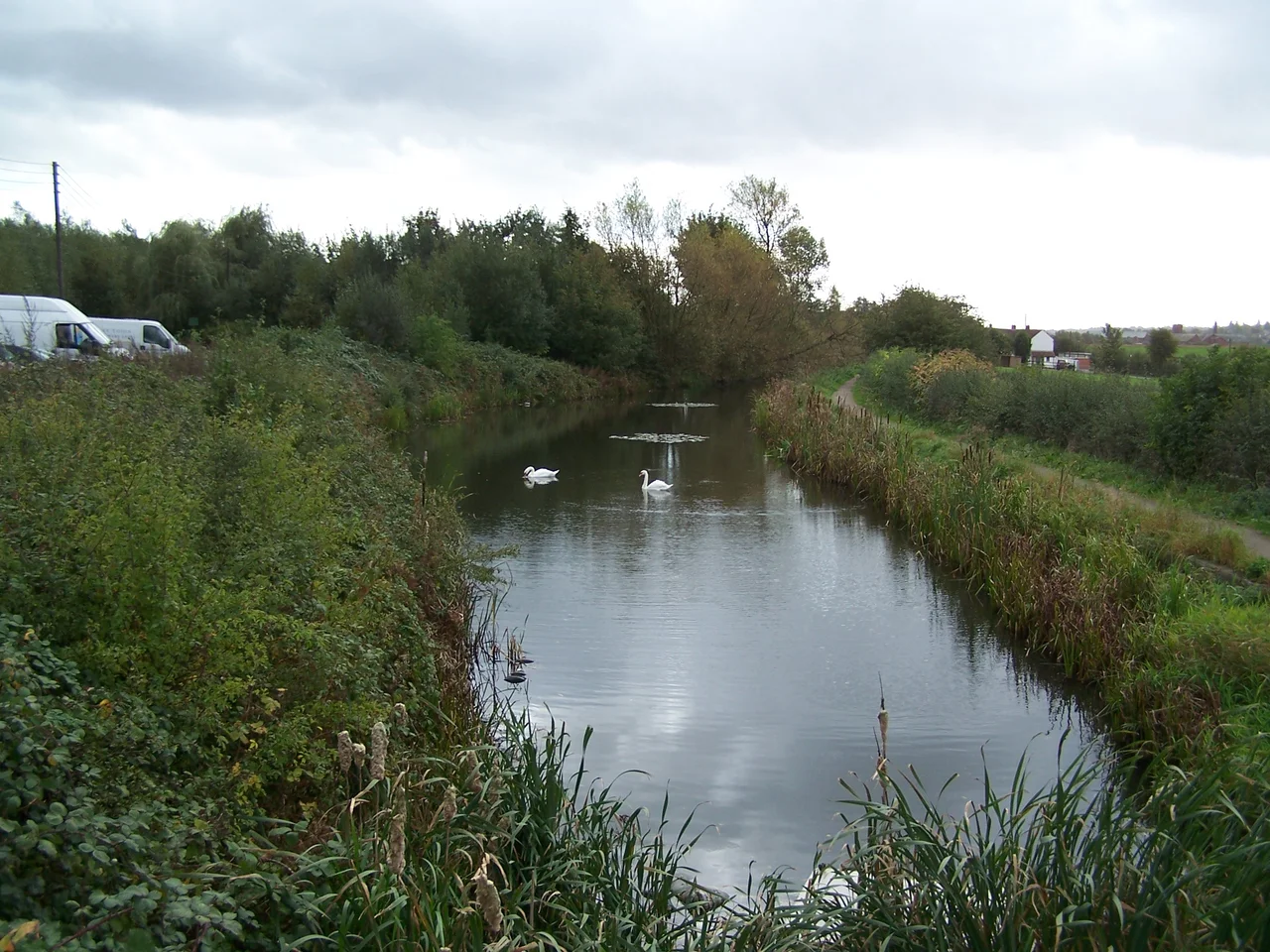

Nottingham Canal
On 30 July 1792, the engineer William Jessop turned the first sod of a fourteen-mile cut between Langley Mill in Derbyshire and the River Trent below Trent Bridge in Nottingham. The Nottingham Canal would be finished in 1796, seventy-seven percent over budget, after fifty years of squabbling with the rival Erewash Canal Company. It would carry coal at a steady profit for a generation. It would then be ground down by railway competition, sold off in 1856, abandoned upstream of Lenton in 1937, and filled in piece by piece between 1955 and 1966. Most of it now lies under car parks and council estates. What survives is split between a working waterway in the centre of the city and a chain of nature reserves running up the Erewash valley toward Eastwood.
Canal Mania
The idea came up at a public meeting in the Nottingham Guildhall on 26 October 1790. Three local promoters — Thomas Oldknow, John Morris, and Henry Green — had become convinced that the Cromford and Erewash canals were about to give the upstream colliery owners a stranglehold on coal prices in Nottingham. The proposal was for a direct cut from the Cromford Canal at Langley Mill down to the Trent below Trent Bridge, cutting out both rivals. The Erewash Canal company opposed it. The Trent and Mersey Canal opposed it. Lord Middleton, who owned Wollaton Hall and the coal mines beneath it, agreed to support the bill only if the route ran on the east side of his park, not the west — a condition the committee accepted, despite the higher cost. William Jessop, fresh from the success of the Cromford, was hired as engineer. Shares were oversubscribed within days. It was the height of Canal Mania.
The Cost of Building
Jessop's original estimate was forty-five thousand pounds. By September 1794, every hundred-pound share had been called for an additional forty pounds. By March 1795, the call had reached fifty. In February 1795, seven weeks of severe frost gave way to a rapid thaw, and sections of the new cut were torn up by flooding. The proprietors wrote to Jessop expressing their dissatisfaction with the erroneous construction of many works on the canal and the very large expense incurred. Jessop, by then juggling several bigger national projects, had limited time for them. The Beeston Cut — the parallel branch that allowed boats to bypass the difficult passage through Trent Bridge — was built separately by the Trent Navigation Company after intense bargaining over rights. The first boat reached Nottingham from the south on 1 March 1796. The whole length opened on 26 April. The final cost was eighty thousand pounds, and most of the original proprietors resigned soon afterwards.
Coal, Gunpowder, and the Quiet Decades
For half a century, the canal worked. Tolls produced about £2,600 in 1798, £4,600 by 1800, £9,900 by 1830, £12,800 by 1840. The bulk of the traffic was coal — nearly 80 percent of the 114,000 tons carried in 1799-1800. Dividends ran at £12 per £150 share, paid twice a year. There was one notable disaster. On 28 September 1818, the canal company warehouse near Wilford Street took delivery of twenty-one barrels of gunpowder from the Nottingham Boat Company. A man named Musson saw that some powder had leaked from one of the barrels. He, in the words of the contemporary account, rather foolishly dropped a hot cinder onto it. The whole consignment went up. Musson was thrown a hundred and twenty-six yards by the blast. Two men died. Boats were destroyed and surrounding buildings flattened. The insurance company refused to pay; the canal company sued the boat company and won a thousand pounds it never collected.
The Railway Kills It
The Midland Counties Railway opened its Nottingham line in 1842 and the canal's income collapsed at a pace nobody had predicted — from £12,500 in 1841 to £6,000 by 1852. The company laid off staff, cut tolls, and finally concluded it would be better to sell out to a railway than to dwindle on. The Ambergate, Nottingham, Boston and Eastern Junction Railway agreed to buy it at £225 a share, then refused to honour the deal, then was forced to by the House of Lords in 1856. Within a few decades the canal had passed through the Great Northern Railway to the LNER, which abandoned everything above Lenton in 1937. Nottingham City Council bought the city section in 1952, began filling it in from 1955, and finished by 1966. Open-cast coal mining destroyed long stretches between Awsworth and Eastwood. The route through the city now lies under roads and buildings, the only trace of it the rerouted River Leen running where the canal once did.
What Survives
Two pieces remain. The main line from Trent Bridge to Lenton, plus the Beeston Cut back to the Trent at Beeston Weir, is still a working waterway — part of the navigation of the River Trent, used by boats and walkers. In the middle of Nottingham, Castle Lock and the Castle Wharf area beneath Nottingham Castle have been redeveloped with bars and restaurants in the old warehouses, and the towpath forms part of the city's 16-kilometre Big Track cycle route. Upstream, Broxtowe Borough Council bought six miles of the abandoned top pound in 1977 — running through Eastwood, Awsworth, Cossall, Trowell, and Bramcote — and declared it a local nature reserve in 1993. The Grade II listed Swansea bridge, built in 1793-95, still spans the cut at Trowell, named for the swans that once congregated there. The swans were moved in 1980 by the RSPB after the section ran short of water. The bridge remains. The canal it crosses, mostly, does not.
From the Air
Main surviving section runs east-west through Nottingham at 52.955 N, 1.279 W, between Trent Bridge (52.94 N, 1.13 W) and Beeston Weir (52.92 N, 1.21 W). View from 1,500 to 3,500 ft AGL; the working canal is a thin parallel water channel south of the city. The abandoned upper pound winds northwest through Trowell and Awsworth toward Eastwood, much of it now wooded nature reserve. East Midlands (EGNX) is 6 nm SW; Nottingham/Tollerton (EGBN) is 5 nm SE.
Nearby Stories
- Rutland Railway Museum 2.4 km away
- Welbeck Abbey 5 km away
- Lichfield rail crash 6 km away
- Peveril Castle 8.8 km away
- Grantham Rail Accident 11 km away
- Croxden Abbey 11 km away
- RAF Scampton 11 km away
- Leicester Abbey 11 km away