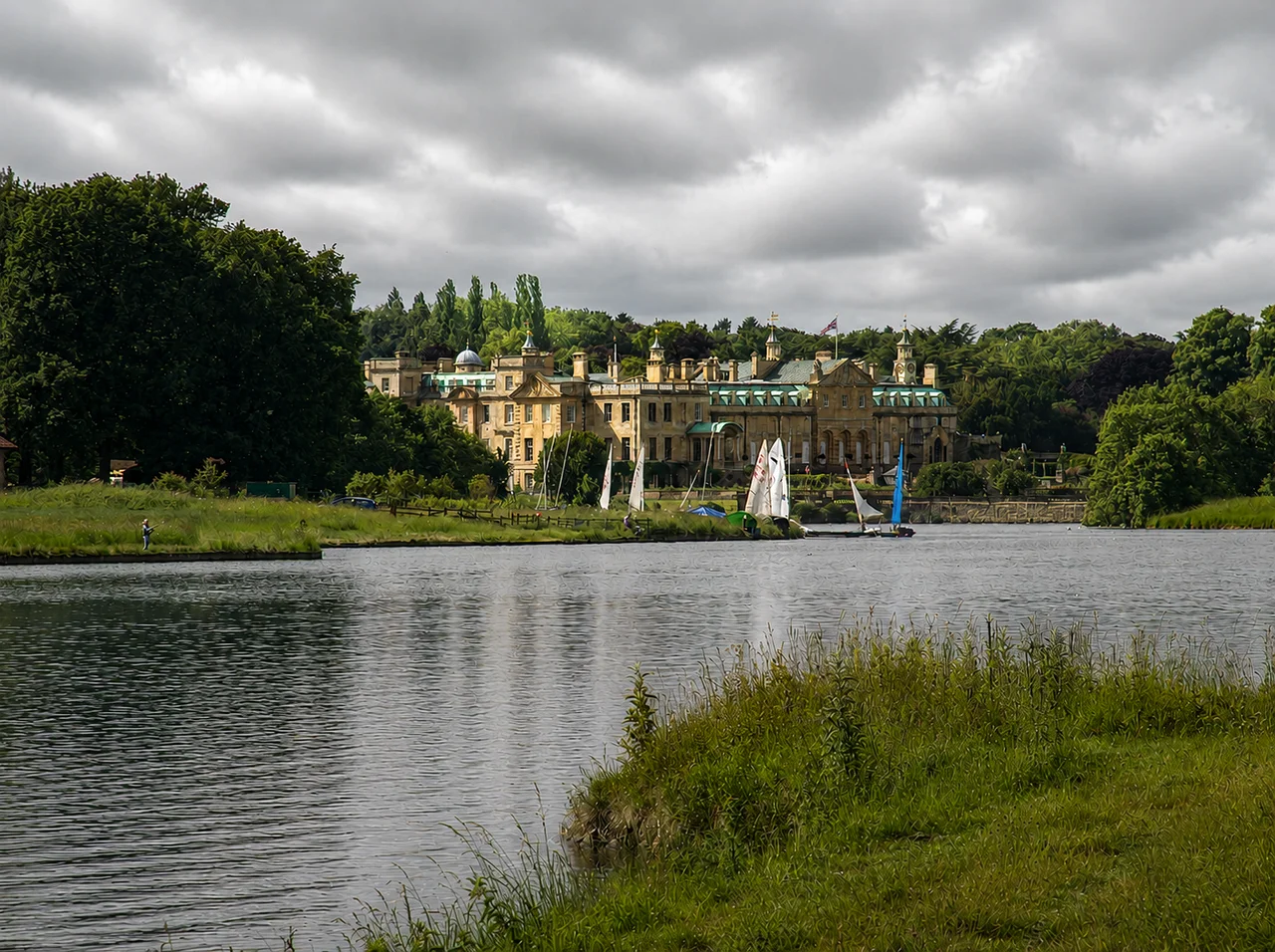

Welbeck Abbey
The 5th Duke of Portland did not want to be seen. He did want a ballroom. The two desires sound incompatible, but at Welbeck Abbey in the 1860s and 70s he resolved them in the most extraordinary way available to a 19th-century English aristocrat: he had one dug. Sixty-three feet wide, a hundred and sixty long, lit from above by skylights cut through a discreet lawn, the underground hall sat empty of dancers for the rest of his life. He never threw a ball in it. He had simply needed to know that, should he ever wish to, the room existed beneath his park.
From Premonstratensian Canons to Cavendish Heirs
Welbeck began as a monastery. Thomas de Cuckney founded it in 1140 for the Premonstratensian order, white-robed canons who would chant the daily offices in the abbey of St James for nearly four centuries. By the dissolution of 1538 the abbot of Welbeck was the chief of his order in England, and the wealth attached to that title made the estate one of the prizes Henry VIII handed out. It passed to Richard Whalley, then to a London clothier, then in 1599 to Gilbert Talbot, 7th Earl of Shrewsbury for £555 6s 6d, then in 1607 to Sir Charles Cavendish, son of Bess of Hardwick. Cavendish hands held it for a century. James I came to dinner here in 1619, Charles I in 1633. Robert Smythson, the architect of Hardwick Hall and Wollaton, designed the great riding house. Then in the 18th century the estate passed by marriage into the Bentinck family, who held the dukedom of Portland, and the long Welbeck story acquired its strangest chapter.
The Duke Who Lived Underground
William John Cavendish-Scott-Bentinck, 5th Duke of Portland, succeeded in 1854 and ran the estate for twenty-five years. He preferred not to be observed. Even his own servants were instructed, on the rare occasions he wished to leave the house, to look the other way as he passed. From this temperament came one of the most ambitious private building projects of Victorian England. The duke had the kitchen gardens enlarged to twenty-two acres behind heated walls, the largest fruit wall over a thousand feet long. He commissioned a riding house 396 feet by 108 feet, said to have been the second largest in the world after the Manege at the Kremlin, lit by 4,000 gas jets so that his horses could be exercised by night. He built a tan gallops 422 yards long, surfaced in spongy oak chips from the leather tanneries. And he tunneled. A passage more than a thousand yards long, wide enough for a row of walkers, ran from the house to the riding school, with a rougher parallel tunnel beside it for the workmen. A second tunnel, intended as a carriage drive a mile and a half toward Worksop, was abandoned only when its dam beneath the lake gave way.
Rooms Beneath the Lawn
What ground-level visitors saw, then and now, was a sprawling country house in restrained taste. What they did not see, unless they were taken there, was the suite of "below ground" chambers the duke excavated beside it. Flat-roofed, skylit, hidden at ground level by careful planting, they included that enormous never-used ballroom and a five-room library complex for the duke's books. By 1879 the abbey itself was nearly empty. Only four or five rooms in the west wing were habitable, all of them painted pink, parquet-floored, almost without furniture, each with a water closet in the corner. The duke had spent prodigious sums and employed thousands of masons, bricklayers, joiners and plumbers. He had paid them fairly, settled disputes about wages and hours without rancour, and earned the unironic nickname "the workman's friend." When he died, the estate inherited an underground kingdom and a workforce that remembered him with something close to affection.
Twentieth Century and the Quiet Estate
The 6th Duke pulled Welbeck back from disrepair and made it a centre of late-Victorian and Edwardian society. Archduke Franz Ferdinand stayed here in November 1913 - ten months before Sarajevo - and nearly died in a shooting accident when a loader fell and discharged a shotgun within feet of the heir to Austria-Hungary. The kitchen block served as an army hospital through the Great War. From 1953 most of the abbey was leased to the Ministry of Defence, housing Welbeck College, which prepared young men for the technical branches of the British Army until the school moved to Leicestershire in 2005. Today the estate is back in family hands - William Parente, a great-grandson of the 7th Duke, inherited in 2008 - and parts of it are open to visitors. The School of Artisan Food teaches in the old fire stables, the Harley Gallery occupies the former gasworks, and the Welbeck Farm Shop trades briskly. The tunnels' skylights still wink up from the verge of the Robin Hood Way, where walkers pass over the duke's hidden world without always knowing it is there.
From the Air
Located at 53.26°N, 1.16°W in north Nottinghamshire, in the heart of the Dukeries. The estate sits between Worksop (3 nm N) and Mansfield. Nearest airports: Doncaster Sheffield (EGCN) 14 nm NW, East Midlands (EGNX) 30 nm S. From 3,000-5,000 ft the great rectangular outline of the riding house and the long fruit walls are visible against the parkland; the tunnel skylights themselves are too small to spot from altitude but the line of the Robin Hood Way traces their route. Approach via the A60.
Nearby Stories
- Flixborough Disaster 0.8 km away
- Peveril Castle 1.7 km away
- Newstead Abbey 2.6 km away
- Huddersfield Town Hall 3.8 km away
- Ackworth School 7.9 km away
- RAF Scampton 11 km away
- RAF Cranwell 16 km away
- Croxden Abbey 18 km away