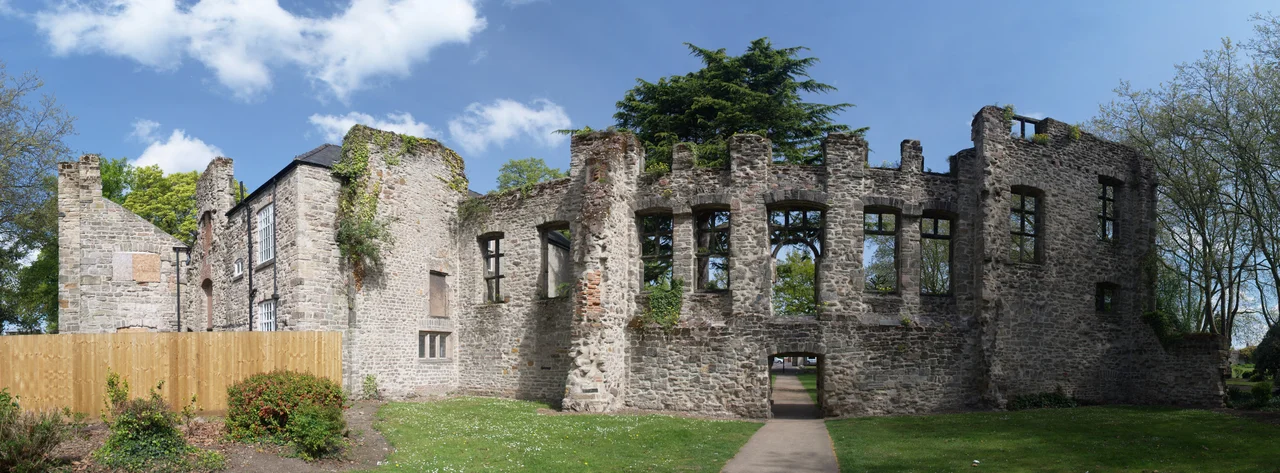

Leicester Abbey
Thomas Wolsey had been the most powerful subject in England, the cardinal-archbishop who had served Henry VIII faithfully enough to amass a fortune larger than most kings'. By November 1530 he was sixty, exhausted, and travelling south under arrest, charged with treason on a thin pretext that everyone knew was the Tudor way of clearing the political stage. He stopped at Leicester Abbey on the evening of 26 November. The abbot, John Penny, met him at the gate. Wolsey is supposed to have said, as he dismounted: 'Father Abbot, I am come hither to leave my bones among you.' He was right. Three days later, on 29 November 1530, he died at the abbey - whether of dysentery, of grief, or of the strategic timing that has always made historians wonder. He was buried somewhere within the abbey precinct. Eight years later, in 1538, the abbey itself was dissolved, demolished, and its stones carried away to build half the great country houses of the Midlands. Wolsey's grave was lost. So, eventually, was the abbey.
An Augustinian House and Its Wealth
Leicester Abbey - more formally the Abbey of Saint Mary de Pratis - was founded in 1143 by Robert le Bossu, the second Earl of Leicester, during the great 12th-century wave of monastic enthusiasm that built most of England's monasteries. It was Augustinian rather than Benedictine, home to 30 to 40 canons regular - sometimes called Black Canons for the dark cloaks they wore over white habits. The abbey grew quickly. Through the gifts of its founders and subsequent benefactors it gained the advowsons of churches across Leicestershire, Berkshire and Northamptonshire, several manors, and exemption from sending representatives to Parliament. By the time Henry VIII's commissioners turned their attention to it in the 1530s, it was the wealthiest religious house in Leicestershire, with an annual income of £951. Unfortunately it also owed £1,000 to its creditors. A succession of incompetent and corrupt abbots in the 15th and early 16th centuries had run the place into a financial hole no amount of episcopal exemption could fix.
Henry Knighton's Black Death
The most famous canon in the abbey's long history was Henry Knighton, whose Chronicle - written in the late 14th century during his time at Leicester - remains one of the most important sources for English history in the years either side of the Black Death. Knighton chronicled the impact of John Wycliffe and the rise of the Lollards. He gave an unusually favourable account of John of Gaunt at a time when most chroniclers were turning against the duke. Most importantly, he kept records of what the plague did to Leicester. The chronicle includes detailed parish-by-parish death tolls suggesting that one-third of the population of Leicester died of the disease - a number that has held up reasonably well under modern epidemiological scrutiny. He recorded the price collapses, the wage shocks, the labour shortages that followed. When canons of the abbey itself began to die, Knighton wondered in writing whether God was punishing the order for 'the ordination of candidates ill-prepared and but little suited for the sacred ministry.' Whatever divine judgement was or was not at work, plague did not discriminate.
Wolsey's Last Inn
The story of Wolsey's arrival and death at Leicester Abbey is one of those moments in English history that has acquired a slightly improving quality through repetition. The dying cardinal, riding south to face Henry's anger, supposedly told the assembled monks: 'Had I but served God as diligently as I have served the king, He would not have given me over in my grey hairs.' Shakespeare puts the line in Wolsey's mouth in Henry VIII. Whether the cardinal really said it, or whether the chronicler George Cavendish - who travelled with him - improved the speech for posterity, the substance is true enough. Wolsey understood what was happening. He had risen further than any subject in living memory; he was dying because he had failed to deliver Henry's annulment from Catherine of Aragon. He was buried inside the abbey church. When the church was demolished in 1538 the burial was lost, and despite multiple later attempts no one has ever convincingly located it. Somewhere beneath what is now Abbey Park in north Leicester, the bones of one of Tudor England's most consequential figures are still there.
Stones Scattered to Half of England
The Dissolution was followed by demolition that was, in this case, unusually systematic. The Marquess of Northampton - brother of Henry VIII's last queen, Catherine Parr - was granted the site in 1551 and used much of the abbey stone to build a mansion on top. The Marquess fell out of favour two years later for supporting Lady Jane Grey, and the property passed through several aristocratic families before being acquired by the 1st Earl of Devonshire in 1613, after which the mansion became known as Cavendish House. The house was looted and destroyed by fire in 1645 during the English Civil War, after Royalists captured Leicester. The remaining stone went on, in stages, to construction at Calke Abbey, Longleat House, Syon House, Welbeck Abbey, and Woburn Abbey - a partial list. The abbey was donated to Leicester Council in 1925 by the 9th Earl of Dysart. The 1920s and 1930s saw the first systematic excavations, which finally rediscovered the lost footprint of the church and cloister; the layout was marked out in low stone walls that visitors still walk between today. Abbey Park is now a public park. The abbey itself is a scheduled monument and Grade I listed. Penny's Wall, a stretch of the abbey precinct wall built in brick around 1500 by Abbot Penny, still stands - the most substantial surviving fragment of the place where a cardinal came to die.
From the Air
Leicester Abbey lies in Abbey Park at 52.6486°N, 1.1369°W, about 0.8nm north-northeast of Leicester city centre and west of the River Soar. From altitude, Abbey Park is identifiable as the large green space between the inner ring road and the canal, with the abbey's low marked-out wall outlines visible on its eastern side. East Midlands Airport (EGNX) lies approximately 14nm to the northwest. The neighbouring Belgrave area's Golden Mile runs immediately to the east. Visit at lower altitudes to pick out the marked stone outlines of the lost abbey church and cloister.
Nearby Stories
- National Shell Filling Factory, Chilwell 1 km away
- Staffordshire Regiment Museum 2 km away
- Rutland Water 3.3 km away
- Grantham 4.4 km away
- Wellingborough 9.9 km away
- Croxden Abbey 11 km away
- Bordesley Abbey 14 km away
- Electric Railway Museum 17 km away