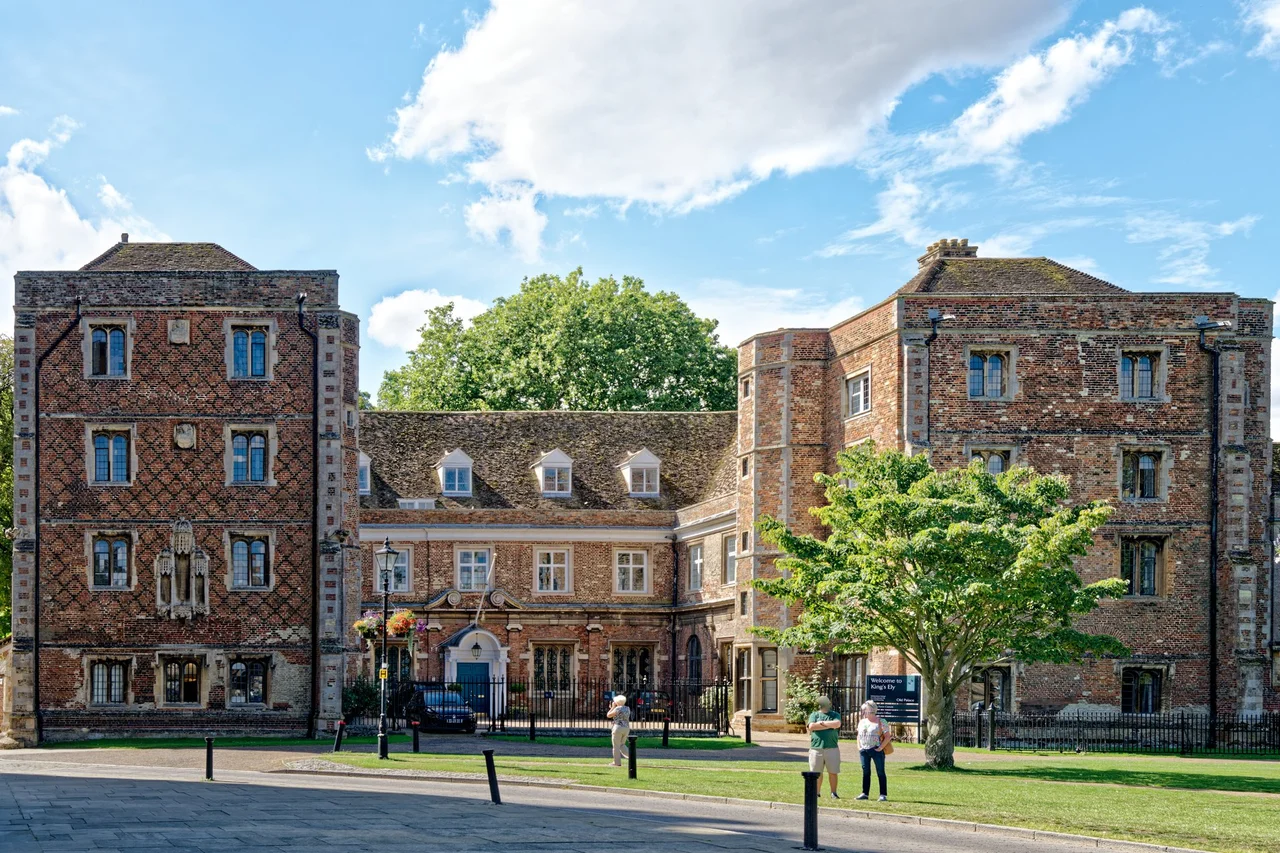

King's Ely
When the monks of Ely betrayed Hereward the Wake in 1071, revealing the secret passageway that led to the last Saxon rebel's defeat, the teachers at the school within those walls were complicit in one of medieval England's pivotal moments. That school has been here ever since — through floods, conquests, dissolutions, civil wars, and eleven centuries of British life. King's Ely, founded in 970 AD, is not simply one of the oldest schools in the world. It is a living institution whose corridors are the corridors of English history.
A Thousand Years in Stone
The school's origins reach back further than its official founding date. In 673 AD, an abbey founded by St Etheldreda on this same site began educating child oblates — the school traces its lineage to that first classroom. The Danes burned the site to the ground in 840. A century and a quarter later, in 970, Æthelwold, Bishop of Winchester, and St Dunstan, Archbishop of Canterbury, restored the monastery and with it the school, which has operated continuously from that point. When Henry VIII dissolved the monasteries in 1541, many connected schools faced abolition. King's Ely survived: the king himself re-endowed it, giving the school its first royal charter and placing it among his seven King's Schools. Elizabeth I issued a second charter in 1562, Charles II a third in 1666. Three monarchs, three fresh beginnings — though the institution itself never actually stopped.
Living Classrooms
Today more than 1,000 pupils study in buildings that were never designed as a school. The imposing Porta — the great medieval gateway into the cathedral's monastic complex — now houses the school's main library. The Monastic Barn, which once stored the abbey's crops and tithes, serves as the dining hall. Prior Crauden's Chapel, built in 1324 for John de Crauden and Grade I listed, still holds its original wall decoration; pupils and staff play its organ for small congregations. School House, one of the boys' boarding houses, is claimed to be the oldest inhabited residential building in Europe. The Bishop's Palace, built in the 15th century and once an official residence of the Bishop of Ely, now serves as the Sixth Form Centre, opened in 2013. These are not museum pieces — they are places where teenagers eat breakfast, sit exams, and practice scales.
The Ely Sound
Music has always been central to King's Ely, and nowhere is this more audible than in the cathedral choir. The boy choristers of Ely Cathedral are educated at and board with the school; they sing Evensong four nights a week, plus Saturday and Sunday services, practicing before classes each morning. In 1955 the Reverend Christopher Campling described a quality the choir's director had cultivated: a tone "halfway between the continental guttural sound produced from the chest voice, and the pure hard tone of the traditional English cathedral treble." This became known as the "Ely Sound" — harsher than King's College, more flexible, more vigorous. The Ely Cathedral Girls' Choir was established in 2006, comprising twenty girl choristers drawn from the school's upper years, adding a second voice to an already distinctive tradition.
Scholars and Traditions
Each year the school stages the Hoop Trundle, a tradition marking Henry VIII's 1541 re-founding: students race 75 yards along the east lawn of Ely Cathedral bowling wooden hoops with sticks, a game that was among the privileges the first royal scholars were granted. Top academic performers in Year 12 are nominated as King's Scholars or Queen's Scholars — the latter category created at Queen Elizabeth II's personal request during her 1973 visit — and they earn the right to be married in the cathedral and buried in its grounds. Among the school's former pupils: Edward the Confessor, King of England; Thomas Willett, the first mayor of New York City; Goldie Sayers, who was awarded an Olympic bronze medal for javelin at the 2008 Beijing Games (after a Russian athlete was disqualified for doping in 2018, elevating Sayers from fourth place); and Gus Unger-Hamilton, keyboardist for the band alt-J.
Survival as a Skill
The school that has survived a thousand years has had practice at resilience. It was burned by the Danes, flooded, subjected to dissolution, renamed by successive regimes — Queen Anne's School, Ely Cathedral Grammar School, back to King's School — and only finally settled on the name King's Ely in 2012. In the 2021 inspectorate review, it received the highest possible grading in every category assessed. School House claims the oldest inhabitable building in Europe. The Great London Plane Tree in the Bishop's Palace grounds, planted in 1674 by the Bishop of Ely, was named one of the Top 50 British Trees by the Tree Council in 2002. Some institutions accumulate history. King's Ely seems to generate it.
From the Air
King's Ely is located at approximately 52.40°N, 0.26°E in the city of Ely, Cambridgeshire. The school campus surrounds Ely Cathedral, whose distinctive octagonal lantern tower is a landmark visible from considerable distance across the flat Fenland. Nearest airports: Cambridge (CBG) approximately 16 miles south, and Peterborough/Conington (KNS) approximately 20 miles northwest. The surrounding Fens are extremely flat, making Ely's cathedral spire the dominant visual feature for many miles in all directions.
Nearby Stories
- Bed Burial 2.5 km away
- Thetford Priory 6.6 km away
- Oundle School 8.1 km away
- RAF Lavenham 9 km away
- John Bunyan Museum 11 km away
- King's Lynn Minster 15 km away
- Woolsthorpe-by-Colsterworth 21 km away
- Walsingham Priory 21 km away