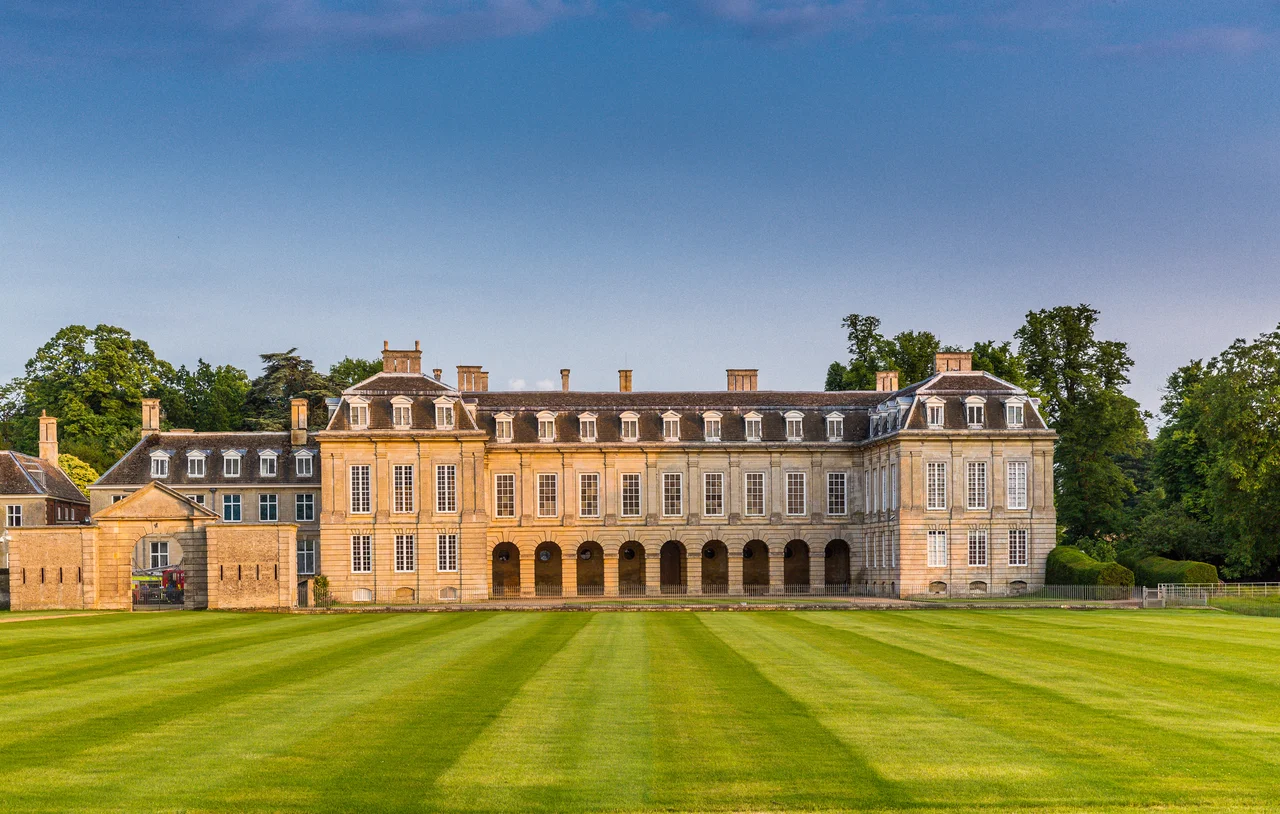

Boughton House
Ralph Montagu served as the English ambassador to France in two spells during the late 1660s and 1670s and came home obsessed with the Palace of Versailles. He inherited an estate in Northamptonshire in 1683 from his father, whose grandfather had bought it from monks in 1528 just before the Dissolution. What Ralph did with that inheritance is one of the strangest cultural transplants in English architecture: he built a French chateau in the middle of an English park. The result was Boughton House, called by everyone since The English Versailles - low and long and pale-stoned, set behind reflecting pools and lines of plane trees and turf cut into perfect geometries. Three centuries later the same family still owns it. The collections inside are stupefying. And the present Duke of Buccleuch has been quietly rebuilding the gardens his ancestors planted.
Three Families, One House
Boughton's name is on every English aristocratic family tree worth tracing. The original Tudor mansion was bought in 1528 by Sir Edward Montagu, Lord Chief Justice to Henry VIII, who acquired the property just as the monks who built it were being turned out by his royal master. His descendant Ralph Montagu, made first Duke of Montagu, completed the Versailles transformation in the 1680s. When the third Duke died in 1790, the house passed through his daughter Elizabeth's marriage to Henry Scott, third Duke of Buccleuch and fifth Duke of Queensberry - which is why the current owner, Richard Montagu Douglas Scott, the tenth Duke of Buccleuch, carries three great surnames stitched into one. Montagu, Douglas, Scott: the families who built up the largest private collection of art and furniture still in private hands in Britain, by simply marrying each other over the course of three centuries.
The Collection
Walk through Boughton today and you find paintings that should not be in a single house. El Greco's Adoration of the Shepherds. A Thomas Gainsborough portrait of Mary Montagu. A celebrated series of grisailles - paintings done entirely in shades of grey - by Anthony van Dyck. John Wootton's Breaking Cover. The furniture is largely 17th-century French, brought back by Ralph from his ambassadorship and by his successors from their continental travels. The tapestries are extraordinary. The armoury, occupying what was once the servants' hall next to the kitchen, is considered by experts one of the finest privately held collections in Britain - assembled largely by John, the second Duke of Montagu, who died in 1749 and was nicknamed John the Planter for what he did to the grounds. In 1945 the diarist Henry Chips Channon visited Boughton and wrote: It is a dream house with a strange, sleepy quality, but its richness, its beauty and possessions are stupefying. Everything belonged to Charles I, or Marie de Medici, or was given by Louis XIV to the Duke of Monmouth.
Orpheus and the Golden Ratio
The garden is the part that has been most actively reinvented. The original 1680s landscape used the golden ratio for its proportions - vast turf rectangles, long reflecting basins, avenues of elms and planes. The second Duke - John the Planter - swept away the earlier ornamental parterres and made water the structural element. Charles Bridgeman, who later designed the celebrated gardens at Stowe, worked here in the early 18th century and is believed to have shaped the sculptural earth forms that still survive. After centuries of decline the ninth Duke began restoration; the tenth Duke has continued it. The River Ise was returned to its 18th-century width using two miles of green oak boarding bolted into place. In 2009 the landscape designer Kim Wilkie was commissioned to create something new beside an existing grass pyramid: he produced Orpheus, an inverted pyramid carved seven metres down into the earth, with a spiral rill descending to a small pool at the bottom. Both the existing pyramid and the new inversion sit precisely on the garden's golden-ratio grid. In 2015 the Grand Etang, a long-vanished reflecting lake from the original layout, was excavated and refilled - with a 75-foot water jet rising from its centre, just as it had three centuries earlier. The ice-skating in winter has not yet returned.
The House That Stays Quiet
Boughton's strangest virtue is its silence. After the mid-18th century the family used it relatively little, preferring other seats. The house was well cared for but rarely altered, with the result that it has some of the best preserved Baroque state rooms in the British Isles - rooms that were modern when they were built and have hardly been touched since. Most great houses get knocked about by every generation. Boughton has been allowed to age. In the late 20th century Mary, Mollie, Duchess of Buccleuch, widow of the eighth Duke, made it her dower house and brought it gently back to life. After her death in 1993 the ninth Duke opened it for small tours, and today the public can visit on specific dates each year - the house remains a working seat, with the family still in residence. In 2012 unknown Italian Baroque scores, including by Vivaldi, were discovered in the Montagu Music Collection here. From 2014 the grounds have hosted the Greenbelt festival every August - tens of thousands of people on the same turf the second Duke laid out with such mathematical care. Ridley Scott filmed parts of his 2023 Napoleon here. The dream house, as Chips Channon called it, keeps drawing visitors who arrive ready to be quiet.
From the Air
Boughton House sits at 52.4245N, 0.6778W, about three miles north-east of Kettering in Northamptonshire, set in 11,000 acres of estate. From the air the house is identifiable by its long, low pale facade, the formal water features and reflecting lakes immediately in front, the avenue-lined approach, and the surrounding mature parkland. The grass-pyramid mount and the inverted Orpheus landform are visible to the east. Best viewed at 2,000-4,000 ft AGL. Nearest airfields: Sywell (EGBK) about 11 miles south-west, Conington (EGSF) about 18 miles north-east, Cranfield (EGTC) about 18 miles south. The A14 lies four miles south.
Nearby Stories
- Selwyn College, Cambridge 7.2 km away
- John Bunyan Museum 9 km away
- Canons Ashby House 9.4 km away
- Woolsthorpe-by-Colsterworth 11 km away
- Loughborough 11 km away
- Wigston 13 km away
- RAF Witchford 19 km away
- King's Lynn Minster 27 km away