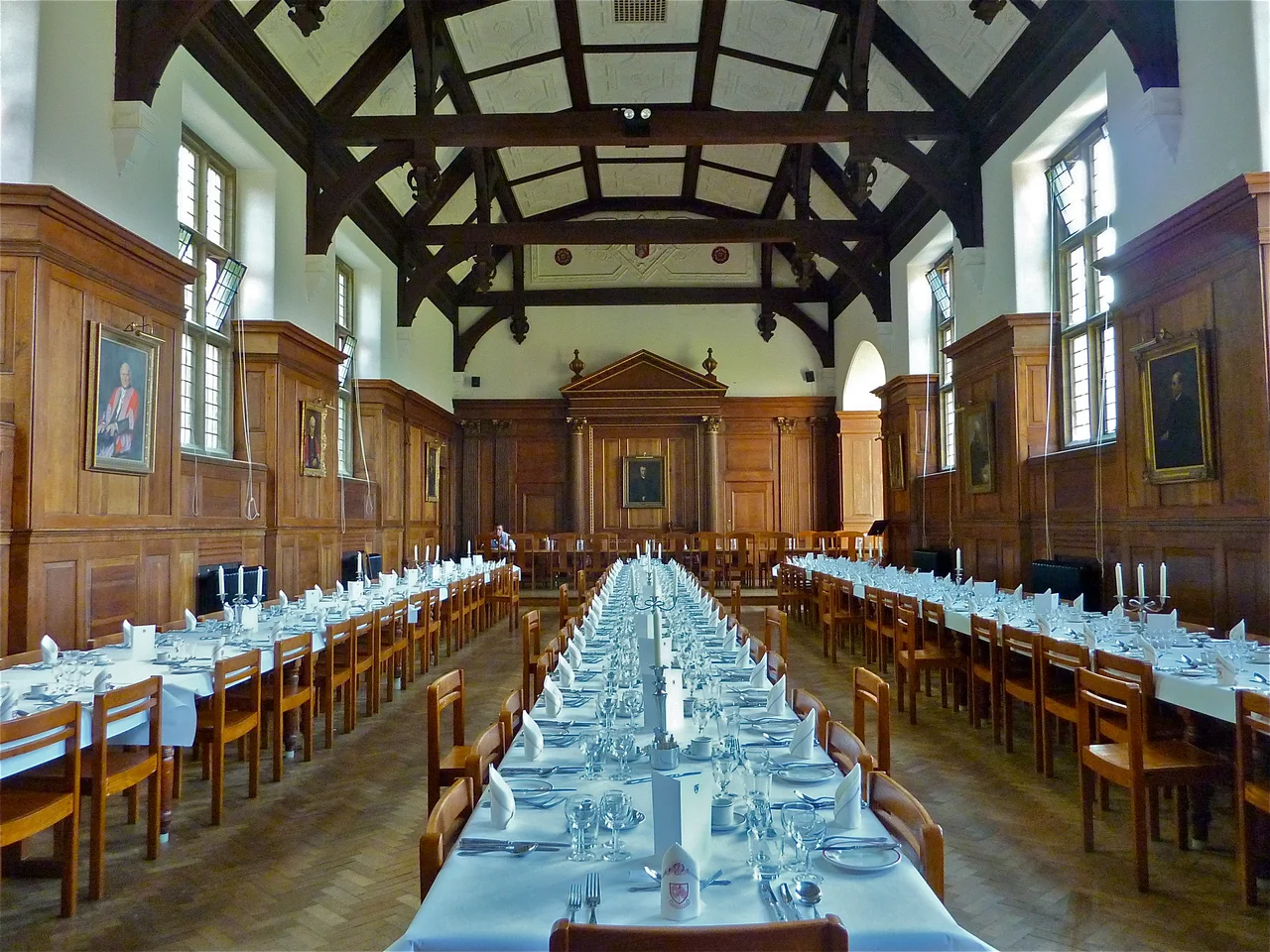

Selwyn College, Cambridge
George Augustus Selwyn rowed in the inaugural Oxford-Cambridge Boat Race in 1829, came second in the Classical Tripos in 1831, and was ordained a priest in 1834. In 1841, the Bishop of London offered him a newly created position: the first Bishop of New Zealand. Selwyn accepted and spent 26 years in the southern Pacific, playing a central role in establishing the Anglican church in a new nation. He returned to England in 1867 and died as Bishop of Lichfield in 1878. The college founded in his memory four years later carries his pastoral staff — a hardwood Maori staff he brought back from New Zealand — in its chapel.
A College for Gentlemen of Modest Means
When Cambridge scholars began planning a memorial college for Selwyn after his death in 1878, they imagined an institution that would make Cambridge accessible to men of Christian character who lacked the financial means to attend other colleges. In November 1879, they purchased six acres of land from Corpus Christi College for £6,111 9 shillings and 7 pence. The site, between Grange Road, West Road, and Sidgwick Avenue, was considered somewhat remote from the university's centre. Construction of Old Court began in 1880, built in Ketton stone and local red brick in the Victorian Late Perpendicular Gothic Revival style, designed by Sir Arthur Blomfield. Chapel attendance was compulsory from the college's founding until 1935. By 2023, Selwyn was admitting 81 per cent of its undergraduates from maintained schools — state schools — one of the highest proportions in Cambridge, while ranking first in the university for good honours examination results in 2024.
Coat of Arms, Maori Staff, and a Motto Carved in Stone
The college coat of arms violates one of the fundamental rules of heraldry — the rule of tincture, which prohibits placing a metal colour on another metal colour — in exactly the same way as the arms of the Kingdom of Jerusalem. The arms' dexter half, adapted from the Diocese of Lichfield, places gold on silver, which heraldic convention forbids. This is thought to be a deliberate reference to Jerusalem's arms, known for the same violation. Over the main college gate, built in 1881, the college motto is carved in Greek: ΑΝΔΡΙΖΕΣΘΕ — 'Quit ye like men,' from 1 Corinthians. Selwyn's pastoral staff, displayed in the chapel, is based on a hardwood Maori crozier he used in New Zealand.
Hugh Laurie, The Who, and a Unique Winter Ball
Selwyn is the only Oxbridge college to hold an annual Winter Ball — the Selwyn Snowball — traditionally on the last Friday of Michaelmas term. The May Ball tradition dates to 14 June 1948, when hundreds of students in black tie attended the first all-night celebration. In 1967, The Who performed at a May Ball here. Hugh Laurie — the actor, writer, and musician — was a member of the Selwyn College Boat Club before his career took a different direction. Tom Hollander and Olympic sports director Richard Budgett are also alumni of the boat club. Selwyn's student magazine, Kiwi, published continuously since 1982, is the longest-running student magazine of any Cambridge college. The Controversialists, founded in 1893, are the college's oldest secret society; their badge is a purple lyre.
Notable Alumni and a Mixed Choir That Tours
Selwyn's alumni include Wes Streeting, Secretary of State for Health and Social Care; Kate Forbes, SNP politician and Member of the Scottish Parliament; Hugh Laurie, best known internationally for the television drama House; Sophie Wilson, the computing pioneer who designed the ARM instruction set that now runs in most of the world's mobile devices; and John Sentamu, former Archbishop of York. The college chapel choir is a mixed choir that sings three services weekly during term and has made over 15 commercial recordings. It has included members from neighbouring Newnham College since before women were admitted to Selwyn itself. The choir director is a professional appointment; the choir has toured to Gibraltar, Iceland, and Portsmouth.
From the Air
Selwyn College is located at 52.201°N, 0.106°E on the western side of Cambridge, near the Sidgwick Site and the Backs. Cambridge City Airport (EGSC) is approximately 2.5 nautical miles to the northeast. The college's distinctive limestone and red-brick buildings are visible from low altitude; the three courts of Old Court, Ann's Court, and Cripps Court form a compact campus west of the main university buildings. Best viewed at 1,000–2,000 feet in clear conditions on approach from the north or east.
Nearby Stories
- Kentwell Hall 2.5 km away
- Thetford Hoard 2.8 km away
- King's Ely 6 km away
- Bedford 7.8 km away
- White House Farm murders 13 km away
- Oundle 14 km away
- Hemel Hempstead 14 km away
- North Weald Airfield 15 km away