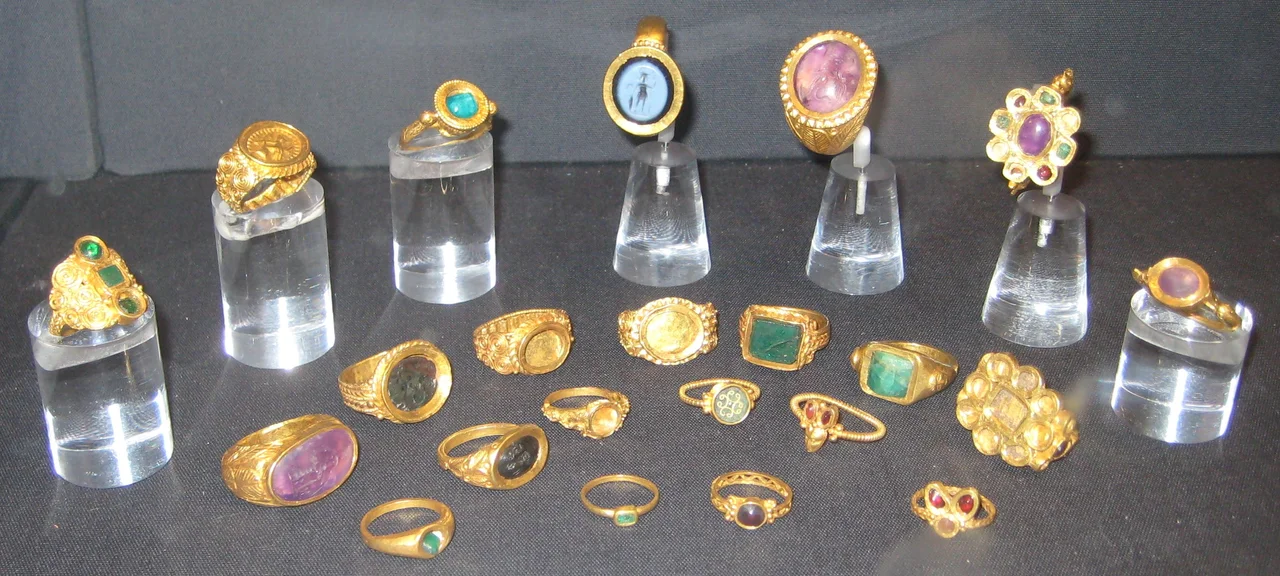

Thetford Hoard
The finder was working in failing light on a November day in 1979, without permission, on land that had just been cleared for building work. He dug fast, probably missed some pieces, and stuffed what he found into bags. Then he went home and tried to sell it quietly, because he knew he had no right to be there. By the time archaeologists heard about the find, the building site had been paved over. By the time the objects reached the British Museum for study, the finder was terminally ill. He died the following July, taking whatever he knew about the exact spot and the circumstances of burial to his grave. What he left behind is one of the most extraordinary hoards of late-Roman treasure ever found in Britain.
Gold, Silver, and Pagan Devotion
The Thetford Hoard, dating from the mid- to late-4th century AD, contains thirty-three silver spoons and three strainers, twenty-two gold finger rings, four gold bracelets, four necklace pendants, five gold chain necklaces, a gold amulet, an engraved gem, four beads (one emerald, three glass), a gold belt buckle, and a small shale box that probably held the smaller pieces. It is a complete ceremonial assemblage — not the accumulated savings of a wealthy family, but something assembled with deliberate purpose.
The key to understanding it lies in the inscriptions. Many of the spoons bear dedications to Faunus, a minor Roman god of the woodland and wild places who shared much with the Greek Pan. The inscriptions contain Celtic linguistic elements, suggesting a specifically Romano-British cult — not a transplant from Rome, but a local fusion. The spoons are of two types: slender cochlearia with long tapered handles, and the larger cigni, whose coiled handles end in birds' heads. The gold rings display elaborate filigree work. One tiny bezel shows a horned, Pan-like head, almost certainly a reference to Faunus himself.
The Moment of Crisis
What makes the Thetford Hoard exceptional is what it tells about the world it came from. By the end of the 4th century AD, Christianity was the official religion of the Roman Empire. The Theodosian edicts of the 390s had made pagan worship not merely unfashionable but dangerous. Scholars who have examined the hoard closely suggest that whoever buried it may have been part of a community of intellectuals — people who fervently held to the old gods, who commissioned this silverware and jewellery for ritual use, and who hid it when persecution of non-Christians became serious.
The gold objects appear in fresh, unworn condition. High-purity Roman gold scratches easily, and these pieces show almost no signs of use. Most of the rings share construction characteristics that suggest a single workshop produced them all at roughly the same time. This is not a collection built up over a lifetime; it looks more like a commission — and one that was hidden before it could be used.
What Cannot Be Known
The hoard's story is permanently shaped by what was lost in the circumstances of its discovery. Was the full hoard recovered, or did the rushed dig in failing light miss pieces? Persistent rumours suggested coins were originally present — but this was never confirmed or definitively ruled out. Was the burial a ritual act, a cache of cult objects placed deliberately in consecrated ground? Or was it a practical emergency measure, sacred objects hidden from imperial authorities in the chaos of the 390s? The findspot, now covered by a building, cannot be excavated.
The gold belt buckle, decorated with a satyr carrying a shepherd's crook and a bunch of grapes — Bacchic imagery linking to the broader pagan world of the hoard — was the kind of object worn as a symbol of status and office. One ring carries an engraved gem of brown chalcedony, bearing a cock-headed, snake-legged deity inscribed in Greek: magical words associated with ancient power. Greek charms appear in a Latin-speaking province. A community of believers left their gods buried in Norfolk soil, expecting, perhaps, to return. They never did.
In the Museum, After the Gods
The Thetford Hoard is now in the British Museum, where it has been studied, catalogued, and debated since it arrived in 1980. The scholarly consensus treats it as one of the most intriguing late-Roman precious-metal hoards found in Britain — important not merely for its beauty, but for what its openly pagan iconography reveals about resistance to Christianisation at a time when that resistance was becoming dangerous.
The man who found it died before he could tell his story. The people who buried it died without recovering it. Only the objects remain: gold that still catches light the way it did sixteen centuries ago, spoons that were never dipped into any dish, rings that were never worn. They outlasted everyone who had designs on them.
From the Air
The Thetford Hoard was found at Gallows Hill, near Thetford at approximately 52.40°N, 0.73°E, in the Breckland region of Norfolk. Norwich Airport (EGSH) is the nearest airfield, around 28 miles to the northeast. The flat Breckland landscape is visible from altitude; Thetford itself is a small market town easily identified by the River Little Ouse. The exact findspot is now beneath a building and not publicly marked. Recommended viewing altitude for the broader area: 2,000 feet in clear conditions.
Nearby Stories
- Ding Family Murders 1.5 km away
- Bungay Castle 2.6 km away
- Ely and Littleport Riots of 1816 4 km away
- Aldeburgh Festival 7.9 km away
- Bed Burial 12 km away
- Happisburgh Lighthouse 13 km away
- Walsingham Priory 18 km away
- Chain Bridge Forge, Spalding 34 km away