
Kentwell Hall
The mile-long avenue of lime trees was planted by a lawyer turned baronet in the 1670s, and it still lines the driveway to Kentwell Hall today — the most visible sign of the human accumulation that this moated manor house in Long Melford represents. Kentwell appears in the Domesday Book of 1086, when the manor was called Kanewella and counted among the properties of Frodo, brother of Abbot Baldwin of St Edmund's. Nine centuries later, Patrick Phillips bought the house in 1971 when it was in an advanced state of disrepair, and has been restoring it with the proceeds from opening it to the public ever since.
Six Centuries of Building
The Clopton family shaped Kentwell into its recognisable form. They arrived around 1375 when Sir Thomas Clopton married Katherine Mylde, and successive generations built, extended, and accumulated until the last resident Clopton died there in 1661. The oldest surviving structure is the Moat House, probably built in the early 15th century — its ground floor divided into a dairy, bakery, and brewery, the upper floors serving as service rooms. Sir William Clopton, who fought at Agincourt in 1415, is the most likely commissioner; his effigy in full armour can be seen in the nearby Holy Trinity Church. The main hall followed in three phases: main block in the late 15th century, wings added in the 1540s, and a third level including a new long gallery in the 1560s. The facade that visitors see today is largely the work of those 16th-century Cloptons.
Fires, Debts, and War
Kentwell's post-Clopton history accumulated its own drama. The baronet who planted those lime trees died in 1683 jumping from a window in London while escaping a fire. His son inherited and died the following year. The third baronet sold in 1685 to pay gambling debts. In 1826 a fire destroyed much of the interior, prompting the then-owner Robert Hart Logan — a Canadian timber merchant — to commission the Victorian architect Thomas Hopper, who had just worked on nearby Melford Hall. Hopper gave the Great Hall a new ceiling copied from Audley End in Essex: hammer beams and wall posts designed to resemble oak but made entirely of plaster. During World War II, the house and park were requisitioned as a transit camp; British airborne troops and elements of the 50th Northumbrian Infantry Division passed through before D-Day.
Tudor Life, Re-enacted
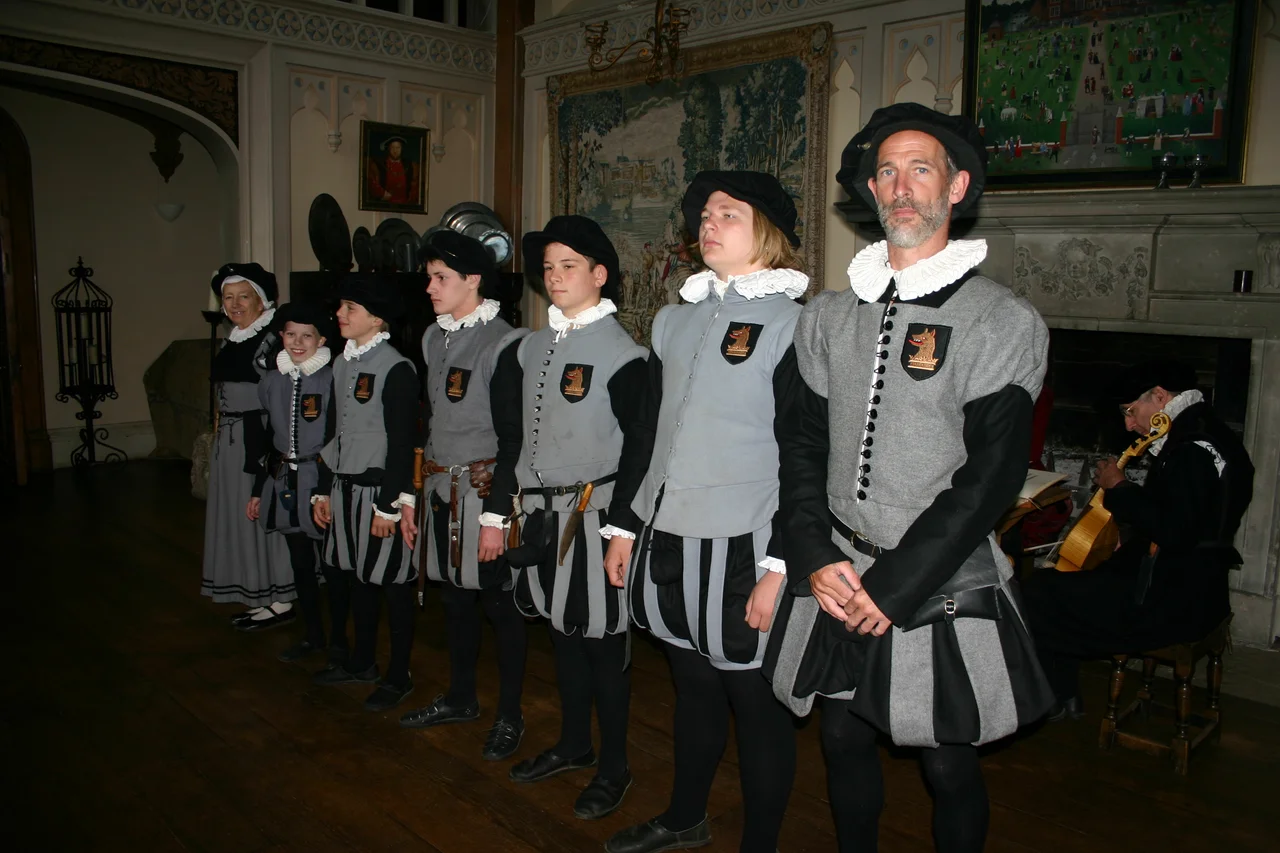
Since 1979, Kentwell has presented annual Tudor re-enactments that have made it one of the more unusual visitor destinations in England. Each year is themed around a specific year in the Tudor period — 1520, the Field of the Cloth of Gold; 1535, the Dissolution of the Monasteries; 1578, Queen Elizabeth I's visit to Suffolk; 1588, the Spanish Armada. Up to 350 costumed volunteers populate the hall and grounds, speaking in Tudor idiom and inhabiting domestic roles from cook to dairymaid to musician. More than half a million schoolchildren have visited over the decades, including groups from Japan. The re-enactors do not narrate for visitors; they simply live the year that has been chosen, and visitors find themselves in it.
Scaresville and Other Lives
October brings a different transformation. Scaresville, launched in 2007, winds through the hall's woodland, ancient buildings, and open farmland after dark with a cast of 250 actors. The designers employed stage magic techniques — mirrors, trapdoors, the Pepper's Ghost illusion — refined over years by the principal artistic designer Paul Dufficey, whose work is associated with the director Ken Russell. The event won the Best Seasonal Hallowe'en award at the Screamie Awards in 2009 and Best Multi Part Halloween Event at the 2018 SCARE Awards. In winter, Kentwell offers Dickensian Christmas events. Throughout the year it serves as a film and television location, a wedding venue, and the private home of the Phillips family — a Tudor manor that has found multiple ways to stay alive.
From the Air
Located at 52.10°N, 0.72°E in Long Melford, a village in the Babergh district of Suffolk. The moated hall and its mile-long lime tree avenue are visible from the air. Nearest airports: Cambridge Airport (EGSC), approximately 30 miles northwest. Recommended viewing altitude 2,000–3,000 feet to see the avenue and moat in context. The River Stour valley surrounds the area; Long Melford church is the primary visual landmark.
Nearby Stories
- Ely Cathedral 6.2 km away
- Aldeburgh Festival 8 km away
- Bungay Castle 8.4 km away
- Thetford Castle 9.1 km away
- White House Farm murders 12 km away
- RAF Bottisham 12 km away
- North Weald Airfield 20 km away
- Broadstairs 55 km away