
Loughborough
On 5 July 1841, Thomas Cook chartered a train from Leicester to Loughborough for a temperance group at a shilling a head. They were going to a rally to denounce drink. The trip ran on time, the price was fair, and Cook realised he had invented something. The first package tour in the world finished at Loughborough station. Almost everything Loughborough has done since has had that same quietly consequential quality - small Leicestershire town, large global footprint.
Bells Heard in Three Continents
John Taylor & Co has cast bells in Loughborough since the 1850s, and the foundry is the world's largest. From its furnace came Great Paul - cast in 1881 for St Paul's Cathedral in London, at sixteen and three-quarter tons the largest bell in the United Kingdom - and Great Peter at York Minster, the country's third largest. Taylor bells hang in Saint Thomas Church in New York, in Sydney's St Andrew's Cathedral, in Cape Town City Hall, in the Burton Memorial Tower at Ann Arbor. In 1980 the foundry got a phone call from Australia. AC/DC wanted a 2,000-pound bell for a song they were recording called Hells Bells. The bell that opens the Back in Black album was cast in Loughborough. It went on tour with the band, has been struck thousands of times since, and remains one of only a handful of contemporary rock songs scored for genuine cast bronze.
Lace, Riots, and a Move South
Industrialisation came to Loughborough through John Heathcoat, a Derbyshire-born inventor who patented an improvement to the warp loom in 1809 and made it possible to produce machine-woven net that looked like handmade lace. He set up his bobbinet works at Hathern, just outside the town, with the Nottingham manufacturer Charles Lacy. In 1816 Luddites - widely believed to be in the pay of Nottingham competitors who were watching him eat their market - broke into the factory and smashed fifty-five frames. Heathcoat packed up his machines and moved them to a disused wool mill in Tiverton, Devon, where his descendants still operate. Loughborough kept the bell foundry, the Falcon Works that made first steam locomotives and then motor cars and eventually became part of Brush Electrical Machines, and from 1897 the Herbert Morris crane works on Moor Lane that became one of the foremost crane manufacturers of the twentieth century.
Sport as a Vocation
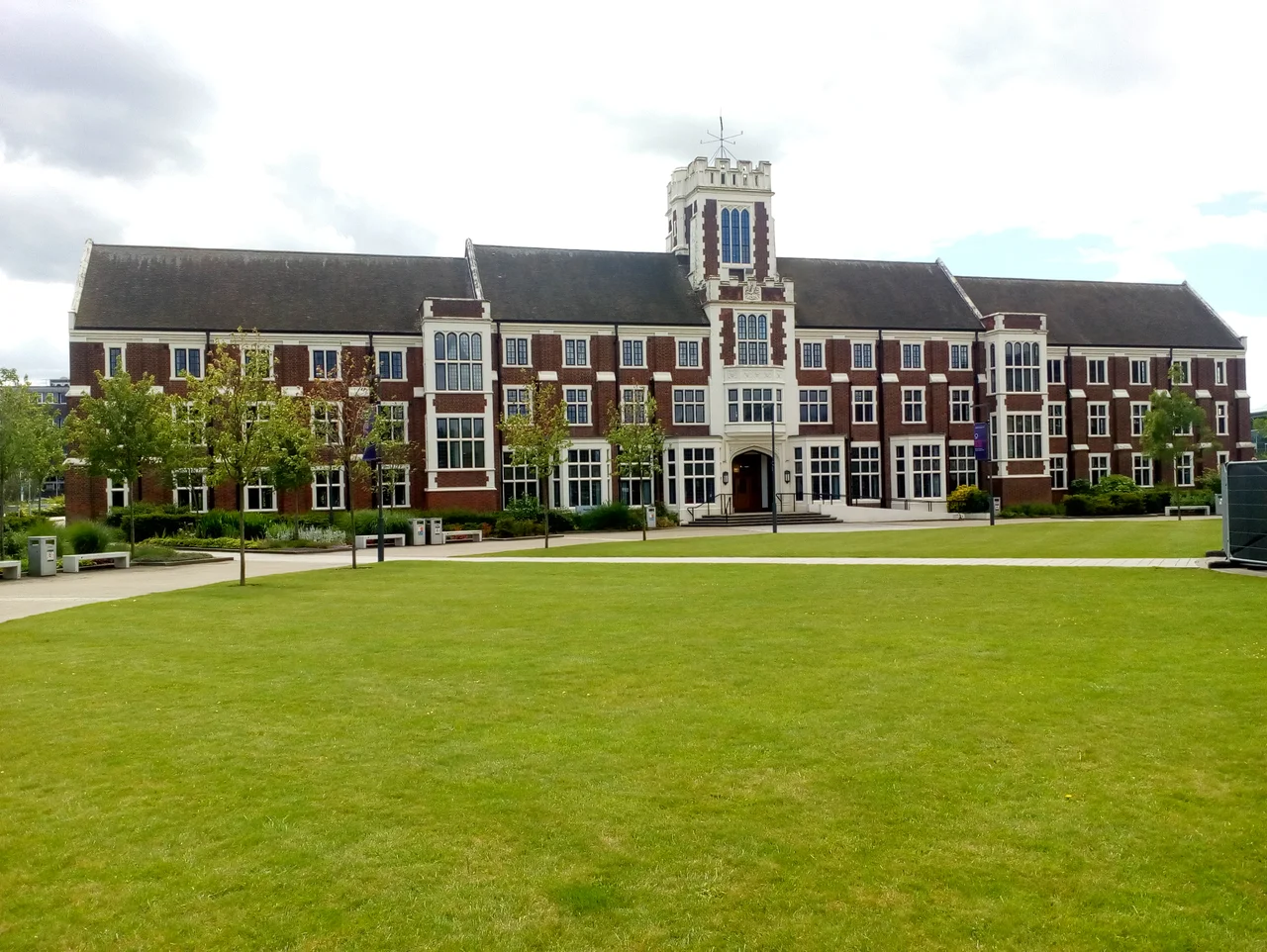
Loughborough University was named Sunday Times University of the Year in 2008 and consistently ranks at the top of British higher education for sport. The university hosts the largest concentration of elite athletes anywhere in UK universities - over 250 international athletes train and study on the campus at any given time. Olympic medallists train alongside undergraduates; the campus contains an Olympic-standard athletics track, a pool, and the National Cricket Performance Centre. The town has built a culture around it. Loughborough's secondary schools and sixth-form colleges feed talent into the university programmes; coaches, physiotherapists, sport scientists move in and out of the town the way insurance agents do in Hartford or financiers do in Frankfurt. Sport is Loughborough's industry as much as bells once were.
Old Streets, Two Stations
The market in the Market Place was first recorded in 1221, and is still held every Thursday and Saturday. Loughborough Grammar School was founded in 1495 with money left by Thomas Burton, a wool merchant, making it one of the oldest schools in the country. The town has two railway stations. Loughborough station on the Midland Main Line puts London St Pancras around 75 minutes away, with onward connections by Eurostar to Paris and Brussels. A short walk east is Loughborough Central, the southern terminus of the Great Central Railway - a preserved heritage line that has been slowly closing the Loughborough Gap, a missing stretch over the Midland Main Line, the A60, and the Grand Union Canal, to reconnect the line's southern and northern sections. A new bridge over the Midland Main Line was installed in 2017; work continues.
What Charnwood Looks Like From Above
The town sits at the foot of Charnwood Forest, a low upland of ancient volcanic rock that pushes through the Leicestershire plain west of the M1. The River Soar - made navigable to Loughborough by the Loughborough Navigation of 1778, joining the Trent system to the north - passes east of the town centre. From cruise altitude the bell foundry chimney, the university campus, and the broad pale stripe of the A6 are the main markers. Loughborough today has a built-up population of just under 65,000, second largest in Leicestershire after Leicester itself, and it does almost everything quietly: bells, athletes, cranes, package tours, lace, locomotives. The bell at the top of Back in Black is just the one the world hears.
From the Air
Loughborough is at 52.77°N, 1.21°W in north Leicestershire, on the eastern edge of Charnwood Forest. From cruise the university campus south of the town is a distinct geometric block of buildings and playing fields. East Midlands Airport (EGNX) is 7 nm west-northwest, Nottingham Airport (EGBN) is 8 nm northeast. Recommended viewing altitude 2,500-4,000 ft AGL. The bell foundry on Freehold Street is in the older industrial quarter east of the town centre.
Nearby Stories
- Sherwood Observatory 3.2 km away
- Woolsthorpe Manor 5.1 km away
- Sudbury Hall 7.1 km away
- Corby 7.5 km away
- Nechells 9.4 km away
- RAF Waddington 15 km away
- Nuneaton Rail Crash 16 km away
- Litton Mill 19 km away