
Sherwood Observatory
The dome is held together by more than 5,000 rivets, and most of them were driven by hand. The aluminium sheets that clad it, all 120 of them, were cut and shaped on site by people who held day jobs and turned up at the weekend with measuring tapes. The main ring-beam was bent into a circle using a hydraulic jack normally reserved for lifting heavy goods vehicles. Sherwood Observatory, perched on one of the highest points in Nottinghamshire, was not built by a university or a government agency. It was built by an amateur astronomical society that decided in 1972 to make their own.
A Society on a Hill
The Mansfield and Sutton Astronomical Society held its first meeting in February 1970, gathering at a local engineering company because that is where one of the founders worked. Within two years the members had bought a piece of high ground near Sutton-in-Ashfield. Foundations were poured in 1975. The University of Nottingham's architecture department helped with the dome design, but most of the materials were salvaged from local demolition sites. Steel channelling for the ring-beam came from somewhere; aluminium for the cladding came from somewhere else. The telescope main-frame was assembled from scaffold tubing on an equatorial fork mount, driven by DC motors for tracking the stars across the sky. The whole project carried the stamp of people doing serious science with whatever they could lay hands on.
Grinding the Mirror
A reflecting telescope needs a precisely curved mirror, ground to within a small fraction of a wavelength of light. The society built its own grinding machine and started polishing a piece of glass in the observatory. The work took four years. Then they sent the finished mirror away to be aluminised, the standard reflective coating, and it came back damaged. After more fundraising, the society purchased a replacement mirror and installed it. The first light, the traditional first observation made through a new telescope, targeted Messier 42, the Orion Nebula, that bright cloud of dust and gas easily found in Orion's sword. The observatory was officially opened in 1986 by the Astronomer Royal of the day, Professor Sir Francis Graham-Smith. By then the project had been running for sixteen years.
The Telescope
The main instrument is a 0.61-metre Newtonian reflector, sitting in a 6.5-metre dome. The telescope began life as a Nasmyth design but had collimation problems, so in the 1990s the society converted it to the simpler Newtonian configuration. Stepper motors drive both the focus and the dome rotation, so the dome follows the telescope as it tracks across the sky. Cameras can be attached to the telescope to capture images and video, which then appear on a two-metre projector screen in the adjacent lecture theatre. Public open evenings make it possible for visitors to see, on a screen, what the telescope is looking at in real time, with society members standing by to explain what the patches of light on the screen actually are.
The Planetarium and the Reservoir
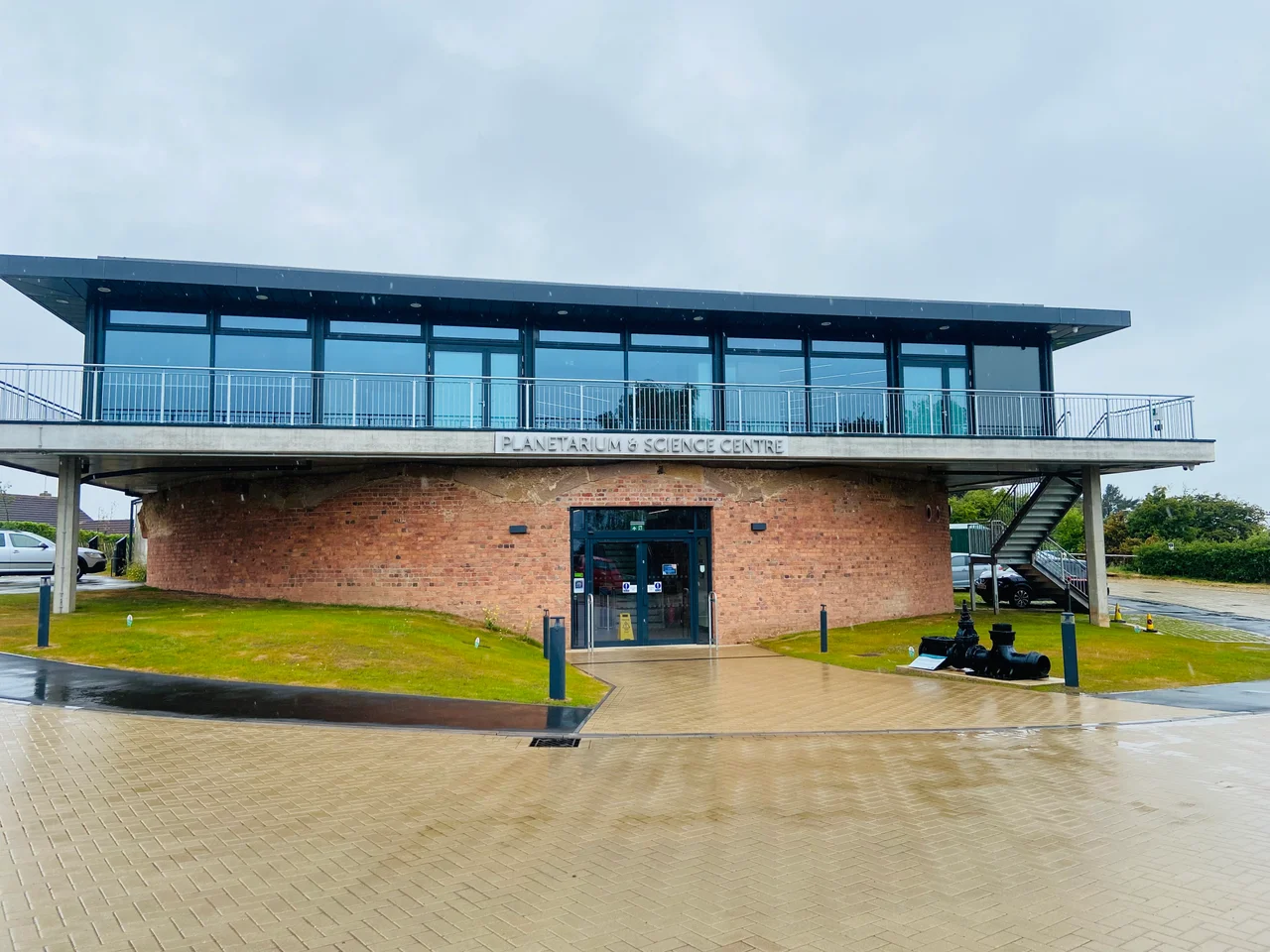
Underneath the observatory, until 2023, was a Victorian water reservoir, a buried brick chamber that had been quietly sitting there for over a century. The society and Ashfield District Council recognised an opportunity. The tank was excavated, its multiple brick arches exposed and retained, and the space converted into a planetarium and science discovery centre, with virtual reality elements built into the visitor experience. The facility cost £5.3 million, funded by grants, National Lottery money, the government's Towns Fund routed through the council, and private donations. The result is a small but unusual venue: a dome on the ground level for live astronomy, a planetarium below for guided star tours, and the original Victorian brickwork forming the ceiling above the seats. Few amateur societies anywhere have ended up with a setup quite like this.
From the Air
Sherwood Observatory is at 53.114 N, 1.222 W, on high ground near Sutton-in-Ashfield in Nottinghamshire, around 200 m above sea level - one of the higher points in the county. Best viewed from 2,000-3,500 ft AGL; the white dome is a small but recognisable feature against the surrounding fields. Nearest airports: Nottingham East Midlands (EGNX) 19 nm south-southwest; Doncaster Sheffield (EGCN) 22 nm north. Best visited on dark, clear nights; surrounding light pollution from Mansfield and Sutton is moderate but tolerable for the kinds of objects the telescope targets.
Nearby Stories
- HMS Sherwood (shore establishment) 1.7 km away
- Sudbury Hall 2.7 km away
- Grantham Rail Accident 3.8 km away
- Conisbrough Castle 5.2 km away
- Doddington Hall, Lincolnshire 6 km away
- Litton Mill 8.9 km away
- Flixborough Disaster 20 km away
- Astley Deep Pit Disaster 22 km away