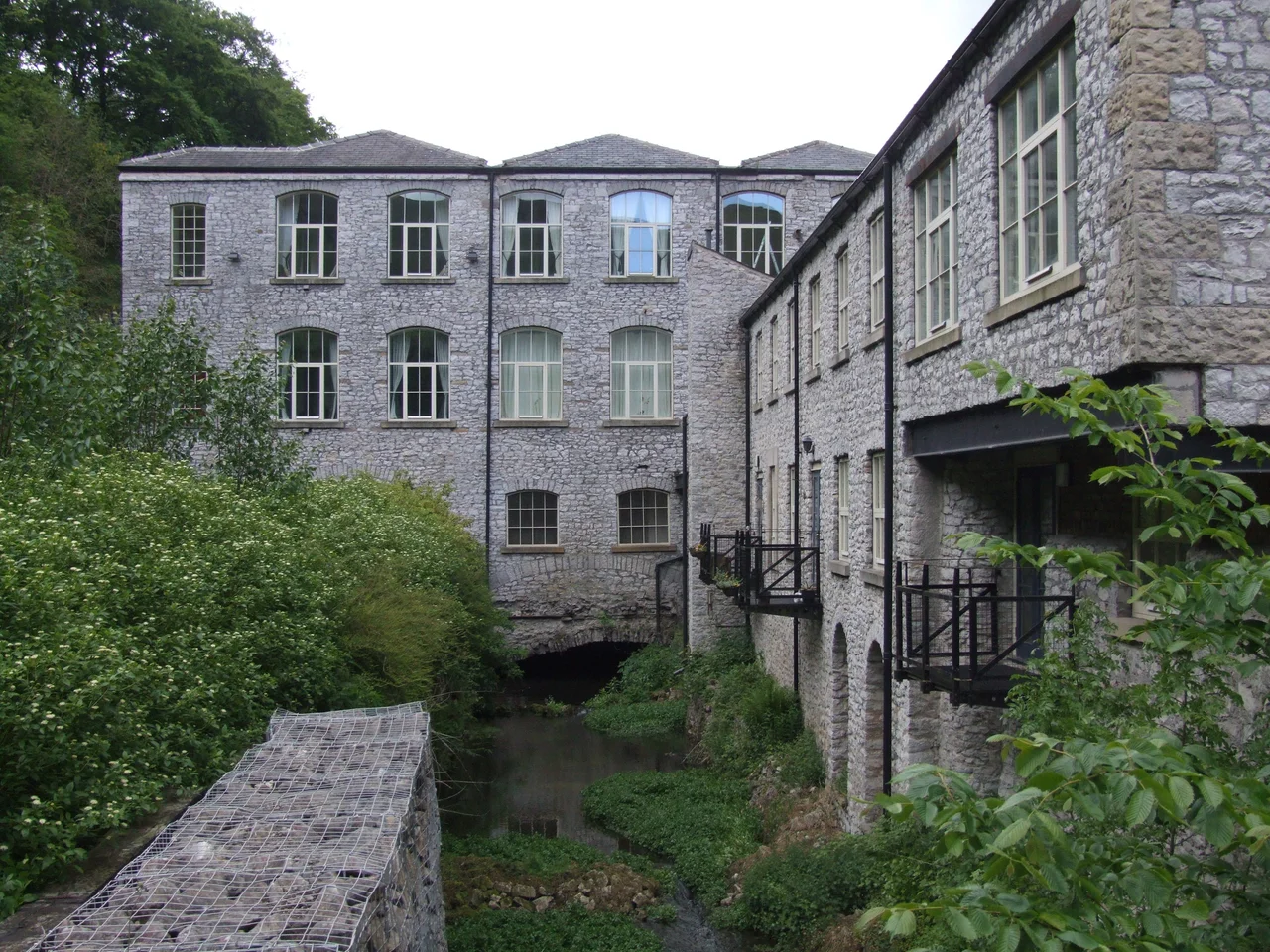

Litton Mill
A boy named Robert Blincoe arrived at Litton Mill in 1803 from a London workhouse, indentured to spin cotton until he turned twenty-one. He was about seven years old. The narrative he later dictated to a journalist would describe beatings with iron bars, starvation rations, and children dropped down hoists for sport. That account, more than the mill itself, is what survives. Tucked into the steep slot of Miller's Dale, where the River Wye cuts a green corridor through the limestone, this small stone building helped expose the human cost of the new factory system and forced parliament to look hard at what was being done to England's poorest children.
A Mill in the Wrong Place
Ellis Needham and Thomas Frith were farmers, not industrialists. In 1782 they pooled what they had and built a cotton mill on the Wye, licensing Richard Arkwright's water frame and hoping the Industrial Revolution would lift them. The valley itself worked against them from the start. Roads in and out of Tideswell were poor, hauling raw cotton and finished yarn was expensive, and the scattered farming families who lived on the surrounding hills wanted nothing to do with the mill. Arkwright at Cromford could attract whole weaver families. Evans at Darley Abbey could draw workers from Derby. Needham and Frith had a building, a river, and almost no one willing to work in it. By 1786, just four years in, the partners put the mill up for sale and found no buyers.
Children from the Parish
The Poor Relief Act of 1601 contained a quiet provision that would shape industrial Britain: parishes could indenture pauper children to employers, who in return agreed to feed, clothe and train them. The system was designed to give a poor child a trade. By the 1780s it had become something else. Workhouses in London, Nottingham, and other distant towns shipped their children in cartloads to remote northern mills, glad to be rid of the cost. The mill owners gained a workforce who could not quit, could not go home, and were too young to organise. Needham and Frith, unable to hire free labour, took this path. The apprentices who arrived at Litton were as young as five or six. They worked twelve to fourteen hours a day, slept in a building above the mill, and were entirely at the mercy of their employer and his overlookers.
The Blincoe Memoir
Robert Blincoe survived. After leaving the mill as a young adult, he settled in Manchester, married, and worked as a cotton waste dealer. In 1822 he told his story to the radical journalist John Brown, who shaped it into A Memoir of Robert Blincoe. Published in 1828, the book described what had happened to him and the children around him at Litton: hunger so constant that boys ate the pigs' food, beatings with sticks and metal weights, ears pierced with nails as punishment, children's fingers crushed in unguarded machinery. Several apprentices died. The memoir was widely read, cited by parliamentary reformers, and influenced both the Factory Act of 1833 and Frances Trollope's industrial novel about a fictional apprentice clearly modelled on Blincoe. Whether every incident happened exactly as told has been debated since, but the pattern of cruelty is supported by other accounts of the parish apprentice system from this period. The children were real. What was done to them was real.
Decline, Fire, and What the Valley Forgot
The mill never thrived. The waterwheel broke in 1811 and sat idle for a month. By 1815 Needham was bankrupt; by 1828 he was a pauper himself, the same legal status as the children he had once worked. Frith retreated to his farm. The Newtons of Cressbrook Mill took the building on, then a fire destroyed it in 1874. Very little of the original structure remains. The replacement now spins nylon yarn for stockings. In 1893 the Stockport mill owner Matthew Dickie bought what was left, brought in families from his old town, and built the house called Ravenstor up the hill. That house was given to the National Trust in 1937 along with a stretch of the Wye and Tideswell Dale; today the building is leased to the Youth Hostel Association, and walkers tramp past the mill site without often pausing to think about who once worked there.
What the Dale Holds
Miller's Dale is beautiful in the way only English limestone country can be, the kind of place ramblers come for the air and the River Wye's clear runs. The Monsal Trail passes nearby on the old Midland Railway line, and cyclists glide through tunnels cut for steam traffic. The contrast between the dale's current calm and the small piece of industrial history that happened inside it is not subtle. Litton Mill is not a grand ruin or a heritage attraction; it is a working factory in a quiet valley. But it is one of the places where Britain decided, slowly and after great damage, that children should not be worked to death for profit. The dale is worth the visit for its own sake. The mill is worth a thought.
From the Air
Litton Mill sits in Miller's Dale at 53.254°N, 1.762°W, deep in the limestone country of the Derbyshire Peak District. The site is tucked into a steep, narrow valley along the River Wye, which makes it hard to spot from directly above; look for the cleft running roughly east-west between Tideswell to the north and Bakewell to the south. Recommended viewing altitude is 2,500 to 3,500 feet AGL to clear the surrounding ridges (Wardlow Hay Cop tops out near 1,200 feet AMSL nearby). East Midlands Airport (EGNX) lies about 35 nautical miles south-southeast, Manchester (EGCC) about 27 nautical miles west-northwest, and Sheffield City Heliport (EGSY) about 18 nautical miles east-northeast. Peak District weather is changeable: low cloud and orographic drizzle are common, and the dale tends to fill with mist on still mornings.
Nearby Stories
- Brianna Ghey 4.9 km away
- RAF Tern Hill 6.5 km away
- Vale Royal Abbey 7.8 km away
- Lundhill Colliery Explosion 8.7 km away
- Donington Park 9.1 km away
- Markham Colliery disaster 9.3 km away
- Hixon rail crash 10 km away
- Astley Deep Pit Disaster 11 km away