
Markham Colliery disaster
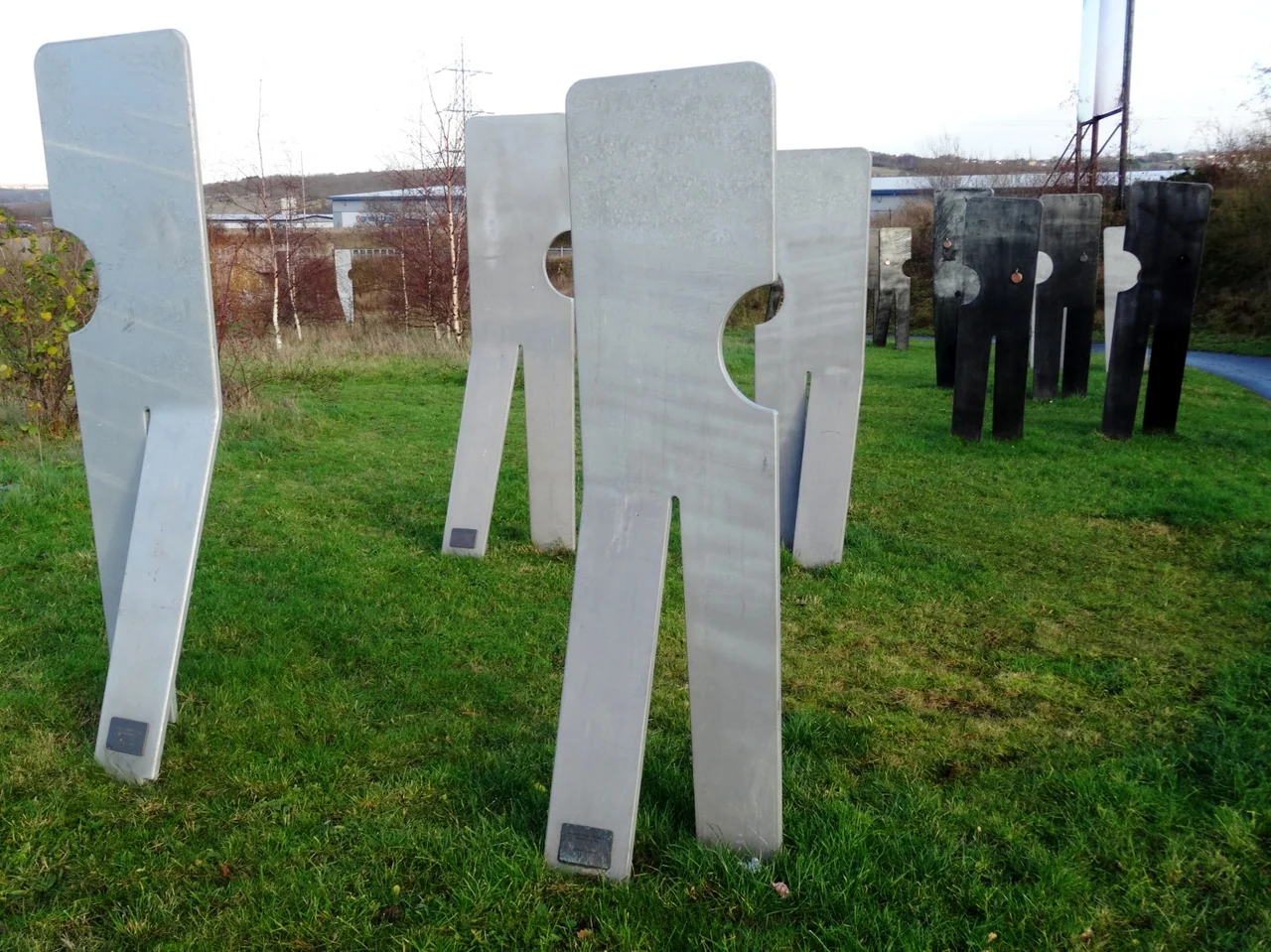
There are 106 steel figures walking together at the edge of Staveley. Each one carries a name stamped on a bronze tag at the chest, and each name belonged to a man who went to work at the Markham Colliery and did not come home. The figures arrived in stages between 2013 and 2022, paid for by collections and grants and patient years of fundraising. They commemorate three separate disasters at one pit: a 1937 explosion, another in 1938, and a cage that fell to the bottom of the shaft on a Monday morning in 1973.
The Pit at Staveley
The Markham Colliery worked the deep coal seams of north Derbyshire, just outside Chesterfield, in a landscape stitched together by railways, ironworks and the dark heaps that mining leaves behind. By the interwar years it was one of the busy pits feeding the foundries and power stations of the East Midlands. Shifts moved underground every few hours; cages dropped men down the shaft and brought them back up, day in and day out, the rhythm of work measured in the rise and fall of a wire rope. Mining in Derbyshire was always dangerous work. The men who took it on were fathers and sons and brothers, neighbours in pit villages where everyone knew which household had lost whom.
1937 and 1938: Explosions Underground
The first of the great Markham disasters came in 1937, when an explosion underground killed nine men. The community had barely steadied itself when, less than a year later, another explosion tore through the workings. The 1938 blast killed seventy-nine miners and seriously injured forty more. Two disasters in two years at the same pit produced grief on a scale that whole streets carried for decades. Wives, widowed in their twenties and thirties, raised children who had only photographs of their fathers. The Coal Mines Act of 1911 already required inquests and inquiries into accidents of this kind, but no inquiry could undo what had happened. The names from 1937 and 1938 became part of local memory long before they were ever cast in bronze.
30 July 1973: The Cage
On the morning of 30 July 1973, twenty-nine men stepped into the descending cage at Markham. The cage was a double-deck steel box, lowered on a winding rope under controlled deceleration. As it approached the bottom of the shaft, the winding engine man saw sparks beneath the brake cylinder. He increased the regenerative braking. He pulled the brake lever. He pressed the emergency stop. None of it had any effect. The brake rod, a two-inch steel bar eight feet long under constant tension, had broken in two from metal fatigue. With nothing to slow them, the men plunged onto the wooden landing baulks at the bottom of the shaft. Eighteen were killed by the impact. Eleven more were seriously injured. The investigation that followed found that the rod had been quietly cracking for a long time, weakened by alternating bending stresses it had never been designed to bear. A National Committee for Safety of Manriding in Shafts was formed within months, and the National Coal Board began an industry-wide overhaul of every winder's braking system. The cost of the lesson had already been paid.
Walking Together
The Markham pit closed in 1994, swept away with most of the deep mines of central England. The headstocks came down; the spoil heaps softened into grass. What might have been left was silence. Instead, in 2013, the sculptor Stephen Broadbent installed the first of his steel figures on the site of the old colliery: a slow processional column of life-sized walkers in profile, each one with a circular bronze tag at the chest carrying a name, age, occupation, and the year of the disaster. The first eighty-eight figures went in over the following years. The remaining figures arrived in October 2022, completing the line. One hundred and six men: the nine of 1937, the seventy-nine of 1938, the eighteen of 1973. The trail is open to anyone who comes to walk it, and it is impossible to walk it quickly. Each figure asks you to read a name and consider that someone, once, knew that man well enough to grieve him.
From the Air
Markham Colliery sits at 53.244 N, 1.330 W, just east of Chesterfield in north Derbyshire. The site is at about 100 m elevation in gently rolling former coalfield country between Staveley and the M1. Best viewed from 2,000 to 4,000 ft AGL; the Walking Together sculpture trail and surrounding parkland are visible on the old pit footprint. Nearest airports: Sheffield City Heliport, Doncaster Sheffield (EGCN, currently closed to commercial traffic), Nottingham East Midlands (EGNX) to the south. The crooked spire of Chesterfield is visible 5 nm to the west.
Nearby Stories
- HMS Sherwood (shore establishment) 1.7 km away
- Sudbury Hall 2.7 km away
- Grantham Rail Accident 3.8 km away
- Conisbrough Castle 5.2 km away
- Doddington Hall, Lincolnshire 6 km away
- Litton Mill 8.9 km away
- Flixborough Disaster 20 km away
- Astley Deep Pit Disaster 22 km away