
Lundhill Colliery Explosion
At twenty past twelve on 19 February 1857, the men and boys at Lundhill Colliery were finishing their dinners. Most had eaten underground - 200 of the day shift staying down, only 22 having walked home to eat with families. The miners ranged in age from ten years old to fifty-nine. Their lighting was wax candles. Their safety boots were mostly too big. Then a violent explosion tore through the workings, sent a sheet of flame up the pit shaft that illuminated the countryside for miles, and blew one of the cages out of the top of shaft two. By the end of the day, 189 of them were dead.
The Village That the Pit Built
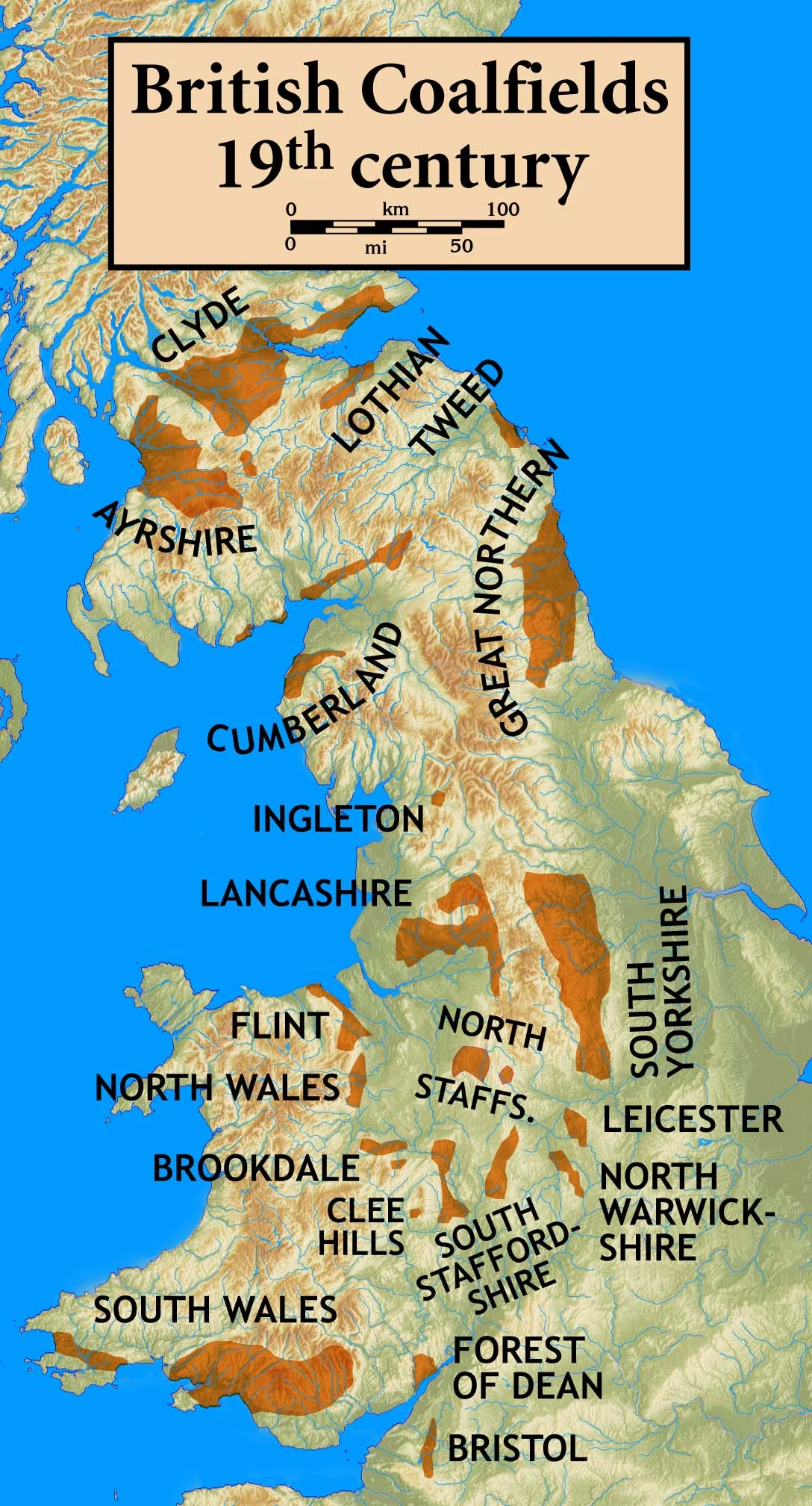
Wombwell had been farmland before Lundhill Colliery arrived - a small population on the South Yorkshire coalfield, growing slowly. The pit changed everything. By the 1850s Lundhill was one of the largest and deepest collieries in Yorkshire, and Wombwell had become a colliery village whose economy and rhythms turned on the daily shifts. The company employed roughly 290 men and boys; about two-thirds of them worked days. Most lived within walking distance, some in cottages within the shadow of the headgear. Six-day weeks. Five hundred to six hundred tons of coal lifted to the surface each day. The pit was known to be dangerous - everyone knew - but it was the work that was there, and so the work that was done. The youngest miners were ten. Most were eighteen or older. They descended in cages on three shafts, the deepest of them going 198 metres into the ground.
Firedamp
Firedamp is the miners' word for methane - the colourless, odourless, explosive gas that seeps from coal seams. In the candle-lit pits of the mid-nineteenth century it was the constant enemy. A pocket of it would gather in a heading, a flame would find it, and the gas would ignite with a force that propagated through the workings, picking up coal dust along the way and turning a localised flash into a roaring shock wave that travelled the length of the mine. At Lundhill at 12.20pm that February day, that is what happened. Whatever the immediate ignition source - and the investigations did not produce one definitive answer - firedamp went off in the workings. The blast was so powerful that smoke, dust and fire arose visibly from shaft three. People miles away saw it. They came running.
The Rescue
The mine was now on fire, and a second explosion was a serious possibility. A group of volunteers - because that is who staffed mine rescues in 1857, neighbours and off-shift miners - descended shaft two anyway. They found 19 survivors, scorched and badly injured. Two of those survivors later died of their burns. The search continued until 7.30 that evening when the fire keeping the rescuers out made further progress impossible. The fire brigade arrived but could not put out a thirty-metre column of flame roaring from shaft three. Between ten and fifteen thousand people gathered to watch and to mourn - to wait for news that, for most families, would not be good news. The Illustrated London News put the disaster on its front page, the first time it had ever done so. For Wombwell, the loss was not abstract. The dead were sons, husbands, fathers, brothers, neighbours. The youngest were children.
What Remains
The Lundhill pit no longer exists. The ground above it is now Hillies Golf Course, a nine-hole layout in the rolling former coalfield landscape. On 17 February 2007 - the 150th anniversary of the disaster - a memorial was unveiled in front of the clubhouse. The sculpture incorporates mining symbols and at its centre is a large piece of coal held in twisted metal. The memorial is for the 189 who died and for the families left behind. The work was hard, the wages thin, the dangers known. In nineteenth-century British coal mining, disasters on this scale were not unique - they were part of an industry that powered the empire on the bodies of men and boys. Lundhill was one of the worst, and on its anniversary, in the quiet of a golf-course clubhouse on a hillside above Wombwell, the names are still read.
From the Air
Located at 53.52N, 1.40W in the former South Yorkshire coalfield, near Wombwell about 3 nm south-east of Barnsley town centre. Doncaster Sheffield Airport (formerly EGCN) lies about 10 nm east; Leeds Bradford (EGNM) is about 18 nm north-west; Sheffield City (EGSY, closed) is about 8 nm south. The site is now Hillies Golf Course - a nine-hole layout in rolling former coalfield landscape - not a dramatic landmark from the air. Best to overfly with respect rather than as a tourist target.
Nearby Stories
- Litton Mill 0.9 km away
- Bradford Murders 1.2 km away
- Battle of Sherburn in Elmet 2.2 km away
- Bolsover Castle 5.6 km away
- Doddington Hall, Lincolnshire 5.8 km away
- Flixborough Disaster 11 km away
- Huddersfield Town Hall 13 km away
- Beverley Bar 19 km away