_3._Beverley.%22_A_street_scene._-_NARA_-_297294.jpg)
Beverley Bar
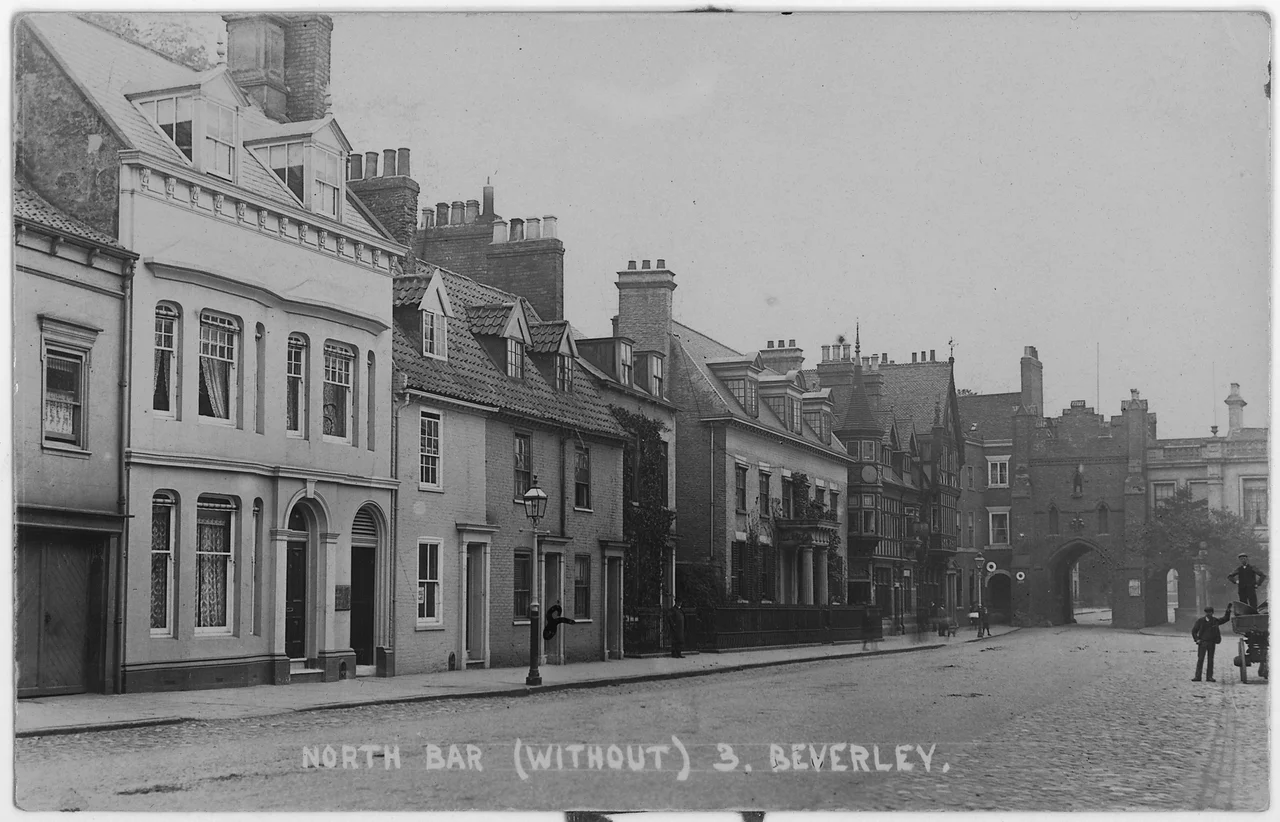
Buses still pass through it. Modern double-deckers operated by East Yorkshire run the road into Beverley one vehicle at a time, in single file, because the arch above the road was built in 1409 and the brick is not negotiable. A set of lights controls the flow. The North Bar, or Beverley Bar, has been the principal entrance to the town since before Henry V passed beneath it in 1420. The town it guards never built proper walls, so the four toll-bars that once collected pavage on every cart and horse and bag of wool entering Beverley were standalone gates in a perimeter that was otherwise hedgerow, ditch and good intentions. North Bar is the last one left.
Built in brick, built for tax
The Bar was put up in 1409 at a cost of 98 pounds, which sounds modest until you translate it into roughly 128,000 pounds in modern money. It is one of the earliest substantial brick structures in northern England, made of locally fired clay rather than imported stone, and the brick has survived six centuries with only a 17th-century renovation. Its primary purpose was administrative rather than military. The town had Bars on the four main roads and constables to collect tolls at each one, and the receipts were used to maintain the roads, a system called pavage. The accounts for 1420, the year Henry V visited Beverley, list the takings: 17 pounds 4 shillings 8 pence at the North Bar, 13 shillings 4 pence at Newbegin, 18 shillings at Keldgate, and so on down the list. North Bar took more than ten times what any other gate brought in. It was the principal road into town.
What the upstairs was for
The Bar is two storeys, with the road running through the arched ground floor and rooms above. In the 15th and 16th centuries the town governors used the upper level as a viewing gallery during the Corpus Christi play cycle, the religious dramas that townspeople performed in the streets each summer. From the windows above the arch you could watch a wagon roll past with the Crucifixion or the Last Judgement playing out on its boards. In 1643, a year into the English Civil War, the mayor of Beverley, the Right Honourable Manbie, ordered that North Bar and the other gates be locked by constables between nine at night and six in the morning. Civil war made even market towns nervous. The Bar's portcullis groove is still visible inside the archway, though the portcullis itself is long gone.
Layout and survival
The North face has two buttresses flanking the arch and a carved stone cartouche of a coat of arms above the centre point. Two recessed windows on either side of the cartouche have been bricked up, with a third recessed window above. A course of brickwork marks the level just below a crenellated parapet. The South face, facing into town, shows three shields hanging from a moulded line of brickwork between two more bricked-up windows. Inside the archway the rib vaulting is built in two bays. By the 19th century the other three Bars had been demolished to ease traffic; the same happened to many medieval town gates across England. North Bar survived because it was load-bearing for the houses now built against it on either side, and because Beverley as a market town never grew big enough to need the road widened. It is Grade I listed, the highest category of British architectural protection.
Fairs and the road through
From the 17th to the 19th centuries, the street within and without the Bar was where the town's livestock fairs happened. In 1673 the biannual horse fair was held on the inside street, the sheep fair outside. In 1686 the cattle fair was moved to the inside street and the sheep and horse fairs to the outside. In 1865 the cattle fair was moved elsewhere. By 1959 all the great fairs had gone. The road continued to do what it always had, carry traffic between Beverley and Hull. The Bar has the slightly absurd modern distinction of being a medieval gate that buses with arched roofs still drive through, and the photographers who line up the picture of a red double-decker squeezing under fifteenth-century brick are doing what tourists have probably done in some form for two hundred years.
From the Air
The North Bar stands at 53.845 degrees north, 0.436 degrees west on the A164, between North Bar Without and North Bar Within. From the air the easiest way to find it is to follow the spires of Beverley Minster and St Mary's Church, both Grade I listed; the Bar sits a few hundred metres north of St Mary's at the top of the main north-south street. Humberside (EGNJ) is 18 nautical miles south across the Humber; Leeds Bradford (EGNM) is 47 nautical miles west. Recommended altitude 2,500 to 4,500 feet AGL gives a clear view of Beverley's compact medieval centre, the racecourse on the Westwood common to the west, and the surrounding chalk wolds.
Nearby Stories
- Battle of Fulford 6.3 km away
- Humber Lifeboat Station 8.5 km away
- Newburgh Priory 8.7 km away
- Scampston Hall 10 km away
- Doncaster Minster 11 km away
- Westermost Rough Wind Farm 13 km away
- Battle of Hatfield Chase 27 km away
- Arctic Viking (H452) 29 km away